

This guide covers 13 of the main churches in Florence. They range from the Duomo, the Baptistery and Santa Croce to San Lorenzo, Santa Maria Novella, San Miniato al Monte and the city’s Russian Orthodox church.
Many call Florence the birthplace of the Renaissance. This period gave the world priceless masterpieces of architecture and painting, as well as many poets, writers, and musicians. The atmosphere of past centuries in the city mingles with the life of modern buildings, streets, and squares. In addition, many sights, churches, and temples of Florence have a magical power that is hard to explain. It draws the eye and makes you stop and enter.
Church of the Nativity of Christ and St. Nicholas the Wonderworker

Not far from the city’s main bus station rises a five-domed church. Its look is familiar from Russian churches. The church in Italy follows the principles of 17th-century Moscow-Yaroslavl architecture for a reason. Its history began when the Russian Orthodox Church bought a plot of land near the Mugnone River. Then construction began in July 1899, based on a design by Preobrazhensky. The church has a two-story structure, a high porch, a central part decorated with kokoshniks, and traditional five domes.
The lower part of the church honors St. Nicholas the Wonderworker (consecrated in 1902). Here, there is a wooden iconostasis and many interesting icons created by specialists from Peshekhonov’s workshop. Many elements of the lower floor’s decoration came from the collection of Prince P. Demidov.
Meanwhile, the upper part honors the Nativity of Christ (consecrated in 1903). It has an interesting iconostasis made of famous white marble. The wall paintings follow the style of Russian modernism. The church also holds rare relics. For example, there is a bell from the cruiser “Almaz” that took part in the Battle of Tsushima. There is also the cross of Metropolitan, Patriarch of Moscow, and all Rus’ Philaret (Romanov).
Church of Santa Maria Novella

The architectural form of the building, decorated with a geometric pattern of polished marble tiles, resembles a lace box. One will definitely want to open it and look inside at first glance at the old building. The powerful and wealthy Dominican order shaped its initial role while it was building another monastery and church for itself. The order built it on the site of the old oratory of Santa Maria delle Vigne. Finally, construction finished in 1420. The Rucellai family commissioned the interesting facade of the church. Their symbol in the form of a ship with billowing sails decorates the portal of the building.
An original element of the church is the pilasters (in the form of columns, with pointed windows on them). Builders changed the church’s interior several times and added new elements. As a result, it now features works of art from the 14th-16th centuries. Among them, you can see the monument to Blessed Villana, the tombs of Bishop of Fiesole, Filippo Strozzi, and the bust of Saint Antoninus. The altar with an interesting bronze crucifix stands in the Cappella Maggiore. In the Strozzi Chapel, you can see famous frescoes depicting the Last Judgment and other oldest frescoes of Florence.
Address: Piazza Santa Maria Novella. The church is open to visitors from 9 AM to 7 PM. The entrance fee is 5 €.
Cathedral of Santa Maria del Fiore
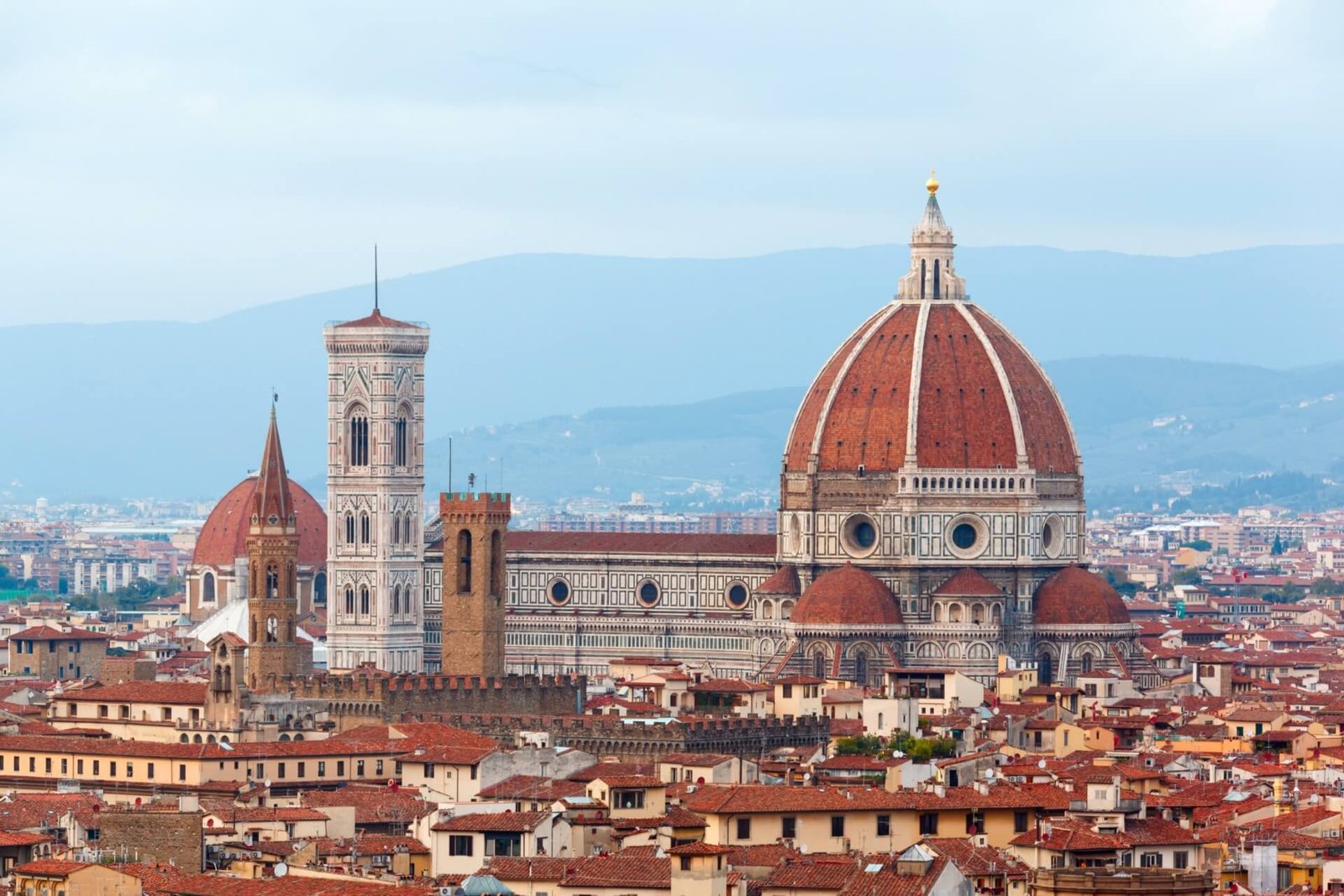
During its heyday and population growth, Florence (the capital of Tuscany) needed a cathedral demonstrating its grandeur. Such a cathedral, consecrated in 1436, became the Duomo. It stands on the site of the ancient cathedral of Santa Reparata, which had existed for nine centuries.
At that time, it could accommodate all the city’s residents. Today, the church’s dome rises above the bright tiled roofs of the city. It points the way to one of Florence’s main sights. If you climb the 414 steps of Giotto’s bell tower, you can enjoy the beauty of the surroundings from the top. You can also walk around the majestic dome via another staircase.
For the dome, architect Brunelleschi used ingenious engineering solutions, so the church has stood for many centuries. It took nearly 14 years to build the massive dome. Its height, along with a small temple on top serving as a lantern, is about 114 meters.
This amazing architectural element has reliably held the dome’s structure for centuries. As a result, the view, size, and beauty of the Cathedral of Santa Maria del Fiore still captivate the world. In fact, the cathedral’s dimensions (length 153 m, width 90 m) have placed it fourth in the world.
Church of All Saints

Ognissanti or the Church of All Saints participated in many historical events on its way to becoming Florence’s first basilica, involving numerous rulers. The names of famous architects and painters remain in the interesting elements of the church’s exterior and interior. For example, the creations of famous painters Botticelli and Ghirlandaio (Michelangelo’s teacher) still stun with the beauty of their extraordinary frescoes. This includes “The Last Supper,” “Madonna of Mercy,” “Saint Jerome,” and Botticelli’s “Saint Augustine,” considered a classic work of the Renaissance. Incidentally, his life has close ties to this church, which holds the famous master’s grave.
It lies at the feet of his beloved, Simonetta Vespucci, who also rests here. She was the wife of a relative of Amerigo Vespucci, who gave his name to America. The enamored Renaissance artist forever captured her beautiful face in his works (Venus, Spring on famous canvases). The church’s history also involves the Vespucci family. Initially, it belonged to the family. The construction of the new basilica began in 1251 as a part of the Humiliati monastery complex. Thanks to strong financial support from Florence’s wealthy people, the church (in Baroque style) quickly gathered masterpieces of art. Famous masters created them over different centuries.
Address: Borgo Ognissanti, 42, 50123 Firenze. The church is open for free from Monday to Sunday, from 7:30 AM to 7:45 PM with a break.
Basilica of Santa Croce
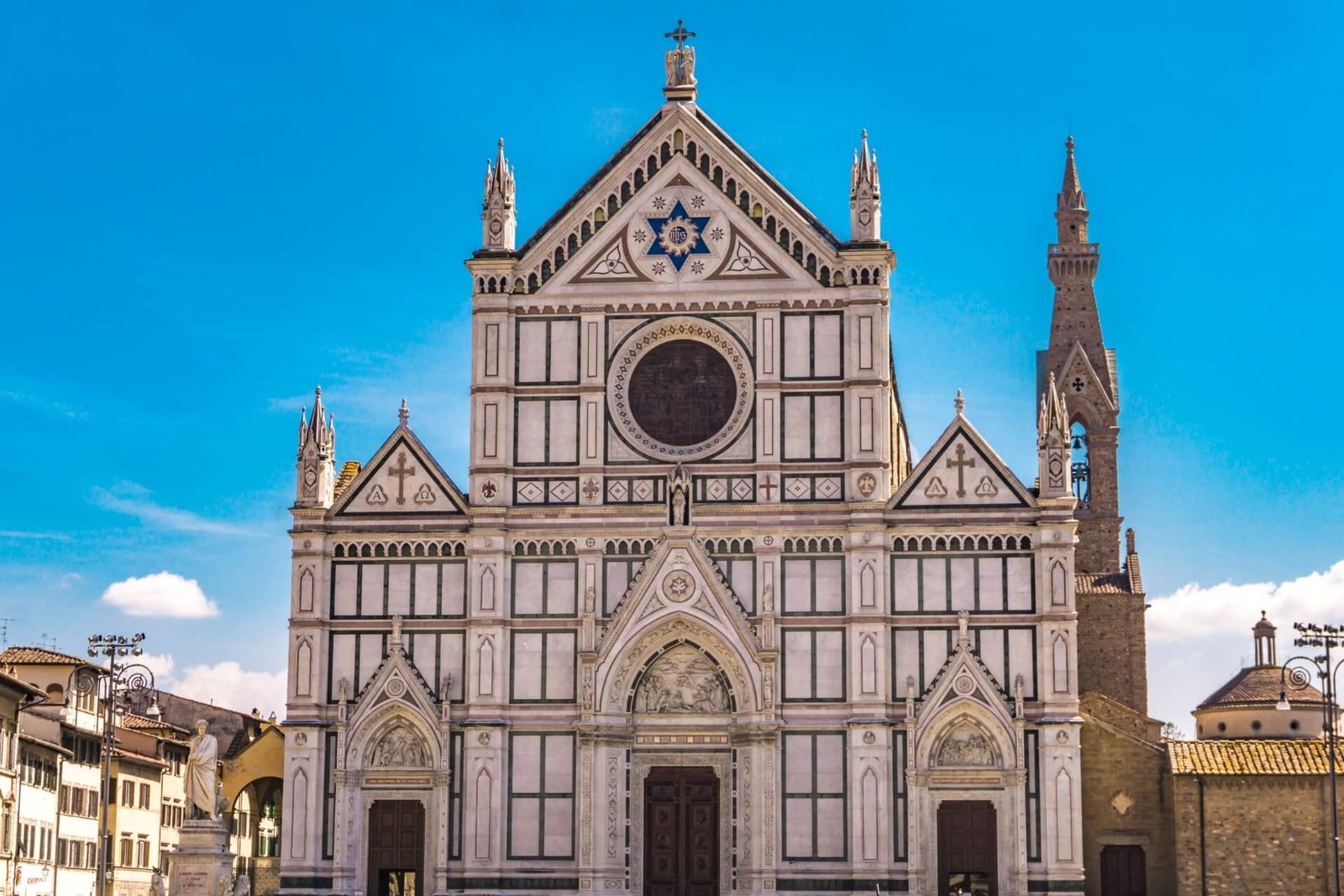
The restored Gothic facade of the church, consecrated by Pope Eugene IV in 1442, attracts attention with its architectural elements. Among them are the sunlit central nave and numerous stained glass windows (some over 700 years old). These windows light the church’s interior in various shades. In addition, an unusual decorative Star of David reminds us of the facade’s designer, the Jewish Niccolò Matas.
The Basilica or “Church of the Holy Cross” has the shape of a T-shaped cross. The church’s main nave is 115 meters long. In fact, it is the largest Franciscan church. The church also has 16 chapels, decorated with frescoes by famous masters of the country from different times.
The church’s facade is a true, expensive work of art made of multicolored marble elements. However, the church’s main feature is the many tombs of great Italian people. Their names stay forever on the tombs that hold their remains. Together, the tombs form the Pantheon of Florence. Galileo, Michelangelo Buonarroti, Niccolò Machiavelli, Gioachino Rossini and many other great figures rest on marble beds with their figures on the sarcophagi. Dante Alighieri and Enrico Fermi have a cenotaph and a memorial here, but their graves are elsewhere.
Each tomb has an arch supported by columns. Together with unique frescoes, sculptures, and paintings, the tombs form the church’s unrivaled wealth, creating an atmosphere of eternal peace. Address: Piazza Santa Croce, 16. The church is open daily from 9:30 AM to 5:30 PM. However, on holidays and Sundays, it operates from 2 PM to 5 PM. The entrance fee is 8 € for adults and 6 € for children over 11 years old. There is also a family ticket costing 8 €.
Basilica of San Lorenzo
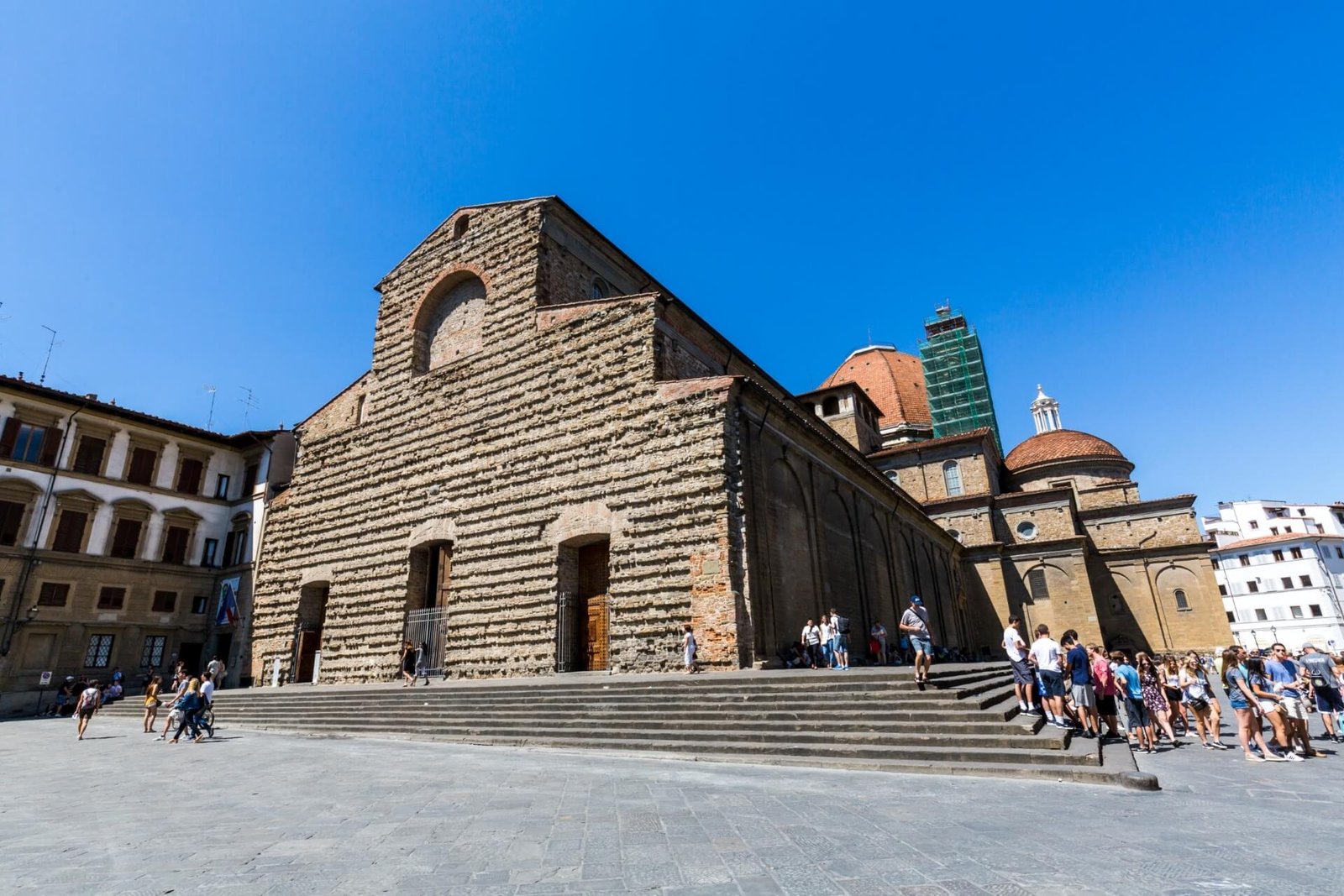
A small church built in honor of Saints Lawrence and Zenobius stood on this site as early as the 4th century. The church served as Florence’s cathedral until the 7th century, after which the title passed to Santa Reparata, the predecessor of the Cathedral of Santa Maria del Fiore. Later, in the 15th century, the wealthy Medici family began rebuilding the church as a family mausoleum. The works of great masters in architecture, sculpture, and painting embodied their ideas in the new church’s exterior and interior.
Among them are the Old Sacristy by Filippo Brunelleschi and the New Sacristy by Michelangelo Buonarroti. However, historians say that Michelangelo could not finish the basilica’s facade according to his plans. In fact, the church’s interior far exceeds the exterior in beauty and wealth. For example, the floor’s intricate mosaic pattern and the starry sky on the ceiling give the church a magical atmosphere. The family’s tombs and sarcophagi, with their interesting sculptures, also complement it well. You can also see the Chapel of the Princes and the ancient Laurentian Library in the church.
Address: Piazza di San Lorenzo, 9. The church is open to visitors from Monday to Saturday (10:00 AM to 5:00 PM). The entrance fee is 4.5 € for the church, 3 € for the library, and 8 € for the Medici Chapel. A combined ticket costs 8 €.
Church of Santa Trinita
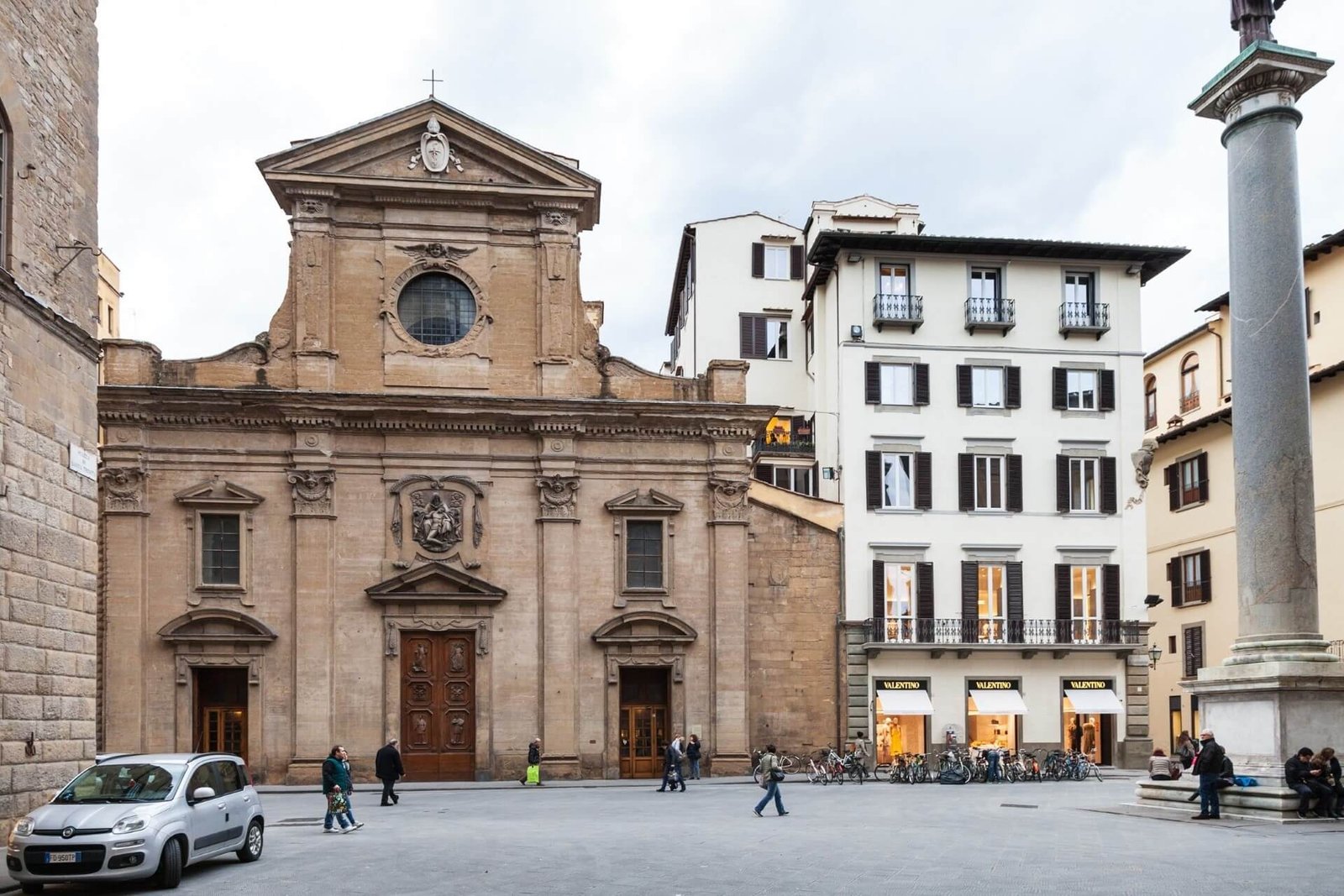
A small structure with a simple facade hides a free museum of medieval masterpieces created by painters Ghirlandaio and Mariotto di Nardo. His famous “Trinity” adorns the main altar of the church. Also, renowned artists painted all the chapels (oratories). In the central part of the church, there is a painting of Christ’s birth, “Adoration of the Shepherds.” Ghirlandaio’s unique creations have always drawn great interest, so their value grew. The monks of the Vallombrosian Order (practicing asceticism), who owned the ancient church, understood this well.
The church dates from 1280. Since then, it has gone through many repairs and rebuilds. In the 16th century, a bas-relief of the Holy Trinity appeared on the building’s facade. Much later, the church got a door depicting saint monks and a cozy courtyard with arcades. Also, the basilica’s chapels are of great value. The church combines various architectural styles, but it keeps its Gothic elements. Today, the church is a Catholic basilica and one of Florence’s oldest churches.
Address: Santa Trìnita, Holy Trinity Church.
Church of Santa Maria del Carmine
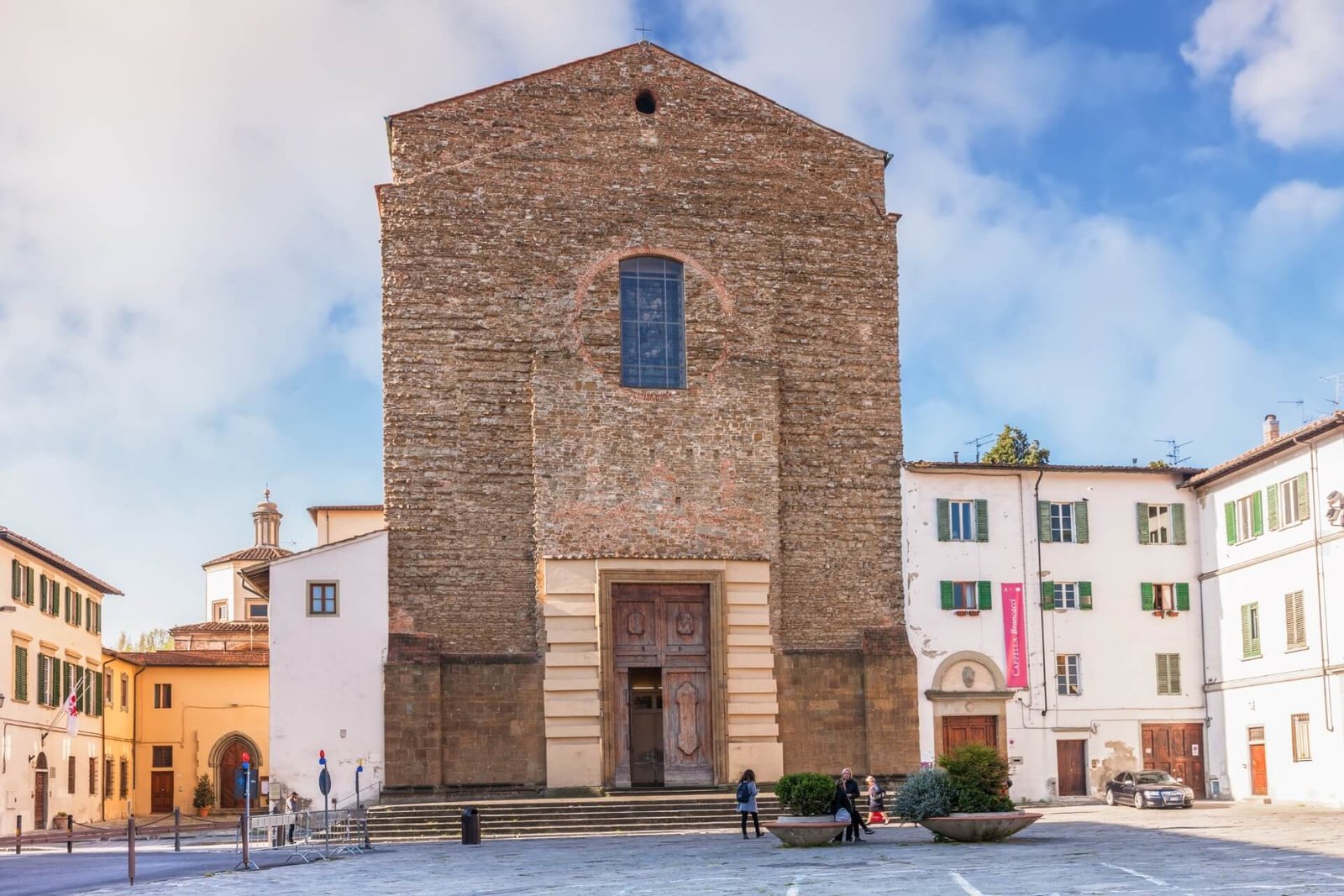
The Carmelites built this small church in honor of the Madonna in 1268. Today, it is one of the sights of ancient Florence. Five towers, a small window, and a simple facade hide the church’s exceptionally beautiful interior. Constant changes introduced Baroque and Rococo elements into the church’s Romanesque-Gothic appearance. Still, the ancient frescoes and marble sculptures of the interior keep their original form. The church has five chapels, monastic rooms. Among them, the Brancacci Chapel is unique.
Its frescoes show the life of the Apostle Peter. “Peter Baptizing the Neophytes,” “Peter Healing the Sick with His Shadow,” “The Tribute Money.” The famous masters Masaccio and Masolino created these frescoes. Since 1990, visitors have been able to enter the church to see the chapel. Entrance to the church is free. However, viewing the Brancacci Chapel frescoes costs 3€. The church complex includes the Corsini Chapel and an active female Carmelite monastery.
Address: Piazza del Carmine, 50124 Firenze.
Basilica of Santo Spirito

The Church of the Holy Spirit is a late work of the famous Filippo Brunelleschi. He planned it as an important element of Florence’s grand urban project. However, it was not possible to complete the construction according to the architect’s bold plans. The early Renaissance church’s construction, like the Basilica of San Lorenzo, took place after the great master’s death. A 13th-century monastery previously occupied the site of the new church (it burned down in 1471). Many considered it Florence’s intellectual center. The monastery housed a school, library, almshouse, and dining room for the poor.
So the city’s residents dreamed of continuing the good deeds in the new church. The building’s simple, elegant architectural style amazes with its proportions and color scheme. Inside the church are famous paintings such as Michelangelo’s “Crucifixion,” Lippo’s “Madonna and Child with Saints,” and Stradano’s “Expulsion of the Money-changers from the Temple.” The architectural complex also includes Cronaca’s portico, two cloisters, and Sangallo’s sacristy. At the church’s entrance is the Romano Foundation Museum. It holds the painting “The Last Supper” by Andrea Orcagna.
Address: Piazza Santo Spirito, 30, 50125 Firenze.
Basilica of San Miniato al Monte
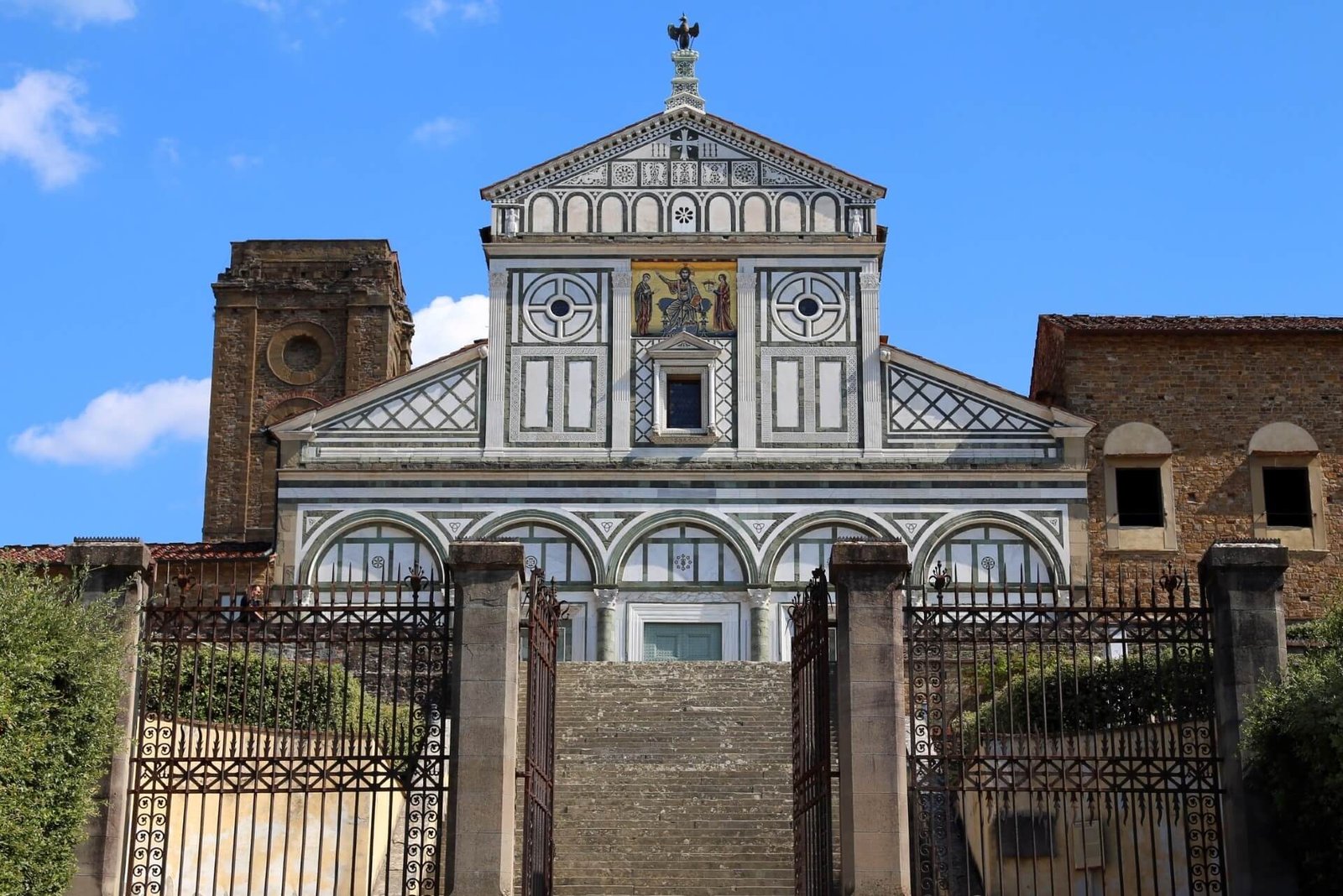
On one of Florence’s high hills lies an ancient basilica. It preserves elements of the best Italian buildings in the traditional Romanesque style. According to legend, this was the site of a chapel (cave) where the first Florentine martyr Miniato (Minas, of Armenian origin, who appeared in Italy in 250) died. Gradually, a monastery grew up next to the church, and it passed to the Benedictine Order. Later, builders rebuilt it, and in 1529 fortress walls designed by Michelangelo appeared. Local monks still offer their famous liqueurs, herbal infusions, and honey.
The church’s facade, decorated with rare multicolored marble tiles, is a model of Tuscany’s ancient style. The modern lighting system makes the facade shimmer and shine. It also highlights the beautiful inlaid pattern of the pediment and the ancient mosaic “Christ between the Madonna and Saint Miniato,” created in the 12th century.
The church’s interior has kept the Romanesque-Florentine style. For example, a beautiful marble mosaic with zodiac signs and symbolic animal figures decorates the central part of the floor. The church’s walls also retain ancient frescoes. Of interest are the basilica’s crypt, presbytery pulpit, Chapel of Saint James, and Chapel of the Crucifixion. Near the church is the cemetery with the grave of the famous writer Carlo Collodi, the creator of Pinocchio.
Address: Via delle Porte Sante, 34, 50125 Firenze. The basilica opens at 7:00 AM with a service. However, tourists can enter from 9:30 AM to 7:00 PM from Monday to Saturday. Admission is free, and donations of 1, 2 € are welcome.
Church of Santa Felicita
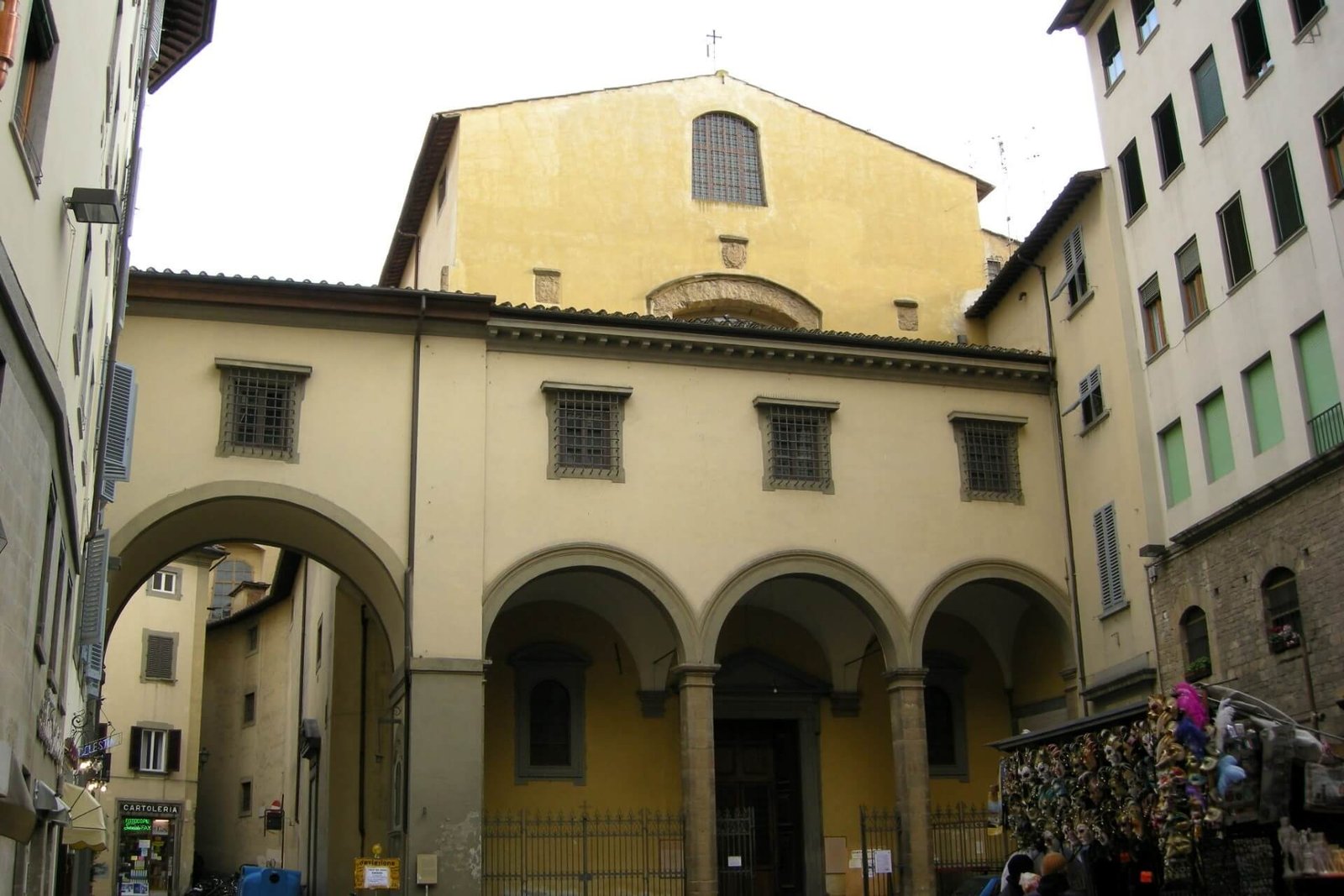
Only a few elements remain from the ancient church built in honor of Saint Felicita in the 4th century. Among them are the altar’s paintings “Deposition from the Cross, Lamentation,” and the dome’s decoration “Four Evangelists” by the famous Italian painter Jacopo Pontormo. Then, after the plague epidemic ended, construction of the new Gothic church began. It was consecrated in 1354. Now, one can only see the Chapter Hall with Gerini’s painting. Later, the present church appeared in the 18th century.
However, the Canigiani and Capponi chapels, the 17th-century choir, and the sacristy have survived. You can see interesting collections of paintings, such as “Madonna and Child,” “Annunciation,” “Birth of Jesus,” and “Meeting of Saint Anne and Saint Joachim”. Volterrano, Ghirlandaio, Lorenzo, and Gaddi created these works. One of the oldest churches in Florence, it stands on the square of the same name. It is open to visitors from 9:00 AM to 8:30 PM.
Baptistery of San Giovanni
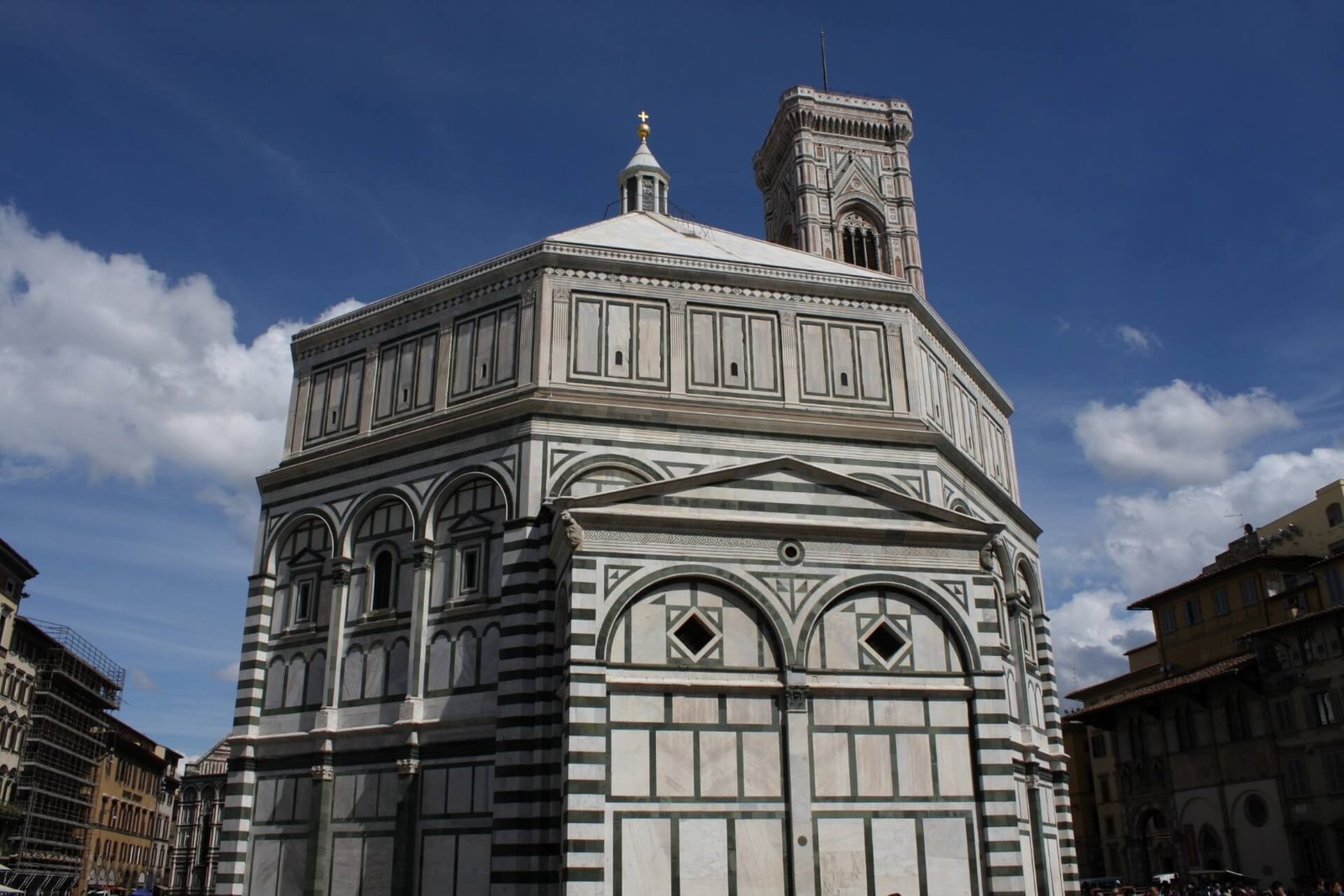
The ancient building is one of Florence’s main attractions, adorning Cathedral Square. Legends say that a temple dedicated to Mars stood here in the 1st century. Only in the 9th century did the rebuilt building in the shape of a perfect octagon become a Romanesque basilica. Later, the church received the status of a baptistery (place of baptism) in 1128. For another hundred years, it also served as the Cathedral. Until the 19th century, the baptistery was where members of famous families like the Medici, Dante, hundreds of famous names of the country, and thousands of commoners accepted the Catholic faith.
So that parishioners can take part in the baptismal ceremony, the building has three pairs of doors. They are now a particular value of the baptistery. For example, 28 scenes from the life of John the Baptist adorn the South Doors. The famous master Pisano created them. The East Doors feature 10 illustrations from the Old Testament history, also known as the “Gates of Paradise.” Finally, the North Doors display gilded reliefs of New Testament scenes in Gothic style.
The baptistery’s interior is also stunning and valuable. It includes a dome covered in golden mosaics created by various Italian masters. The majestic image of Jesus, mosaics depicting scenes of the Last Judgment, Holy Scripture, and the Celestial Hierarchy. The famous baptismal font is also here. It has been an essential element of the baptismal ceremony for nine centuries.
Address: Piazza del Duomo. It operates from 11:15 AM to 6:30 PM. The entrance fee is 5 €.
Church and Monastery of San Marco
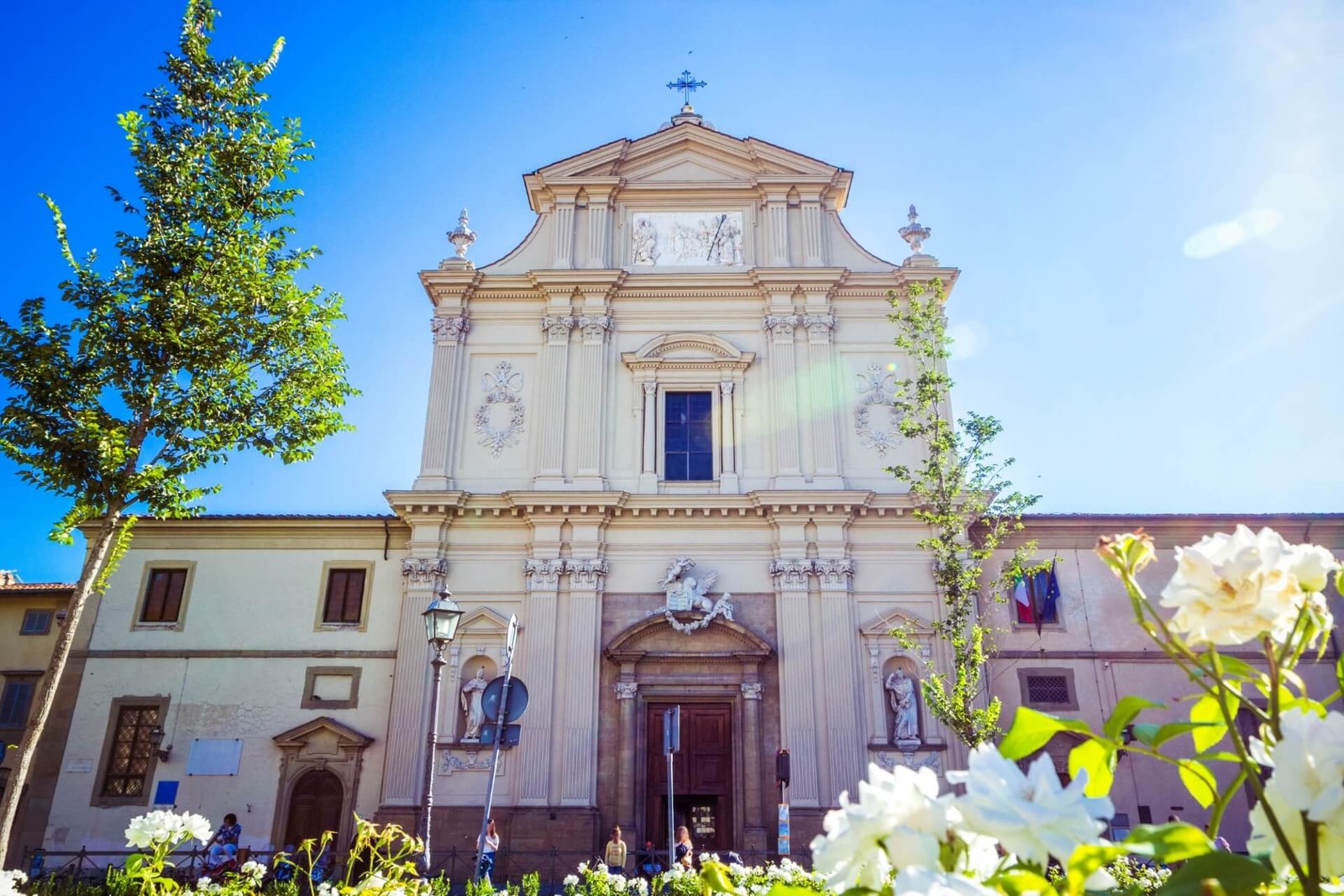
The complex comprises the Church of San Marco and the Dominican friary (now a museum). The church was consecrated in 1443. The Dominican friar Savonarola was its prior until his execution in 1498. You can see the cell where he lived and his portrait. The monastery building was the first in Florence with elegant proportions of Renaissance architectural elements.
Beato Angelico painted the monastery’s frescoes. They decorate the cells, corridors, and other monastery rooms. Many works of Italian masters of the Early Renaissance have become world-class masterpieces, attracting the attention of admirers. The monastery has not been active since 1866. It now houses the Museum of San Marco, famous for the works of Beato Angelico, the 15th-century painter.
The museum also includes a library with a large collection of ancient manuscripts. The organization of work in the library is interesting. No one could use the manuscripts without the permission of specially elected executors. Every year, monks took inventory in their presence. When a book was missing, the monks created a fresh manuscript. You can visit the complex at Piazza San Marco, 1-3, from Monday to Friday, from 8:15 AM to 4:50 PM. The ticket costs 4 €.
Conclusion
Florence, the star of the Renaissance, is a city that captivates visitors with its rich history, stunning architecture, and world-class art. From the grandeur of the Cathedral of Santa Maria del Fiore to the serene beauty of the Basilica of San Miniato al Monte, the city’s churches and temples offer a glimpse into Florence’s glorious past. Whether you spend your days exploring the city’s museums, admiring its frescoes, or simply strolling through its charming streets, Florence promises an unforgettable journey through time and art.
Italy Top 12 Museums for Art and History Lovers
Churches in Florence at a glance
| Church | Don’t miss |
|---|---|
| Cathedral of Santa Maria del Fiore (Duomo) | Brunelleschi’s dome |
| Baptistery of San Giovanni | The bronze “Gates of Paradise” |
| Basilica of Santa Croce | Tombs of Michelangelo, Galileo, Machiavelli and Rossini |
| Santa Maria Novella | The marble façade and the Strozzi Chapel frescoes |
| Basilica of San Lorenzo | The Medici Chapels, the Old Sacristy and the New Sacristy |
| Santa Maria del Carmine | Masaccio and Masolino frescoes in the Brancacci Chapel |
| Basilica of Santo Spirito | Brunelleschi’s late church and Michelangelo’s crucifix |
| San Miniato al Monte | The Romanesque façade and views over the city |
| Santa Trinita | Ghirlandaio’s frescoes |
| Santa Felicita | Pontormo’s Deposition |
| Ognissanti | The graves of Botticelli and Simonetta Vespucci |
| San Marco | Fra Angelico’s frescoes and Savonarola’s cell |
| Russian Orthodox church | Five onion domes and a marble iconostasis |
Visiting churches in Florence: a two-day route
- Day 1: the Duomo and the Baptistery, then San Lorenzo, San Marco, Santa Maria Novella and Ognissanti.
- Day 2: Santa Croce, then cross the Arno to Santa Felicita, Santo Spirito and Santa Maria del Carmine. End the day with a walk up to San Miniato al Monte for sunset.
Tips for visiting churches in Florence
- Cover your shoulders and knees, because many churches turn away visitors in shorts or sleeveless tops.
- Also, book the Duomo climbs in advance, because the dome climb needs a timed reservation.
- Avoid Sunday mornings and service times, when the churches limit tourist visits.
- Ognissanti, Santa Trinita and San Miniato al Monte are free to enter.
- Most churches in Florence stand in the Historic Centre of Florence, a UNESCO World Heritage Site.
- For opening times and events, see the city’s official tourism website, Destination Florence.
Note: we collected the prices in this article when we wrote it, so they may have changed. Please confirm current prices on the official websites before your trip.
Churches in Florence: frequently asked questions
What is the most famous of the churches in Florence?
The Cathedral of Santa Maria del Fiore, known as the Duomo, with Brunelleschi’s huge dome.
Which churches in Florence are free to visit?
Ognissanti, Santa Trinita and San Miniato al Monte are free. Entry to Santa Maria del Carmine is also free, but the Brancacci Chapel has a separate ticket.
Can you climb the Duomo in Florence?
Yes. The climb to the top of Brunelleschi’s dome has 463 steps. Giotto’s bell tower next to it has 414 steps. Both need a ticket.
Where is Michelangelo buried?
In the Basilica of Santa Croce, which also holds the tombs of Galileo, Machiavelli and Rossini.
Related guides on Enjoy The Trip: What to See in Florence in One Day: Most Interesting Places, Why Florence Is the Best Walkable City in Europe, Traveling From Rome to Florence? Easy Ways to Save Money, Lecce: The Amazing Budget Italian City Instead of Florence.

Konstantin is an acclaimed travel writer, celebrated for transforming ordinary journeys into extraordinary narratives. With years of experience exploring diverse destinations across the globe, his work blends vivid storytelling, cultural insights, and practical advice to inspire wanderlust and guide readers toward unforgettable adventures.
As a key contributor to enjoythetrip.org website, Konstantin has built a loyal readership through their expertise in uncovering both iconic landmarks and off-the-beaten-path treasures. He specializes in providing travelers with honest, actionable tips, whether it’s finding the best resorts in Maldives, exploring cultural hubs like Paris, or diving into the natural wonders of Croatia.