
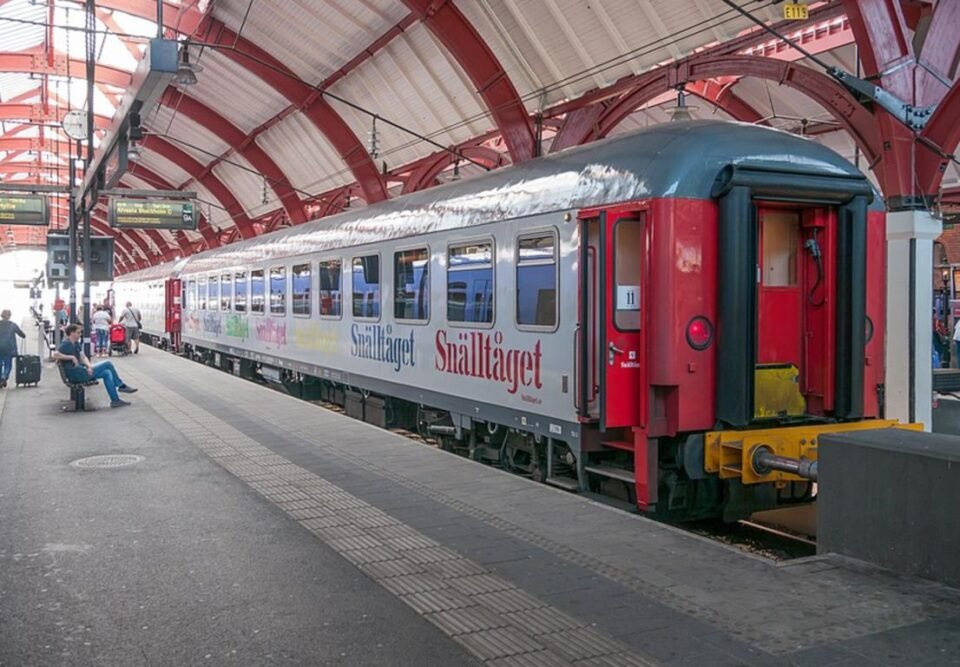
Previously, the journey between Malmö and Oslo involved long bus trips and several train transfers.
A new direct train connects the south of Sweden with the capital of Norway and covers the distance in six and a half hours. Along the way, you can make a stop in the coastal town of Varberg or the bustling Gothenburg. Travel journalist Adam Turner described his journey in The Guardian.
“This carriage needs modernization. Don’t miss the opportunity to immerse yourself in the atmosphere of 1990s Germany,” is written on the doors of the dining car.
The couple inside is doing exactly that: they’re taking selfies non‑stop in the pink‑and‑turquoise carriage, which looks like a hospital cafeteria and smells of cinnamon rolls and strong filter coffee.
As the author explains, he is traveling on the famous red train of the Swedish railway company Snälltåget, which now runs on a new route between Malmö and Oslo. The journey lasts 6.5 hours and takes place along the picturesque western corridor of Sweden.
Previously, traveling between these two cities involved long bus journeys and several train transfers. The new direct route significantly simplifies the trip and is also cheaper: tickets start at £11 one way. The route’s popularity is already evident – since its launch this summer, more than 25,000 passengers have used it.
“Ten years ago, I first became interested in traveling around Scandinavia by train. Then I drove from Stockholm to Gothenburg, spent the night in a cozy compartment made of dark wood and listened to the pianist in the dining car. This time I’m going from Malmo and decide to take a new route to make a few stops on the west coast of the country, ” the journalist writes.
In his opinion, Malmö, located on the other side of the Øresund Bridge from Copenhagen, often remains in the shadow of Stockholm. This port city in southern Sweden is less refined and more rough‑around‑the‑edges than the capital, but its residents seem more open and inquisitive.
What you can see in Malmo
Just an hour after his arrival, he was invited to have a drink by a group of local residents – he hadn’t experienced such openness during his time in Stockholm. Almost half of Malmö’s population is under 35 years old, and overall, the city is home to 187 nationalities, which has made it a creative hub.
In the city center, Form/Design Center is located in a former 16th‑century granary. Today, it is a space for meetings and exhibitions dedicated to design, crafts, and architecture. Nearby are the modern art galleries Moderna Museet and Malmö Konsthall.
In the Melovangen district, or Mjollan, a trendy neighborhood popular among creative young people, it seems as if everyone around is either studying at an art college or has just returned from a weekend in Berlin.
“My friend Rob, who has lived in Malmo for almost a decade, takes me through Folkets Park –” the people’s park ” – and shows me his favorite pizza place, Far i Hatten, set in cute wooden houses. Nearby, we find a table at Ava and order a beer in a green square surrounded by trendy restaurants and organic wine bars. The atmosphere is reminiscent of the London borough of London Fields in Heckney, ” the author shared.
The man writes that Snälltåget currently operates only one direct train to Oslo per day – it departs from Malmö Central Station at 6:38 a.m. The number of services is planned to be increased next year.
The station was full of families and tourists with backpacks that were almost as big as a refrigerator from early in the morning. After passing the Romanesque towers of Lund Cathedral, the train moved through the flat, yellowing agricultural fields. The route then runs along the Apelviken Bay – a long, horseshoe‑shaped sandy beach near Varberg, popular among kitesurfing and surfing enthusiasts.
Varberg: the sea, saunas, and swimming without clothes.
Varberg resembles a Swedish counterpart to a small British seaside town. It has festive flags, cobblestone streets, cozy cafes, and a weekend market where they sell fresh vegetables, fruits, marmalade, leather belts, and socks. Varberg is also known as a resort town.
According to Turner, he was interested in the picturesque Kallbadhuset building – a bathhouse in the Moorish style, built on wooden piles right above the waters of the Kattegat. For about 8 pounds, visitors get access to separate male and female saunas with a breathtaking view of the sea. After the sauna, immersing in the cool water turns out to be the perfect way to recover after an early rise at six in the morning and a bottle of red wine the day before.
“Lying on my back in the water, I see a group of Swedish veterans sitting on a wooden bench, completely unashamed of their nudity – this is a bathhouse where it’s customary to bathe without clothes. The mustard‑yellow hues of the building complement the scene, which resembles Goknæs’ paintings. According to the information on the sign near Skarpe Nord – a nearby public bathing place for women – people have been bathing naked in Varberg for over 100 years,” the author said.
As he strolled along the promenade past the huge passage through the blasted rocks, which resembled a secret path from *The Lord of the Rings*, he passed several more specially equipped areas for swimming without clothes.
Turner adds that in the underground part of the Hotell Gästis hotel, there is a hidden replica of Vladimir Lenin’s favourite bathhouse. The hotel owner, Lasse Diding, created this spa complex in honour of his idol after visiting the original bathhouse in St. Petersburg in the 1980s. This slightly eerie place is lined with more than 35,000 cobalt tiles and decorated with illuminated candle‑lit busts of communist leaders.
Diding’s interest in the communist movement emerged during the Vietnam War and has not waned since. This eccentric entrepreneur was involved in creating many notable landmarks in Varberg with a distinctly left‑wing political slant. Among them are the huge Palestinian flag, the Havanna Hotel, dedicated to revolutionary Cuba, and the statue of Danuta Danielsson, which became a symbol of solidarity after she struck a marching neo‑Nazi with her handbag in the Swedish town of Växjö in 1985.
Gothenburg: fika, vintage, and a beloved park
The next morning, the author boarded a high‑speed train to Gothenburg. The journey took 39 minutes.
“After checking in at the elegant Hotel Pigalle, which is decorated in the style of a French boudoir and is located just a five‑minute walk from the central station, I head along Kungsgatan Street — the city’s modern shopping artery — towards Magasingatan,” Turner wrote.
This area is full of vintage shops, including Ragtime, Pop, and Humana, as well as shops selling handmade items, such as Customwood, where custom wooden furniture is made.
The interior, in a Scandinavian‑industrial style, seems to have stepped straight out of the pages of a design magazine, the traveler adds. People in glasses are working on their laptops, and the scent of fresh bread and coffee wafts from the own bakery and coffee shop.
“My bullar-a classic Swedish cardamom bun-and latte cost just under £10… Later, I walk through Slotsskogen Park and remember why I wanted to move here years ago after my first short visit to Gothenburg,” the story says.
Sweden’s second‑largest city is compact and laid‑back. In some places, it gives the same slightly rough impression as Malmö, but at the same time it combines the convenience of living with the nature and culture of Stockholm.
In the very center lies the picturesque historic Haga district, with its narrow cobblestone streets, the aromas of freshly baked goods, and the creaking wooden trams passing by.
Slottskogen is roughly the same size as London’s Hyde Park. It is home to deer, penguins, and Gotland ponies, and the park itself is ideal for long walks without a specific goal.
The road to Oslo: the most picturesque part of the route.
The section from Gothenburg to Oslo becomes a truly cinematic climax of the journey. First, green hills, cows grazing by the river, and dense forests with tall coniferous trees under the blue summer sky appear outside the window. Then nature seems to start competing with itself: the lakes become wider, the trees greener, and the granite canyons more majestic with each kilometer. The children press their noses to the windows in delight, trying not to miss anything.
Upon arriving in Oslo, the author left his belongings at Citybox – a minimalist hotel a few minutes’ walk from the station – and headed north to Sognsvann. This lake and recreational area on the outskirts of the city serve as the starting point for a circular route to Vettakollen, a popular observation deck. After an easy 30‑minute hike up the mountain, Turner reached a rocky hill surrounded by pine trees, where families with children were resting. In the distance lies the panorama of Oslo: city blocks made of glass and metal stretch all the way to the fjord.
According to the author, this is precisely what makes Scandinavia special – here, the urban and natural worlds seem to merge seamlessly into one.

Konstantin is an acclaimed travel writer, celebrated for transforming ordinary journeys into extraordinary narratives. With years of experience exploring diverse destinations across the globe, his work blends vivid storytelling, cultural insights, and practical advice to inspire wanderlust and guide readers toward unforgettable adventures.
As a key contributor to enjoythetrip.org website, Konstantin has built a loyal readership through their expertise in uncovering both iconic landmarks and off-the-beaten-path treasures. He specializes in providing travelers with honest, actionable tips, whether it’s finding the best resorts in Maldives, exploring cultural hubs like Paris, or diving into the natural wonders of Croatia.