
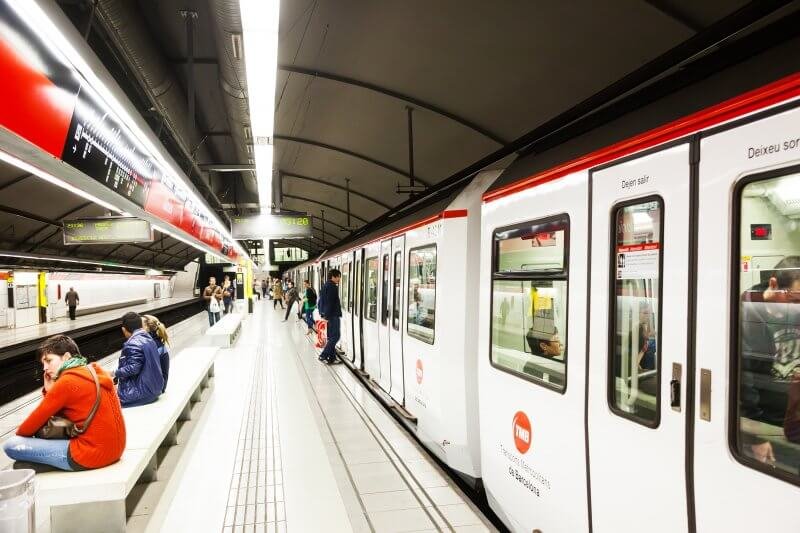
This Barcelona Metro guide explains its history, the metro map, working hours, ticket prices, where to buy tickets and useful tips.
It is no exaggeration to call the Barcelona Metro one of the most developed types of municipal transport. With its help, you can get to any point not only in the city itself, but also in its surroundings. Despite this, many tourists coming here for the first time, beware of the local subway and call it too confusing and complex. Is this really the case and can the average traveler understand the scheme of the Barcelona metro?
General information
The first line on the Barcelona Metro map was opened by the regional company Gran Metropolitano on December 30, 1924. At that time, it connected Plaza de Cataluña with Lesseps station, and now belongs to the 3rd line. The second metro line (the current L1) appeared almost immediately-literally 2 years later. Its construction, carried out by a rival company Metropolitano Transversal, was timed to coincide with the World’s Fair, held in the capital of Catalonia in 1929. Then there was a small lull in the history of the Barcelona metro, which lasted until the end of the military conflict between the Popular Front and the dictatorship of Francisco Franco. In 1951, both operators were taken over by the city, as a result of which Barcelona’s transport system began to develop at a doubled pace.
Currently, the Barcelona metro has 12 lines (8 run by TMB and 4 by FGC). The TMB network alone has 165 stations and is about 125 km long. You can use them to move not only around the city, but also outside it (to L’Hospitalet de Llobregat, Badalona, Santa Coloma de Gramenet, Sant Adrià de Besòs, L’Hospitalet de Llobregat and other suburban villages). And in order not to get completely confused in all this diversity, always carry a metro map with you.
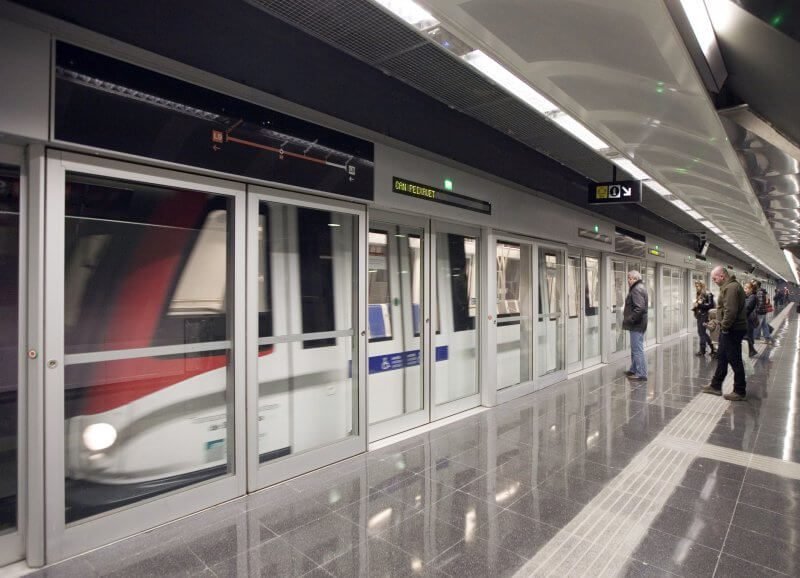
The local subway has several characteristic features, but one of the most important is that children under 4 travel free, while children aged 4 and over need a ticket (local residents can use the free T-16 card). In addition, Barcelona has a special discount system that works when buying several tickets at the same time. And one more thing! This metro became known thanks to the so – called Spanish solution, the essence of which is to have as many as three platforms at the stations-one island and two coastal. Thanks to this design, passengers can enter and exit the car from both sides, which prevents the appearance of crowding and significantly reduces the usual stopping time.
Metro map
Studying the Barcelona metro map, you will probably notice that it consists of 11 branches that do not have names and differ only in color and number:
- L6: Pl. Catalunya-Sarria;
- L11: Trinitat Nova Can Cuiàs;
- L3: Universitaria Zone-Trinitat Nova;
- L10: La Sagrera-Gorg;
- L2: Parallel-Badalona-Pompeu Fabra;
- L4: Trinitat Nova La Pau;
- L1: Bellvitge Hospital-Fondo;
- L7: Pl. Catalunya-Avinguda-Tibidabo;
- L5: Cornella Center-Val d’Hebron;
- L9: T1 Airport-Zona Universitaria, La Sagrera-Can Zam;
- L8: Spain Pl. – Moli Nou-Ciutat Cooperative.
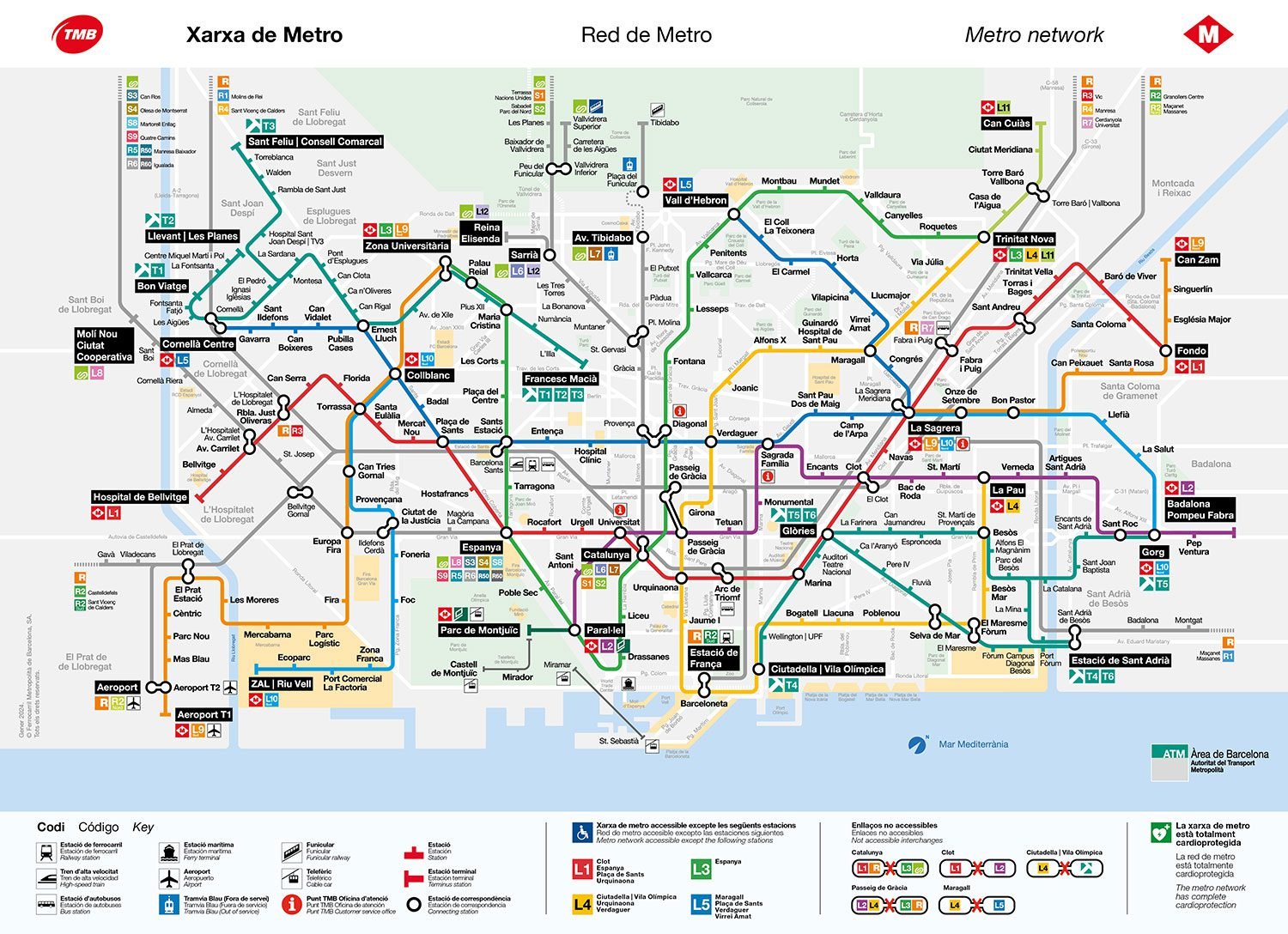
While some of them (L1–L5 and L9–L11) are operated by TMB, the others (L6-L8 and S1-S4) belong to Ferrocarrils de la Generalitat de Catalunya (FGC). In addition, the Metro de Barcelona diagrams are marked with funicular lines, 2 tram tracks (Trambesòs and Trambaix) and the Spanish railway, which in the general scheme is designated by the letter R (from the company name – Renfe). These stations have their own platforms and most often serve for trips to the recreation centers of Salou, Pineda de Mar, Calella and Blanes.
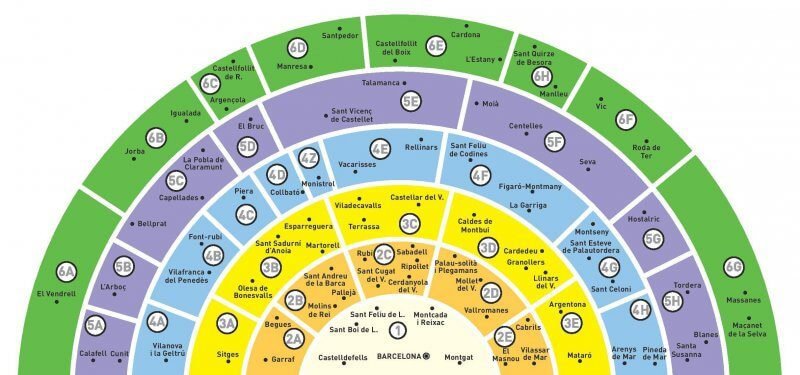
You can change to R trains at one of 4 key stations: Sants Main Railway Station, Plaza Catalunya, El Prat Airport or El Clot-Aragó. Also of note are the 6 fare zones of the Barcelona area. Zone 1 covers the city itself and nearby municipalities, while the outer zones cover the suburbs and more distant towns.
Working hours and driving intervals
Barcelona metro service starts at 5 am, regardless of the day of the week. The only exceptions are those dates when stations are open around the clock:
- June 23-24 (St. John’s Day Eve);
- August 16-17 (Gràcia Festival);
- from 20 to 21 and 23 to 24 September (La Merce Festival);
- from December 31 to January 1 (New Year’s Eve).
If you want to know how long the metro is open in Barcelona, please use this hint, because the closing time may vary depending on whether it is a weekday or a weekend:
- Monday-Thursday: until 00:00;
- Friday and public holiday eve: until 02:00;
- Saturday: around the clock;
- Sunday: until 00:00;
- 24.12: until 23:00.
At the same time, Mas Blau, Mercabarna and L9 Sud Parc Logístic stations are always open from 05:00 to 00:00. At peak times, trains run every few minutes. The stop takes no more than 2 minutes. It will take about 10 minutes to move between the lines.
On a note! Despite the fact that the subway closes a little later on weekends, it becomes more difficult to move around the city. This is due to the fact that trains run less frequently late at night.
How much does the trip cost?

The cost of the Barcelona metro depends on which card you choose to use. Let’s consider only the main ones.
Single Ticket Card
A regular ticket intended for making the 1st trip, with one passenger and one type of transport. Valid for 1 hour and 15 minutes from the moment of composting. The price of the map changes depending on the number of intersected zones:
- 1 – €2.90;
- 2 – €4.15;
- 3 – €5.40;
- 5 – €8.80;
- 6 – €10.25.
On a note! When buying a Single Ticket in the metro, you can use both underground and surface transport. If you buy a pass from a bus driver, but you can only ride on it, although the price will be the same! In addition, it is not possible to get from the airport to the city and back.
T-casual card
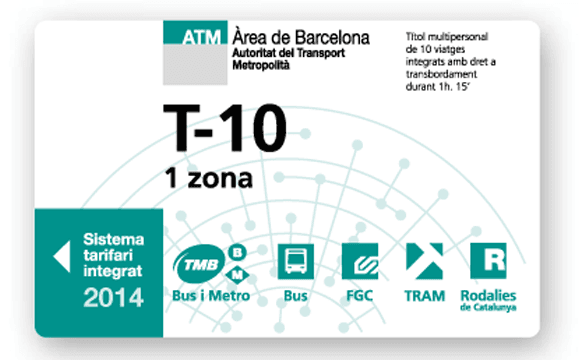
The T-casual (which replaced the old T-10) includes 10 integrated trips. It is a single-person ticket: it is not nominal, but it cannot be used by more than one person at the same time. When traveling within the same zone, the cardholder has 75 minutes to transfer from one type of municipal transport to another. When crossing each subsequent zone, this period increases by a quarter of an hour. The date and time of planting are indicated on the back of the ticket at the time of composting.
The main advantage of the T-casual is that it is valid until the next fare change. The only drawback is that you can only take the subway once during this time. This means that if you get back on the train before the end of the specified period, you will be charged 1 more trip.
This option is perfect for those who plan to stay in Barcelona for 2-3 days. As for the cost of the T-casual, it depends on the number of zones crossed:
- 1 – €13.00 (it is quite enough to get acquainted with the main city attractions);
- 2 – €25.50;
- 3 – €34.70;
- 4 – €44.65;
- 5 – €51.20;
- 6 – €54.45.
On a note! The T-casual is not valid at the Aeroport T1 and Aeroport T2 metro stations on the L9 Sud line.
T-grup card (replaced the T-70/30)
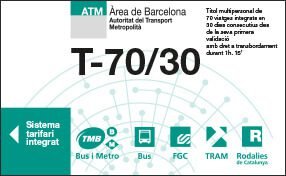
The T-70/30 card has been discontinued. Its current replacement is the T-grup: a multi-person ticket for 70 integrated journeys within 30 consecutive days from the first validation, which different people can use at the same time for the same journey. Note that it is not valid at the Aeroport T1 and Aeroport T2 metro stations on the L9 Sud line. In 2026, a 1-zone T-grup costs €91.00.
Airport Ticket Card
It is necessary to get from the city to Aeroport de Barcelona-el Prat and back, as well as to move between its two terminals. This map only applies to the subway system. Then it all depends on the scheme of your route – if it is planned to transfer to a bus, you should buy a T-casual. This will allow you to avoid overpaying for a one-time ticket. A one-way trip with an Airport Ticket costs €5.90.
On a note! When purchasing this card, don’t forget to check if your arrival time in the city coincides with the time when the metro closes, because if you arrive late at night, you simply won’t be able to use it.
Card for 48, 72, 96, and 120 hours
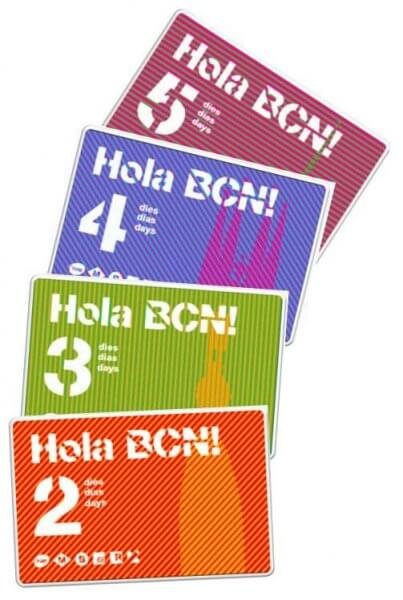
Designed for a certain number of days – 2, 3, 4 and 5 days. They allow you to use any type of municipal transport, except, perhaps, a tourist bus. The validity period of such travel cards starts from the first trip. Cards that have not been activated are cancelled on the last day of February each year.
Their cost is:
- 48 hours – 15€;
- 72 hours – 22€;
- 96 hours – 28.50€;
- 120 hours – 35€.
On a note! These types of travel cards apply to all lines of the Barcelona metro – including the L9sud, which connects the city with the airport.
T-usual card (replaced the T-50/30)
The T-50/30 card has been discontinued. Its current replacement is the T-usual: a personal integrated ticket with unlimited journeys, valid for 30 days from the first validation on all modes of transport within the zones you pay for. It requires identification, so only the registered holder can use it. It is also valid to and from the Aeroport T1 and Aeroport T2 metro stations on the L9 Sud line. In 2026, a 1-zone T-usual costs €22.80.
T-Mes Card (replaced by the T-usual)
The T-Mes monthly ticket is no longer sold; its role is now covered by the T-usual described above (personal, unlimited journeys for 30 days, valid at the Aeroport T1 and Aeroport T2 stations on L9 Sud, €22.80 for 1 zone in 2026).
On a note! When using T-Mes, you must have an identity card (national or issued by the operators of the integrated fare payment system). At the same time, the number of this document must be printed on the travel card itself.
You can view all types of maps and the cost of travel on the page
Where and how to buy a ticket?
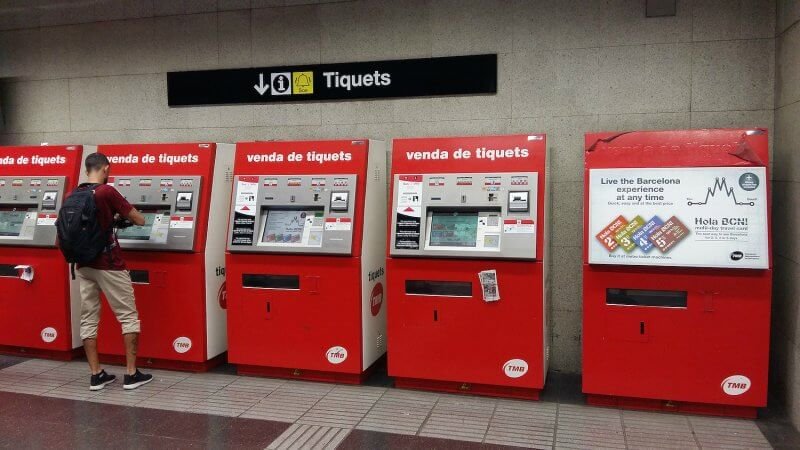
There are very few typical ticket offices in Barcelona, so to buy a card, you need to look for a vending machine (there are different colors, but most often there are red or yellow ones). Using the ticket machines is easy:
- Choose your preferred language – French, Spanish, English, or Catalan. But even if you don’t know any of them, don’t worry – these machines have a very user-friendly and intuitive interface;
- Choose the ticket type. As a rule, the most common option is set on the default screen. If it doesn’t suit you, click the “Other” button;
- Enter the payment method – card or cash;
- Select the appropriate zones;
- Specify the required number of travel cards;
- Wait until the final amount (in euros)appears on the screen;
- Pay for your ticket-vending machines accept both bills and coins. Change is also issued.
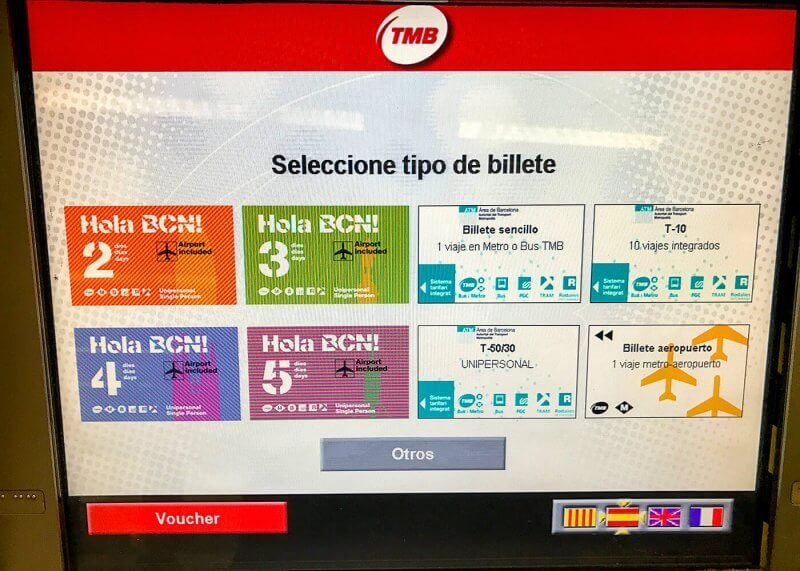
On a note! You can also buy a ticket or travel card at information centers or customer service points.
Barcelona Metro – how to use it?
If you don’t fully understand how to use the Barcelona metro and read its map, take note of some useful tips:
- After going down, go to the turnstile with the green arrow;
- Insert the ticket into the yellow receiver – it will not only check for paid trips, but also print out their date and time. As for trams and buses, their composters are located directly in the salons;
- Wait for the lockdown to be lifted and proceed to the platform;
- Detailed maps and diagrams are available at each stop. Follow the signs to get to the desired station. There are transitions in the opposite direction almost everywhere;
- You need to keep your travel card or travel card until the end of the trip;
- Ticket controllers check tickets either on the platform or in the car itself;
- The penalty for travelling without a valid ticket is about 100€ (check the current amount). Paying on the spot may reduce the fine. Penalties also apply to those who forgot or did not consider it necessary to pass the ticket through the composter.;
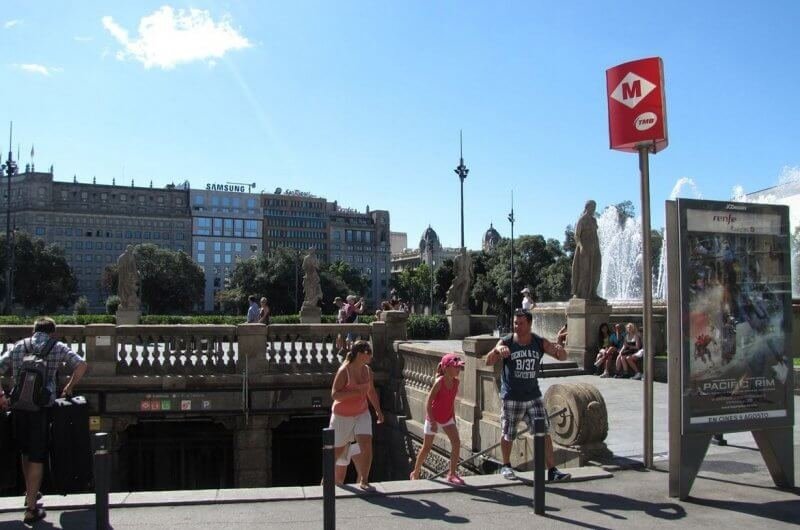
- Find the entrance to the subway can be a red letter “M”, enclosed in a white rhombus;
- You don’t need to crease or fold the card several times – otherwise the monitoring device won’t let you pass it.;
- If the travel card is demagnetized for any other reason, please replace it with the metro employees. All remaining trips are protected.
On a note! When studying the metro layout, do not confuse metro lines with regional train lines.
Useful tips

When planning to use the Barcelona metro, pay attention to several important nuances::
- In order to get into the car, you need to press the green button located on the entrance door. Only then will they open and you can go inside. The exit from the car is carried out in exactly the same way. By the way, in the old trains, the role of the button is played by a special lever.
- If you don’t have a metro map with you, take a look around – on the Metro de Barcelona platform you can see not only a map of the line you are currently on, but also signs of attractions located in the immediate vicinity of the station. In addition, there is information about which way you should go to get out near the place you need.
- After composting your travel ticket, don’t be too lazy to check the number of debited trips. The fact is that the turnstiles in this metro periodically “hang” and can fix incorrect information.
- After the metro closes, you can only get around the city by taxi or night bus.
- When trying to figure out the layout of the subway, do not forget to carefully monitor your belongings. To avoid becoming a victim of pickpockets, wear a backpack on your chest, not behind your back, do not keep your wallet and mobile phone in your pocket, and place the bag so that it cannot be cut.
Enjoy Barcelona on a Budget: Free Entertainment Options
Barcelona Metro at a glance
- First line: opened in 1924
- Tickets: single tickets, T-casual, T-usual, T-grup and multi-day cards
- Where to buy: ticket machines at stations
- Tip: keep your ticket until the end of the trip
Note: prices in this article were collected when it was written and may have changed. Please confirm current prices on the official websites before your trip.
Barcelona Metro: frequently asked questions
Which ticket is best for tourists in Barcelona?
The T-casual card or a card for 48, 72, 96 or 120 hours.
Where can you buy Barcelona Metro tickets?
At ticket machines in metro stations.
When was the Barcelona Metro opened?
The first line opened in 1924.
Related guides on Enjoy The Trip: Taipei Tops Time Out’s Transport Ranking and Locals Love It, Rome Is the Best City for Book Lovers: 226 Amazing Bookstores, 5 Charming, Affordable Seaside Cities in Europe to Visit Now.

Konstantin is an acclaimed travel writer, celebrated for transforming ordinary journeys into extraordinary narratives. With years of experience exploring diverse destinations across the globe, his work blends vivid storytelling, cultural insights, and practical advice to inspire wanderlust and guide readers toward unforgettable adventures.
As a key contributor to enjoythetrip.org website, Konstantin has built a loyal readership through their expertise in uncovering both iconic landmarks and off-the-beaten-path treasures. He specializes in providing travelers with honest, actionable tips, whether it’s finding the best resorts in Maldives, exploring cultural hubs like Paris, or diving into the natural wonders of Croatia.