
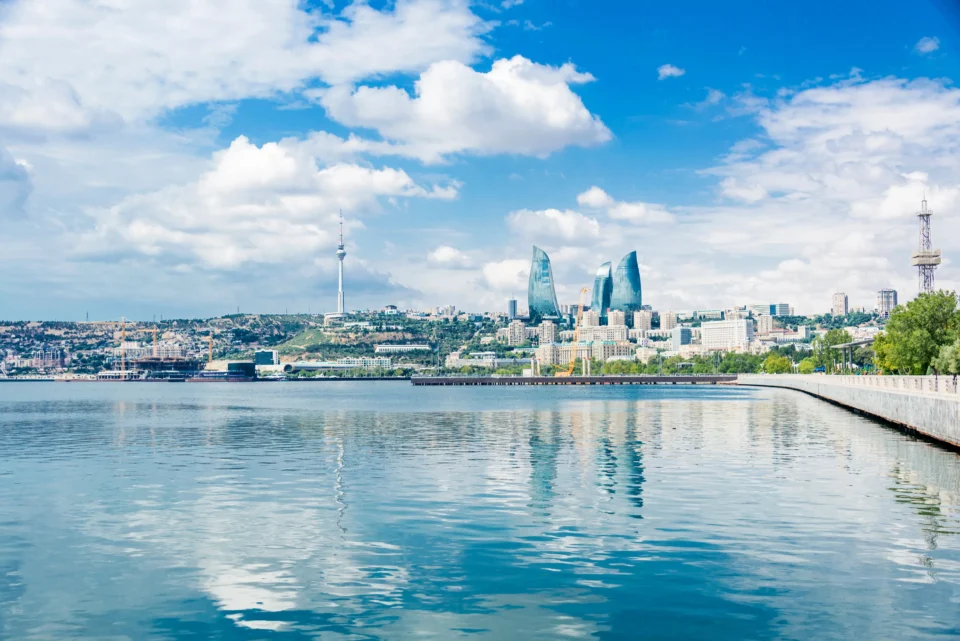
Planning Baku in 2 days? Start with the UNESCO-listed Old City, then explore the Caspian waterfront, Highland Park and the striking modern architecture. This itinerary combines the top sights with optional stops, practical transport tips and a map.
Baku in 2 days: suggested itinerary
| Day | Morning | Afternoon and evening |
|---|---|---|
| 1 | Old City, Maiden Tower, Shirvanshahs’ Palace | Carpet Museum, Little Venice, Highland Park, Flame Towers |
| 2 | Fountains Square, History Museum | Heydar Aliyev Center, waterfront, optional Bibi-Heybat Mosque |
For a relaxed visit, choose four to six major stops per day. The full list below offers extra options depending on your interests. See the official Old City travel guide.
Map of Baku attractions
Baku – The capital of the Azerbaijan Republic. It is a major industrial, economic, and scientific-technical center of the South Caucasus. It is the largest city in the Caucasus. Geographically, the capital of Azerbaijan lies on the southern shore of the Absheron Peninsula, with the largest port on the Caspian Sea. Historically, references to the city appear in early medieval manuscripts. The rich history has endowed the city with unique attractions. So, there’s a lot to see in Baku in 2 days, and it’s very interesting.
How to get from the airport to the center
20 kilometers from the capital of Azerbaijan is the Heydar Aliyev International Airport – named after the former member of the Politburo of the CPSU Central Committee, the first president of the republic, and the father of the current president, Ilham Aliyev. It serves international and domestic flights.
Arriving people exit the airport through two terminals for domestic and international flights. You can get to the city center by bus, taxi, or rented car.
The Airport Express H1 bus departs daily from the airport to the center. The airport announces 24-hour service on the H1 route. Check the airport transport page for current intervals and fares. Cash payment for the fare is not possible. Payment is made with a BakiKart plastic card. The card is purchased at the airport from a special machine.
You can buy and top up a BakuCard at the airport terminals. You enter the bus through the front door, applying the card to the terminal fixed on the handrail at the entrance to the cabin. The signal confirms the payment.
If it’s inconvenient to wait for the next bus trip, you can use a taxi. There are many self-employed taxi drivers, and they can sometimes be annoying, vying to offer their services. Seeing a guest arriving in the country for the first time, independent “autorickshaws” can ask for an incredible amount of money, relying on the client’s unawareness.
To avoid an unpleasant situation, you need to know the average cost of a trip to the city center. Use an official taxi or a reputable ride-hailing service and confirm the fare before departure.
Day 1: Old City and waterfront
On the first day, some time may be spent settling into the hotel and taking a short rest after the flight. Therefore, for the first acquaintance with the city, it is better to focus on visiting particularly iconic and popular attractions.
For a more complete perception of information about interesting places, it is good to use excursion routes led by professional guides. So, dress according to the season and put on comfortable shoes, and boldly go on an exciting journey through a beautiful and incomparable city.
Old City Icheri Sheher
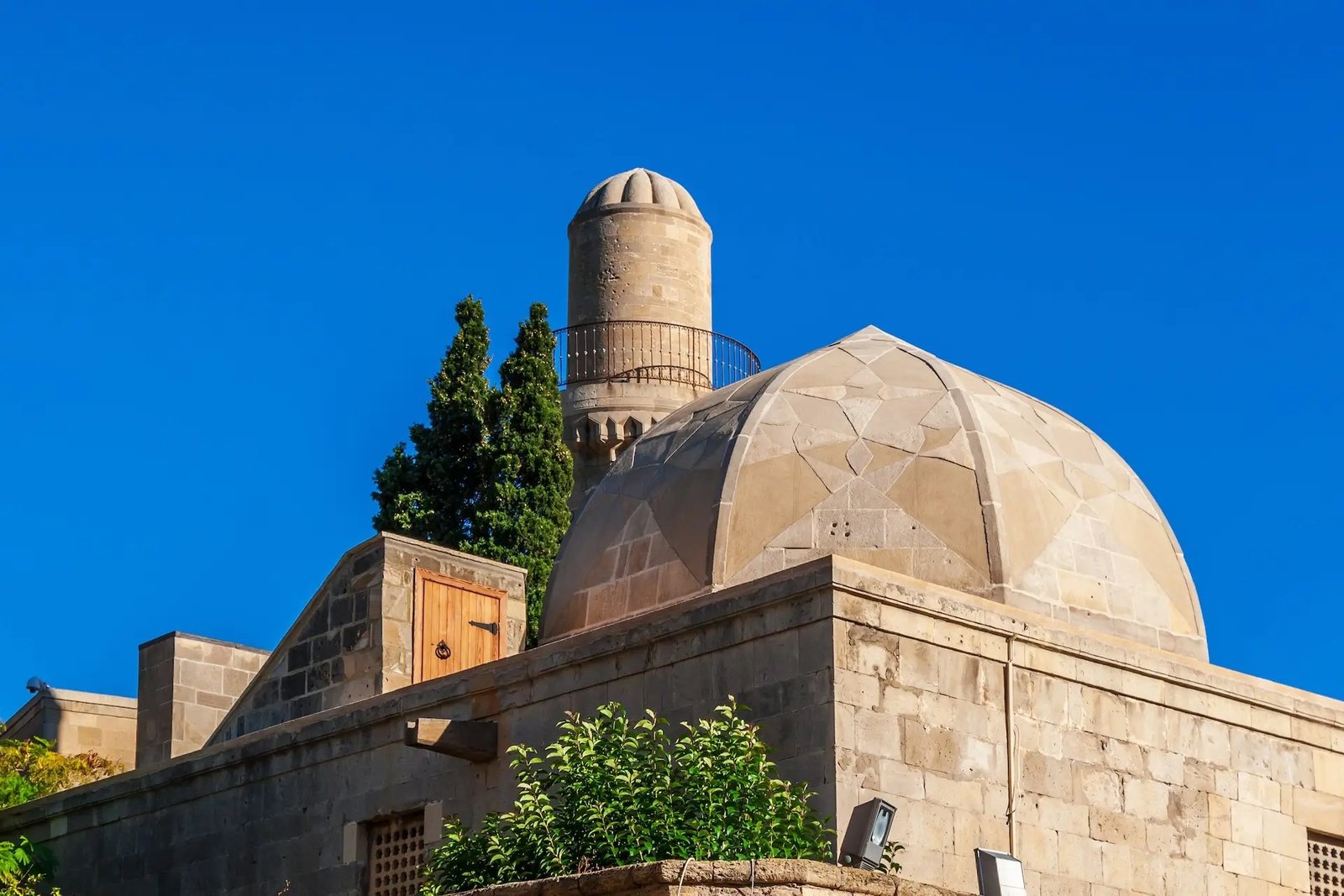
This is where the history of the capital of Azerbaijan began. Residents call the district the Old City or the Fortress. Icheri Sheher is a concentration of the main attractions, which collectively represent an architectural monument listed as a UNESCO World Heritage Site in 2000.
Since 1977, the historical center has had the status of an architectural-historical reserve of Azerbaijan. In addition, it includes many preserved architectural monuments of our time – mosques, towers, churches, squares, and other iconic objects from the times of the shahs.
To the southeast, the Seaside Boulevard borders the Old City. Less than half a kilometer from the historical quarter, the waves of the Caspian Sea splash. On the eastern side, the district, located on a hill, is framed by Neftchiler Avenue. From the southwest, the historical complex is adjacent to the Philharmonic Garden.
A fortress wall surrounds the historical district about 3.5 meters thick and up to 10 meters high in places. The ancient wall serves as the boundary of the reserve, covering an area of 22.1 hectares, where about 1,300 families live today.
Maiden Tower
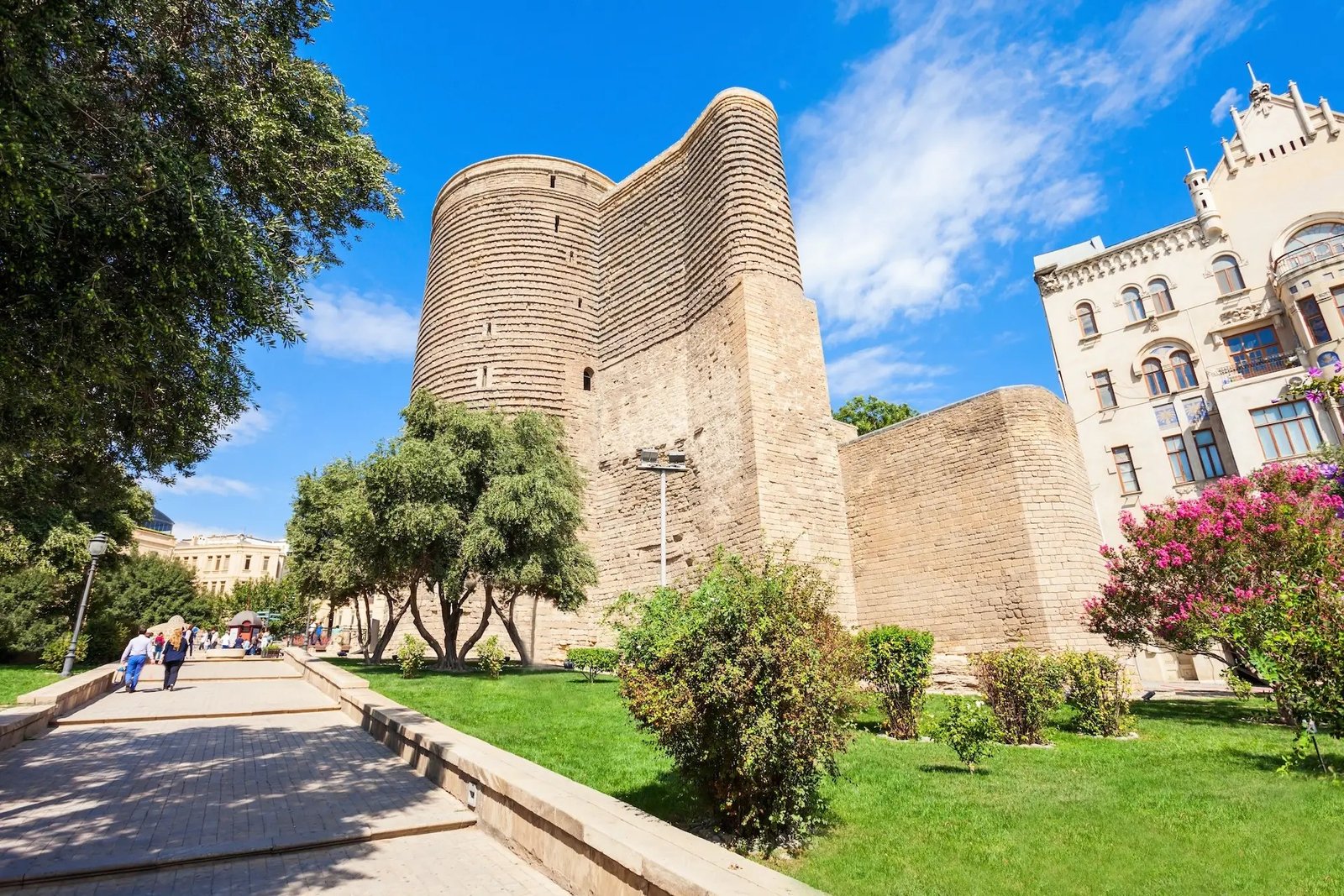
An ancient fortress structure built in the Middle Ages on a rock in the seaside part of the Old City. The Maiden Tower is one of the main symbols of the capital of Azerbaijan. In 2000, the architectural monument was recognized as a UNESCO World Heritage Site.
In particular, the fortress tower, 16 meters in diameter at the base, reaches a height of 28 meters. Its walls at the base are 5 meters thick, narrowing to 4 meters at the top.
Moreover, the tower is part of the fortress wall with semicircular projections. In this unique structure, unlike any other in the East, there is a museum. In addition, the exhibition features artifacts and archaeological finds. Here you can see virtual books with legends about the Maiden Tower and see a model of Baku from past centuries. At the top of the tower, there is an observation deck with a wonderful city panorama.
There are no exact historical records about the construction of the tower. There are many different legends. For example, according to one version, at the walls of the Maiden Tower, pagans executed Bartholomew, a preacher and apostle of Jesus Christ, in the 1st century AD. Bartholomew came to Baku in the 1st century and preached Christianity, but the pagan tribes did not accept this faith and executed the apostle.
In Islamic countries, structures called “Maiden Tower” are often found. The thing is, the word “Maiden” carries the meaning of an unconquered object. That is, the tower, as it were, preserved its virginity. Since 2010, the International Art Festival “Maiden Tower” has been held annually in Baku.
Juma Mosque
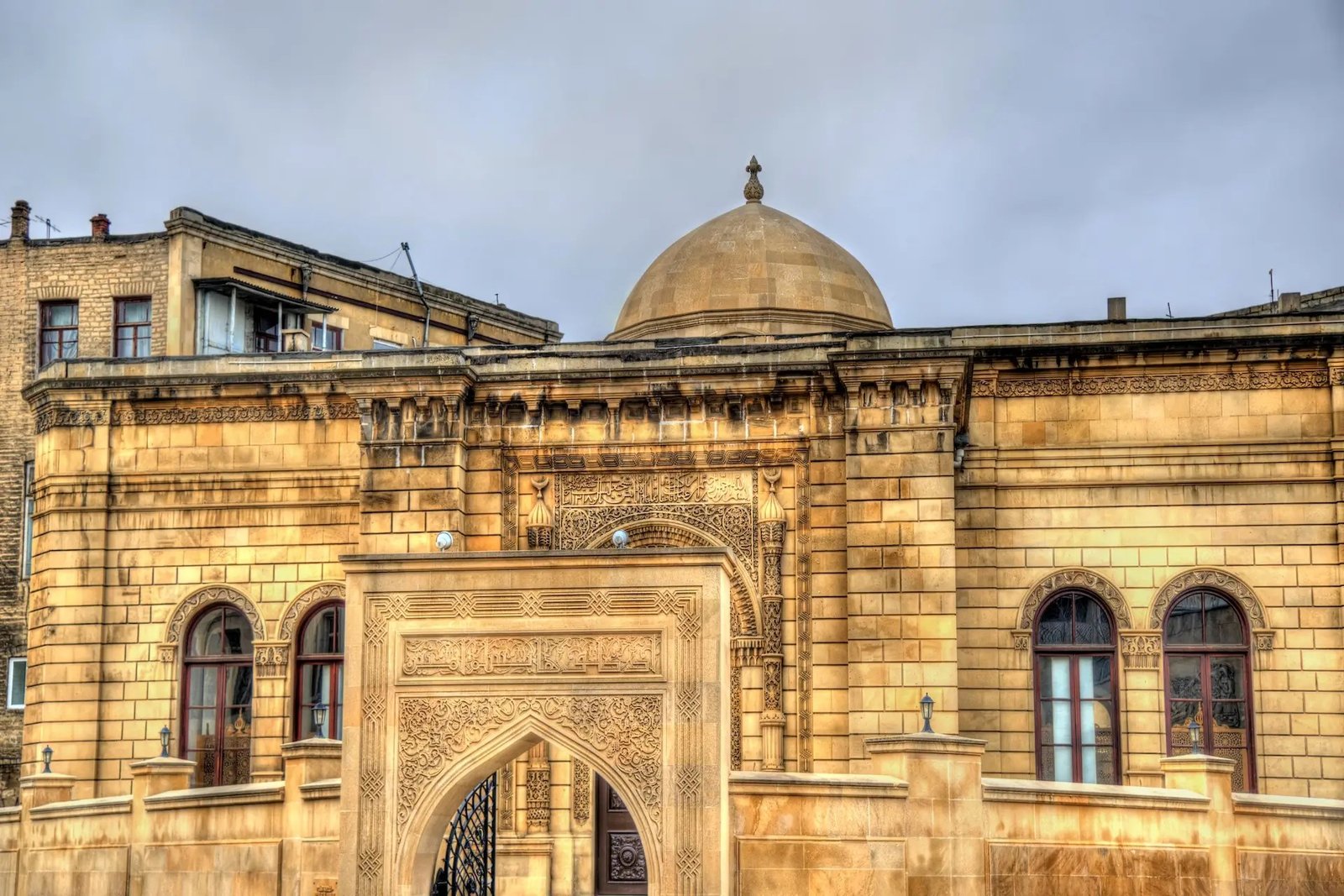
Every Friday at noon, you can see many people in Muslim clothes near the Juma Mosque in the city. These are believers gathering for a public prayer, members of the Baku Shiite community.
At other times, tourists can freely visit this architectural masterpiece to appreciate the exquisite beauty of the ancient mosque. Historians date its construction to the 12th century. Later, in the 15th century, a minaret was added to it.
The place where the Juma Mosque was built was considered sacred ground by pagans who conducted their fire rituals here. After expelling the fire worshipers, Muslims who came here a thousand years ago took over the territory.
A large number of mosques with minarets were constantly under the blows of earthquakes and fires until they were completely destroyed, but the locals patiently rebuilt the shrines. One of the earliest restorations of the Juma Mosque was carried out in 1309 by the architect Emir Sharaf ad-Din Mahmud, as stated on a commemorative stone.
In 1899, the wealthiest local merchant Haji Sheikhali Dadashov acted as a pious patron and paid for the repair work of the entire Juma Mosque. For this, after his death, the patron was buried on the territory of the mosque under a stone tombstone covered with exquisite carvings.
The mosque is a hexagon of irregular shape with beveled corners. Such polygonal bases for temples were adopted in the architecture of medieval Azerbaijan. A patterned high door marks the entrance.
Stone and wooden patterns decorate the facade and colonnade. Inside, the rich decoration is striking in its beauty. Tiles adorn the vaults, and on the pastel-colored walls, you can see verses from the Quran performed in typical Arabic script.
Palace of the Shirvanshahs
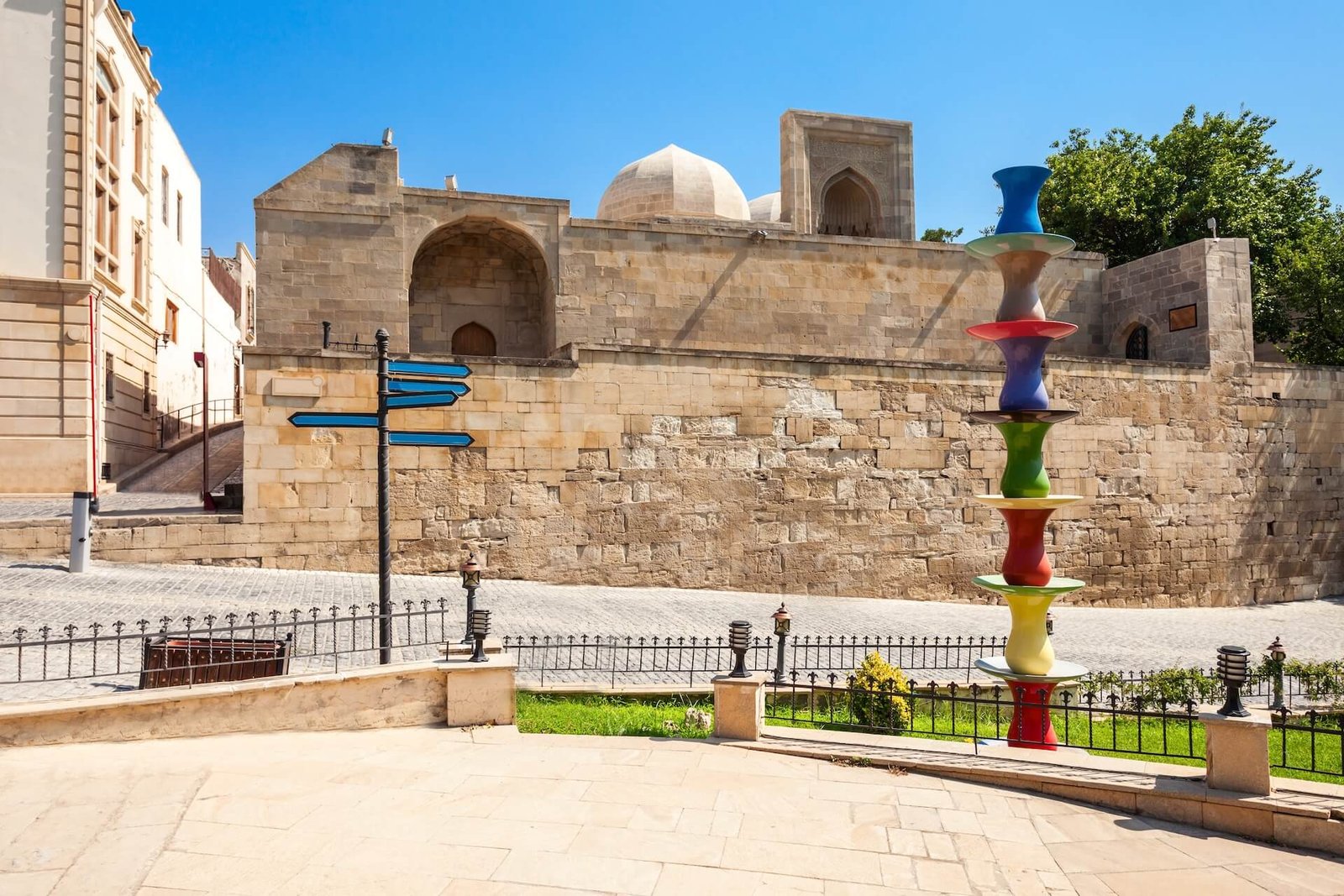
The Palace of the Shirvanshahs, as a world architectural monument, was listed as a UNESCO World Heritage Site in 2000. In ancient times, the castle served as the residence of the rulers of the state – the Shirvanshahs. The history of this dynasty dates back to the 8th century.
Shirvanshah in Persian means lion-shah, so the symbol of the dynasty became the image of a lion. The predator’s image can be seen on the walls of the Old City of Icheri Sheher.
The Shirvanshahs built the palace in the 15th century. Later, the dynasty representatives moved from the city of Shemakha to Baku when the city became the capital of the state of the Shirvanshahs. The palace complex has been a museum-reserve since 1964. Today, the Shirvanshahs’ museum is an architectural monument of Azerbaijan.
However, scientists cannot yet establish the exact date of the construction of the Shirvanshahs’ residence. Therefore, the time of its construction is determined approximately by the neighboring buildings with dates on their walls. These are the mausoleum and the Shah’s mosque, part of the historical complex. Scientists attribute the construction of the Shirvanshahs’ palace to the 15th century.
Later history of the palace
From the 16th century, the palace was captured by the Turks and remained under them until the 18th century when the war with the Russian Empire began. During this time, the palace complex was subject to destruction, especially its eastern and southern sides. As a result, it was in this state that the Russian troops found the buildings.
During the Russian Empire times, some construction work was carried out in the palace, partially destroying the architectural monument. For some time, the palace complex served as an arsenal. Weapons were stored in its premises.
With the advent of Soviet power, the Shirvanshahs’ palace gradually began to be restored. In the 1930s, the National Museum of Azerbaijan and the Museum of the History of Religion were established in the palace. In 1964, the Shirvanshahs’ palace was granted the status of a museum-reserve called the “Shirvanshahs Palace Complex.”
Cafe “Damn It”
Who doesn’t know and hasn’t seen the legendary comedy “The Diamond Arm”? Despite the fact that 50 years have passed since the film’s shooting, the memory of this event is carefully preserved by the townspeople.
For example, the famous episode where the film’s hero Semyon Semyonovich Gorbunkov, slipping on a watermelon rind, falls to the pavement with a cry: “Damn it!” was filmed in one of the streets in the old city of Icheri Sheher. The smugglers’ den, where the accountant’s arm was cast with diamonds, was arranged in house No. 8 on Kichik Gala Street (Little Fortress). It is easy to find as it stretches along the fortress wall.
Today, many tourists visit here, either independently or as part of tour groups. The sign of the pharmacy “Chikanuk” still hangs there. Tourists happily “fall” at the same spot as in the film with the same cry: “Damn it!” to take a photo.
Nearby, workers of the cafe “The Diamond Arm” tell that people fall under the windows around the clock, and foreigners, wondering, worriedly ask: “What is going on here?” When they find out what it is about, they laugh. By the way, on the same street in 1961, an episode of the film “Amphibian Man” was filmed – the chase scene for Ichthyander.
National Museum of Art
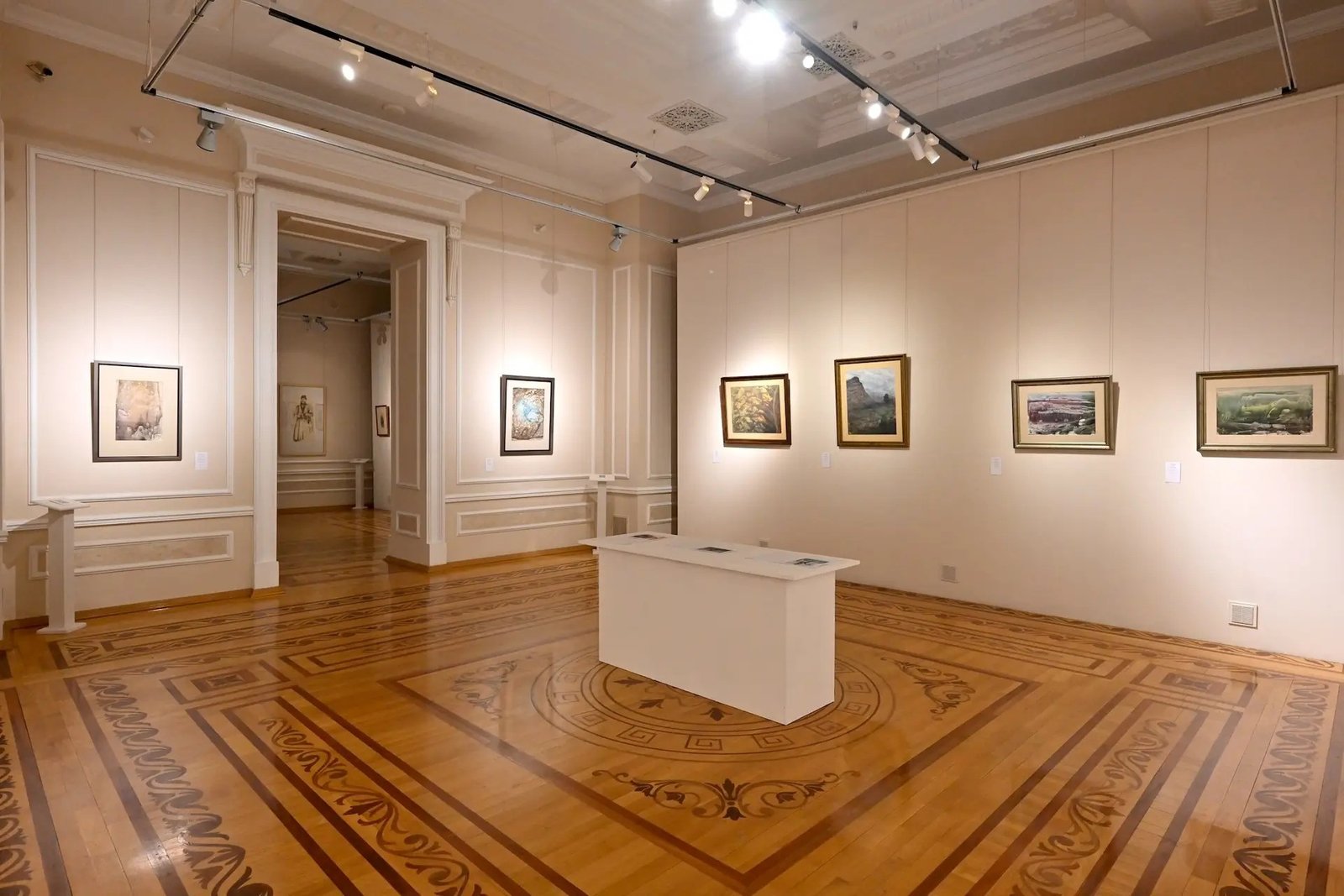
In total, the museum’s collection includes about 17 thousand exhibits. The history of the museum, named after the artist Rustam Mustafayev, began in 1936. Initially, it was two or three halls in a small house.
Today, the complex occupies two elegant buildings, the so-called houses of Debur, built at the end of the 19th century. Here, visitors can get acquainted with national and foreign works of art.
The museum displays European and Azerbaijani works across many galleries. Visitors can also see paintings by Russian artists. In addition, there are separate exhibitions with works by masters from Iran, Turkey, and Japan.
Meanwhile, the new building is entirely dedicated to national art items – these are paintings, metal, and ceramic crafts. Folk art is represented by national clothing, jewelry, and dishes. Here you can admire the beautiful carpets from different regions of the country.
For instance, one of the halls is entirely occupied by landscapes by the famous Azerbaijani artist Sattar Bahlulzade. From Russian art, there are paintings by such famous artists as Rokotov, Borovitsky, Bryullov, Venetsianov, Polenov, Shishkin, and Levitan.
Little Venice
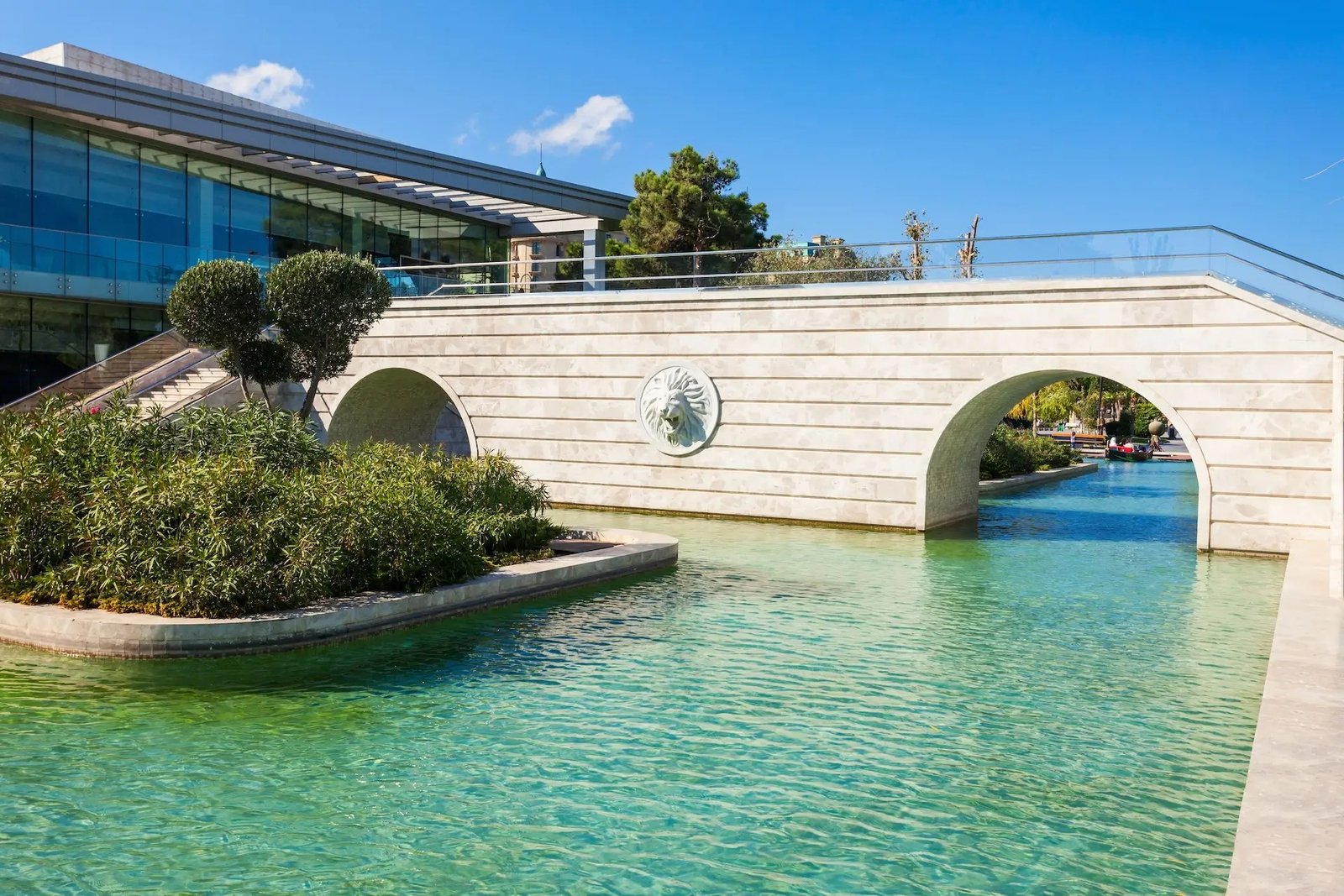
In the 1950s, the chairman of the Baku City Executive Committee Alish Lemberansky, returning from a trip to Italy, namely Venice, was impressed by the city on the water. Soon, he decided to create “Little Venice.” The seaside boulevard was chosen as the place for this. Several years were spent working on the project. And so, in 1960, a new attraction appeared in the city – Little Venice.
At the time, the water wonder in the capital of Azerbaijan represented an entertainment network of water canals and islands. On the banks of the canals with emerald-colored water, cafes and restaurants were built, and squares and flower beds were arranged. On the islands connected by Venetian bridges, there were fountains and bridges, as well as piers for gondolas, on which they began to ride locals and guests. After the collapse of the USSR, the water complex was in disrepair for a long time.
On May 28, 2012, after a general reconstruction, the grand opening of “Little Venice” took place. It again began to receive visitors. The canals, with a total length of about one and a half kilometers and a depth of 1.3 meters, were cleaned and refilled with water with a volume of 7,000 cubic meters.
Furthermore, during the reconstruction, the overall structure of the complex was preserved, new gondolas were brought in. Additional bridges were also built, and two new restaurants, “Sharg” and “Italy,” appeared.
Azerbaijan National Carpet Museum
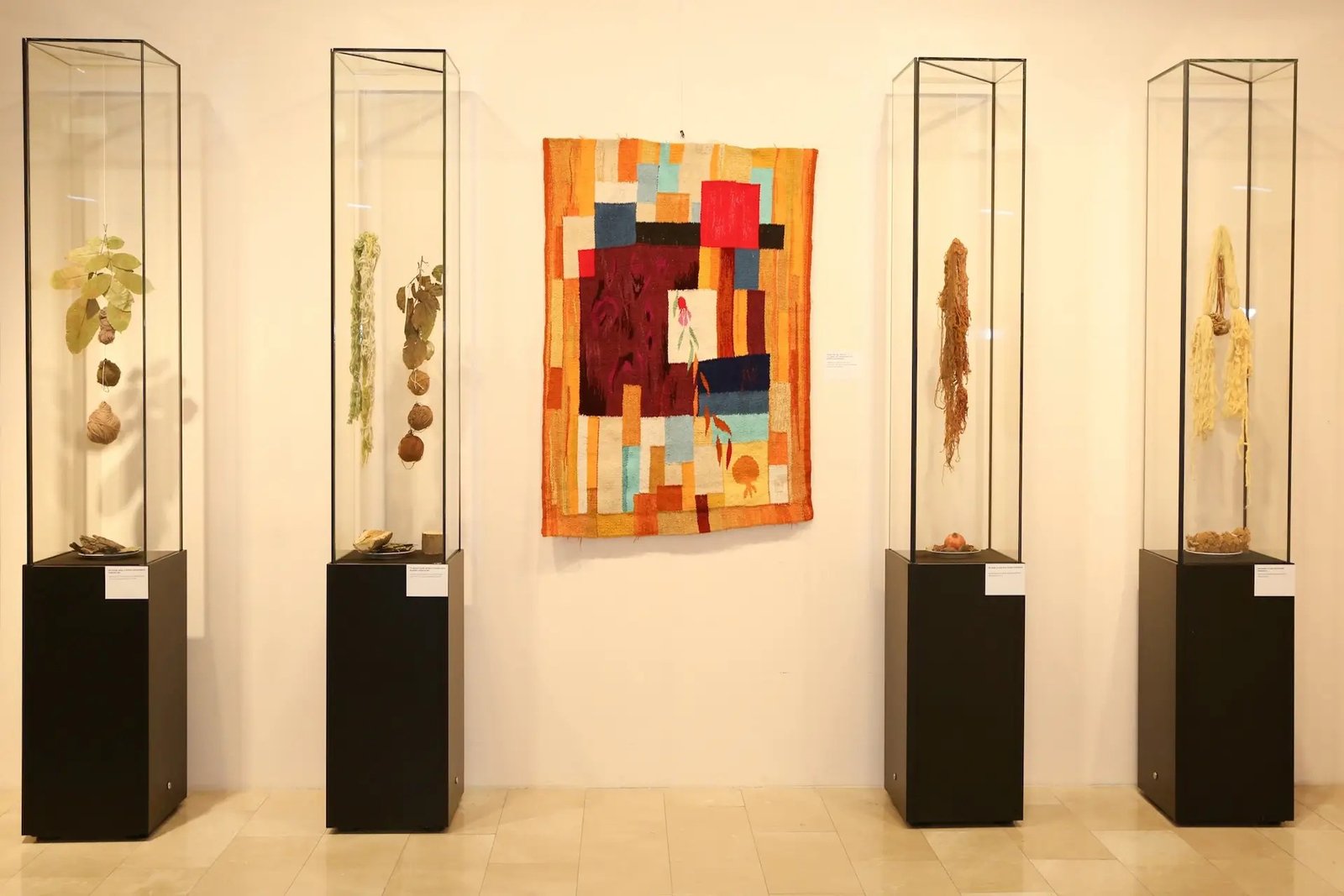
In fact, it is the first of its kind in the world. In fact, it was established in 1967 and officially opened to visitors in 1972. Carpet weaving is an ancient Azerbaijani form of traditional folk art, the history of which goes back centuries, as evidenced by many artifacts found during archaeological excavations.
The exhibition features carpets from many regions of the country. Besides carpet items, the museum presents visitors with a rich historical collection of folk art items. These include ceramics, bronze from the Bronze Age, 12th-century faience, 19th-century national clothing, and metal, wood, and glass jewelry.
The collection also includes historical crafts. Admission for international visitors is 10 AZN; the museum is closed on Mondays. Check official hours and tickets.
Gulistan Palace
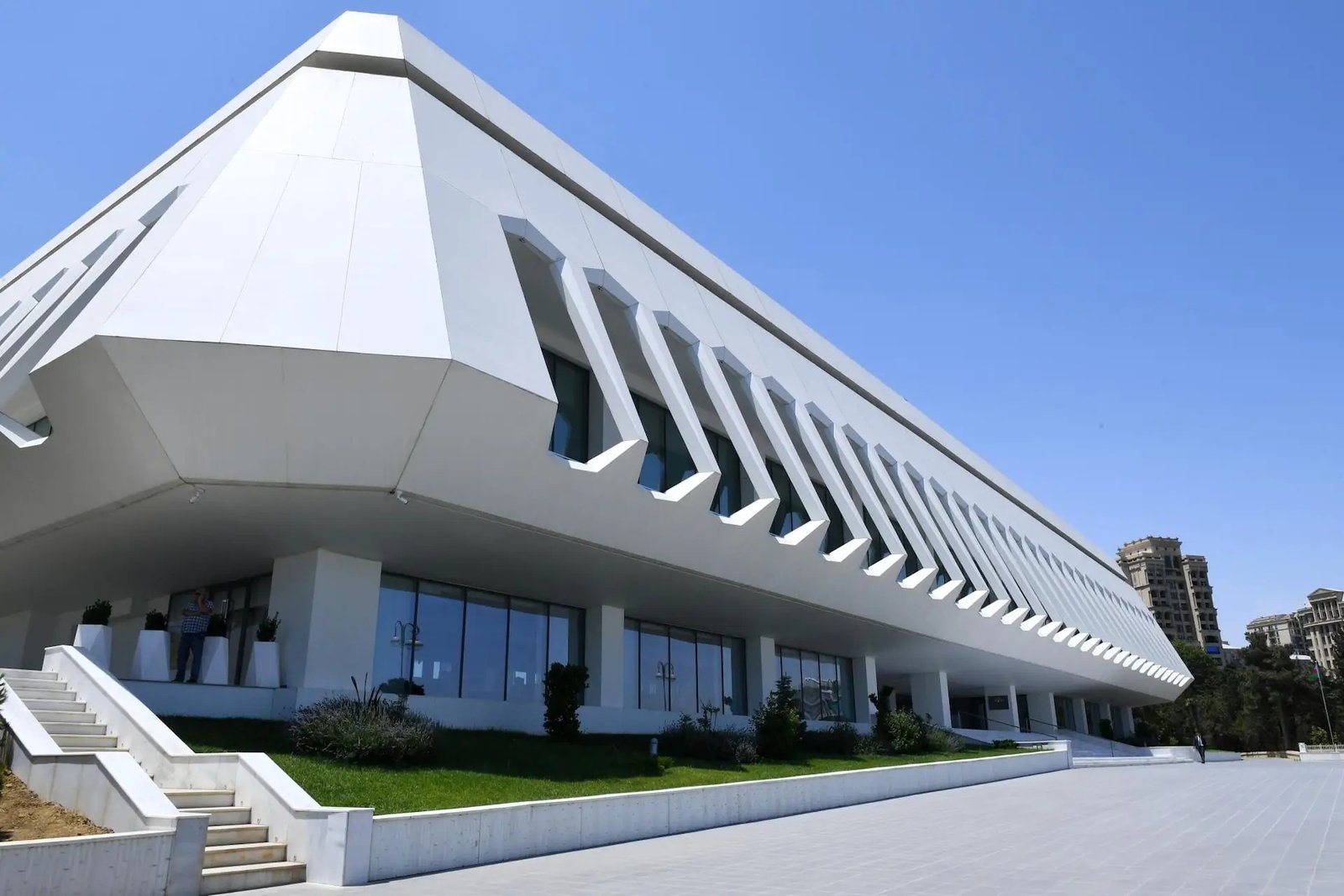
Built in the early 80s by the decision of the Council of Ministers of the republic. The building was intended for holding solemn events of both republican and international significance.
One of the significant events in the republic was an event held within the palace walls, dedicated to the signing of contracts by the republic’s leadership with international oil companies called the “Contract of the Century” on September 20, 1994.
The site for construction was chosen in the mountainous area of the capital of Azerbaijan. From here, a grand panorama of Baku with a bay opens up. Officially, the Gulistan Palace is classified as a monument of national heritage and cultural values of Azerbaijan. The republic’s press celebrated its anniversary here in 2010; the international humanitarian forum took place in 2011, and the anniversary of Azerbaijan’s declaration of independence was also celebrated here, among other things.
In particular, the open terrace arches and upper veranda give the palace its distinctive look. Although the palace underwent several renovations, it retains its original appearance.
The complex is an events venue. Visitors can admire the architecture from public areas; interior access depends on events and permissions.
Baku Funicular
The idea of setting up a funicular arose at the beginning of the 20th century, but it was only realized in the 60s. A rail was laid from the embankment to the Highland Park. A pair of carriages made in Kharkov lifted and lowered passengers.
Four decades later, the city rebuilt the funicular. New rails were laid, and new lifting equipment was installed. Passengers were transported by quiet Austrian carriages with panoramic windows. The opening of the new funicular coincided with the start of the Eurovision Song Contest in 2012 in Baku.
Finding the Bahram Gur lower station is easy. It is located on the embankment next to the huge building of the Carpet Museum. Check operating times and service availability before visiting.
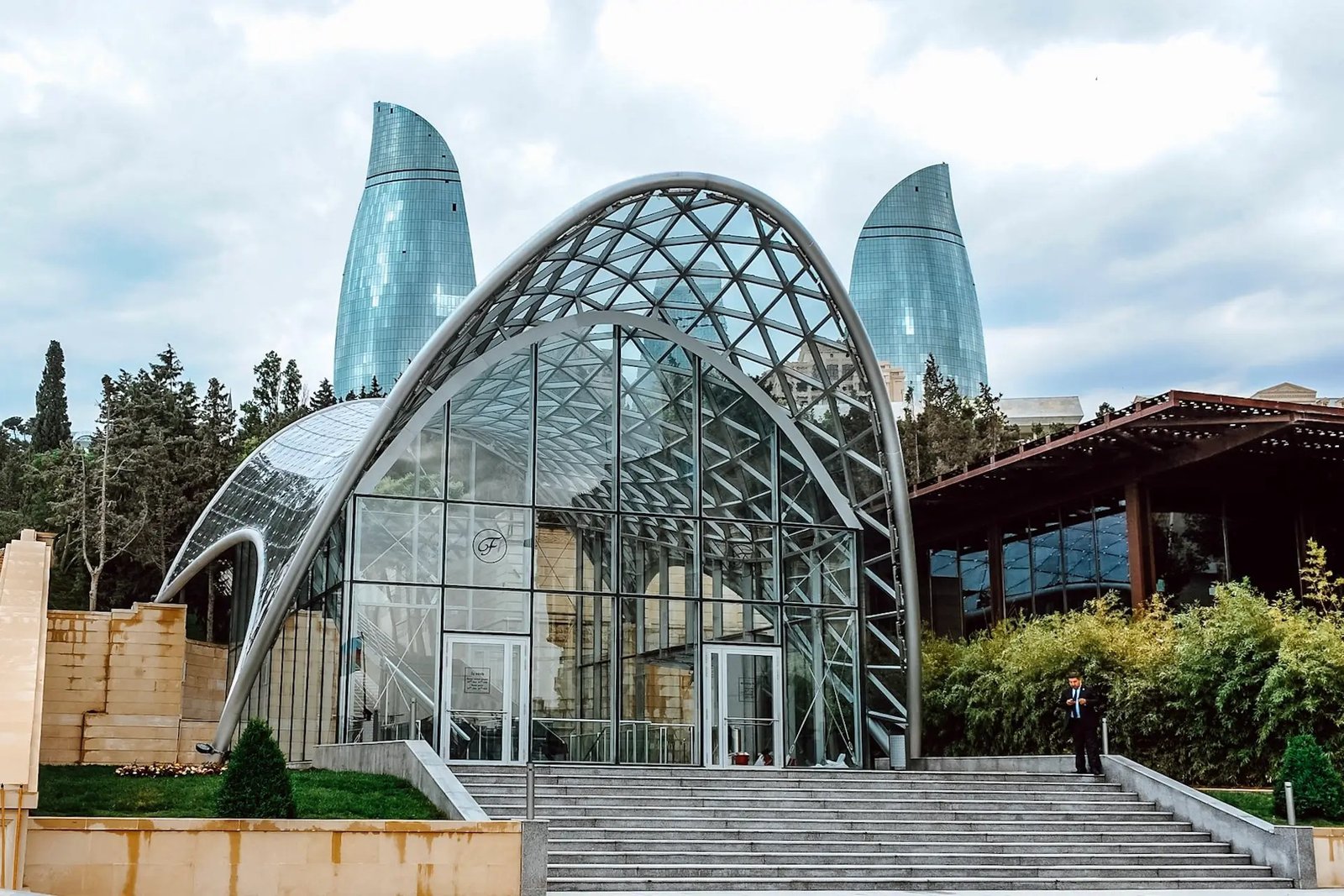
Finally, at the end of the 455-meter route, the carriage enters the upper station with a glass facade directly to the famous Flame Towers with a small mosque. Next, from the station, you can move to the observation deck of the Highland Park, offering a beautiful city panorama.
In addition, the funicular is not only entertainment for tourists but also the most convenient transport for residents of the highland part of the city, who can quickly get from the center to their homes and vice versa.
Flame Towers
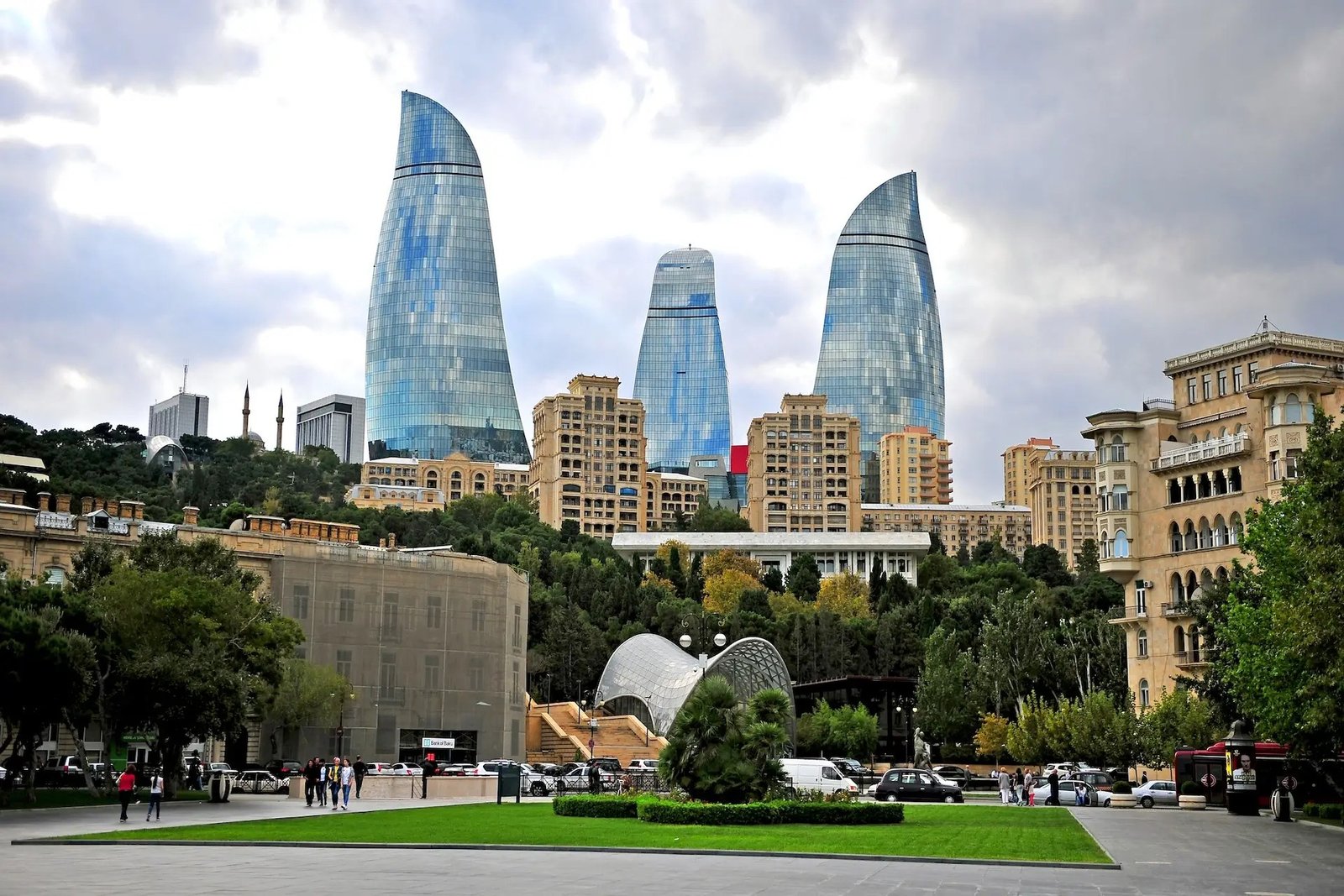
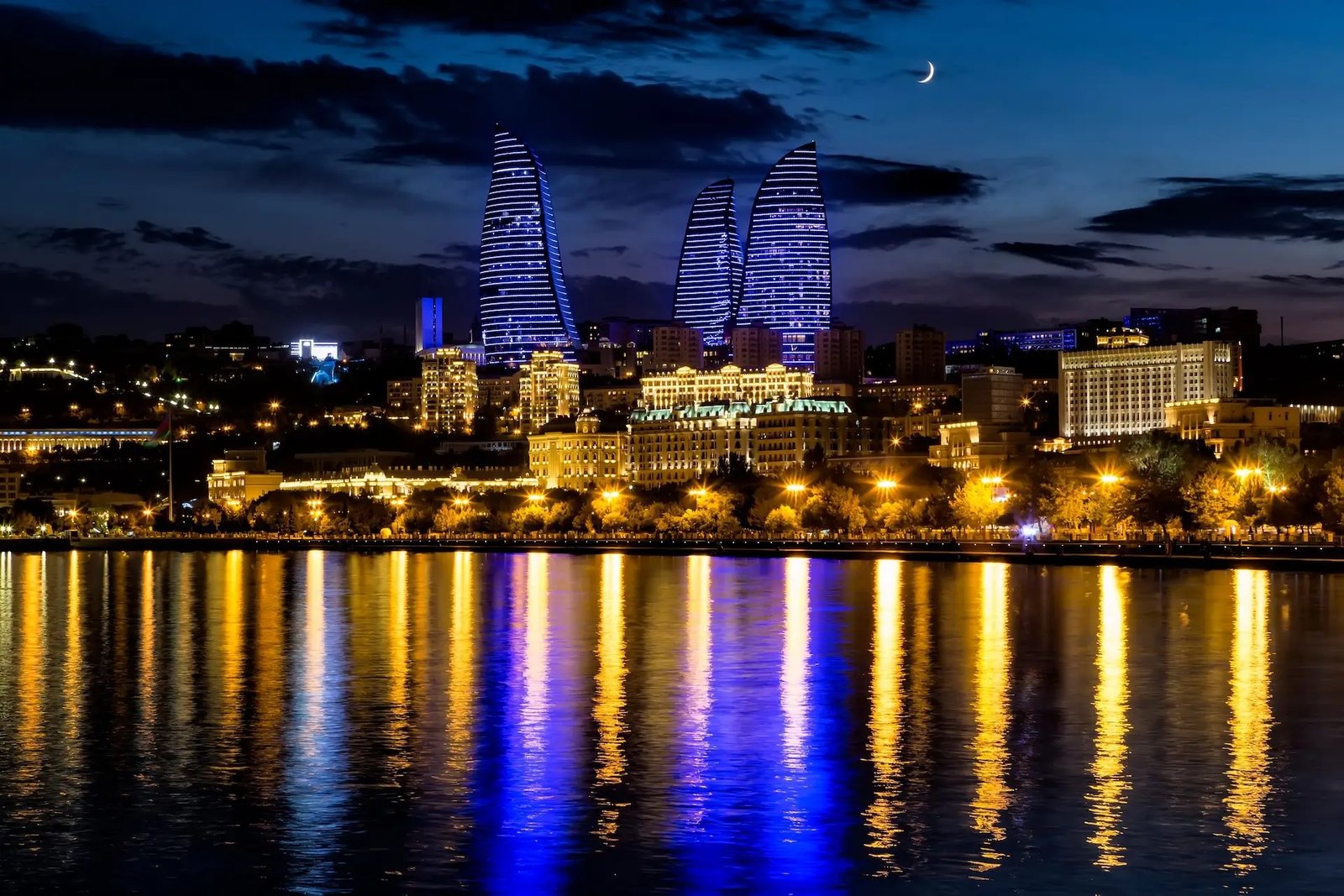
Flame Towers is a multi-purpose complex consisting of three skyscrapers in the shape of three tongues of flame. The high-rises are the largest structures in the republic. The tallest tower reaches roughly 190 metres. They were built on a hilltop overlooking the Caspian Sea with a view of Baku Bay and the Old City of Icheri Sheher.
HOK designed the complex. DIA Holding built the towers from 2007 to 2012. All three towers differ from each other. While one consists of 39 floors and is 190 meters high, the second tower has 36 floors, and the third only 28 floors.
In total, the useful area of the three towers is 227 thousand square meters. The external enclosing structures are screens made using LED technology. The screens display the movement of flames.
One of the towers houses the Fairmont Baku hotel. In 2013, the high-rise complex took 6th place in the prestigious Emporis Skyscraper Award 2013, allowing the towers to enter the TOP 10 best high-rise buildings in the world.
Furthermore, besides the luxurious hotel, the towers house office spaces and residential apartments. However, despite their similarity, all three buildings have different heights – one is 20-30 meters taller than the previous one. Their heights are 140, 160, and 190 meters.
Highland Park
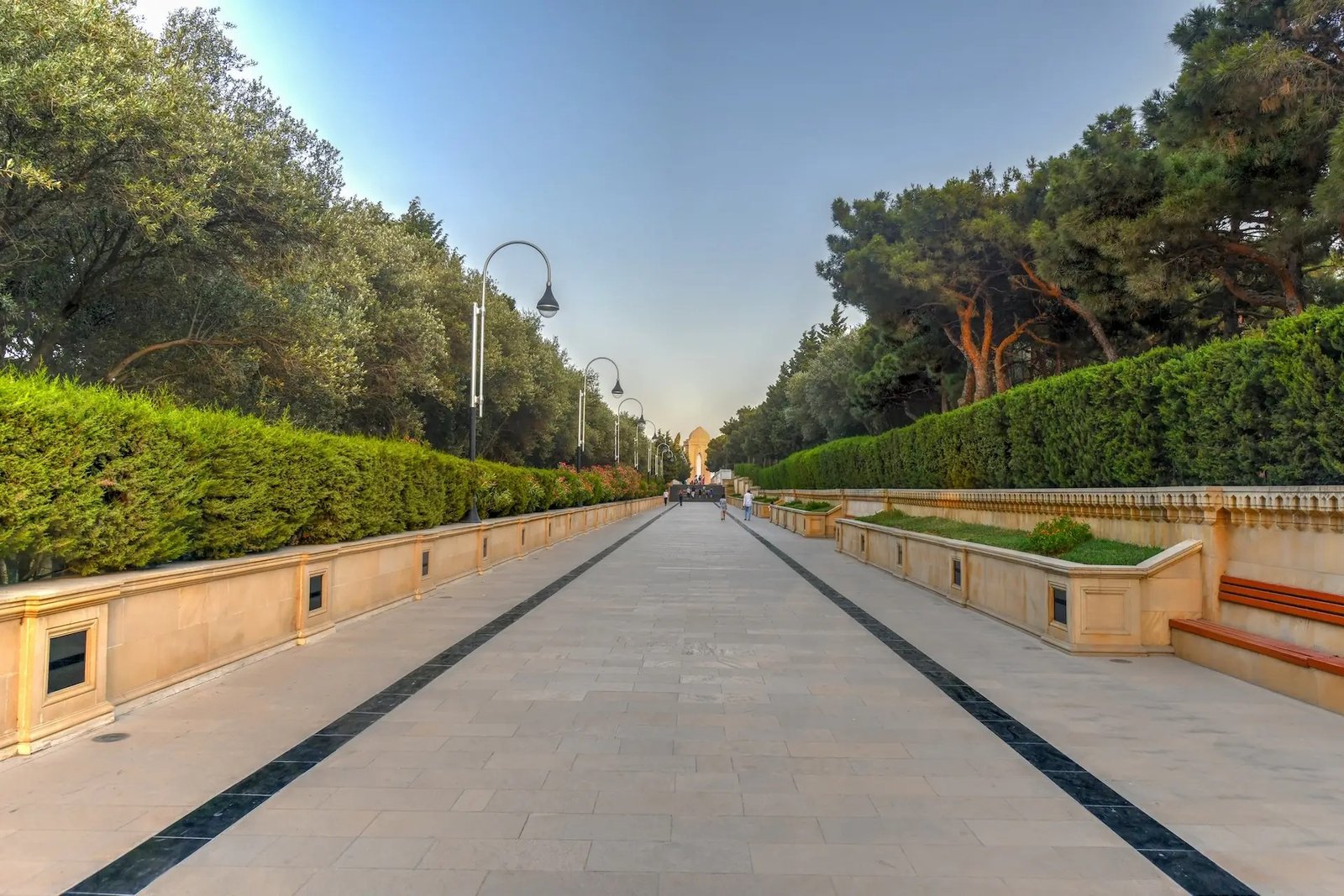
In particular, this is a park area, a memorial complex, and observation decks, and then a local landmark – the “Shehidlar” mosque. Highland Park is located in the central part. It is called Highland because it is entirely on a height.
For example, from here, the observation decks offer a magnificent panorama of the city’s iconic places – the Seaside Boulevard, Baku Bay, the Palace of the Shirvanshahs, the historical center of Icheri Sheher, and the Maiden Tower. Highland Park is one of the most famous and interesting attractions.
In fact, the park overlooks Baku Bay. The recreation area for residents has been preserved in its original form, with spacious stairs, shady alleys, and cozy terraces.
All this was created by the famous architect Lev Ilyin. Initially, it was the English Park. During the Civil War, English soldiers who were in Baku after the collapse of the Russian Empire were buried here. Today, a small monument recalls this history.
History of Highland Park
In 1935, construction began on Ilyin’s new park. In the same year, a monument to Sergey Kirov, the first secretary of the Central Committee of the Communist Party of Azerbaijan, was installed here. For several decades, the park was named after Kirov. After the park’s construction, a theater, attractions, and restaurants opened in it.
After the collapse of the USSR, the monument to Sergey Kirov was dismantled, and the park began to be called Highland. The park’s attractions include the Green Theater, the Gulistan Palace, and a huge boulder, which, for some reason, was left by the builders. Local folklore surrounds this unusual stone.
In the early 90s, all entertainment facilities were removed from the park, dance floors and attractions were closed. This was related to the mass burial of people who died on January 20, 1990, during “Black January.” The Alley of Martyrs was opened in the park, essentially a cemetery for those who died in the Karabakh War.
Alley of Martyrs
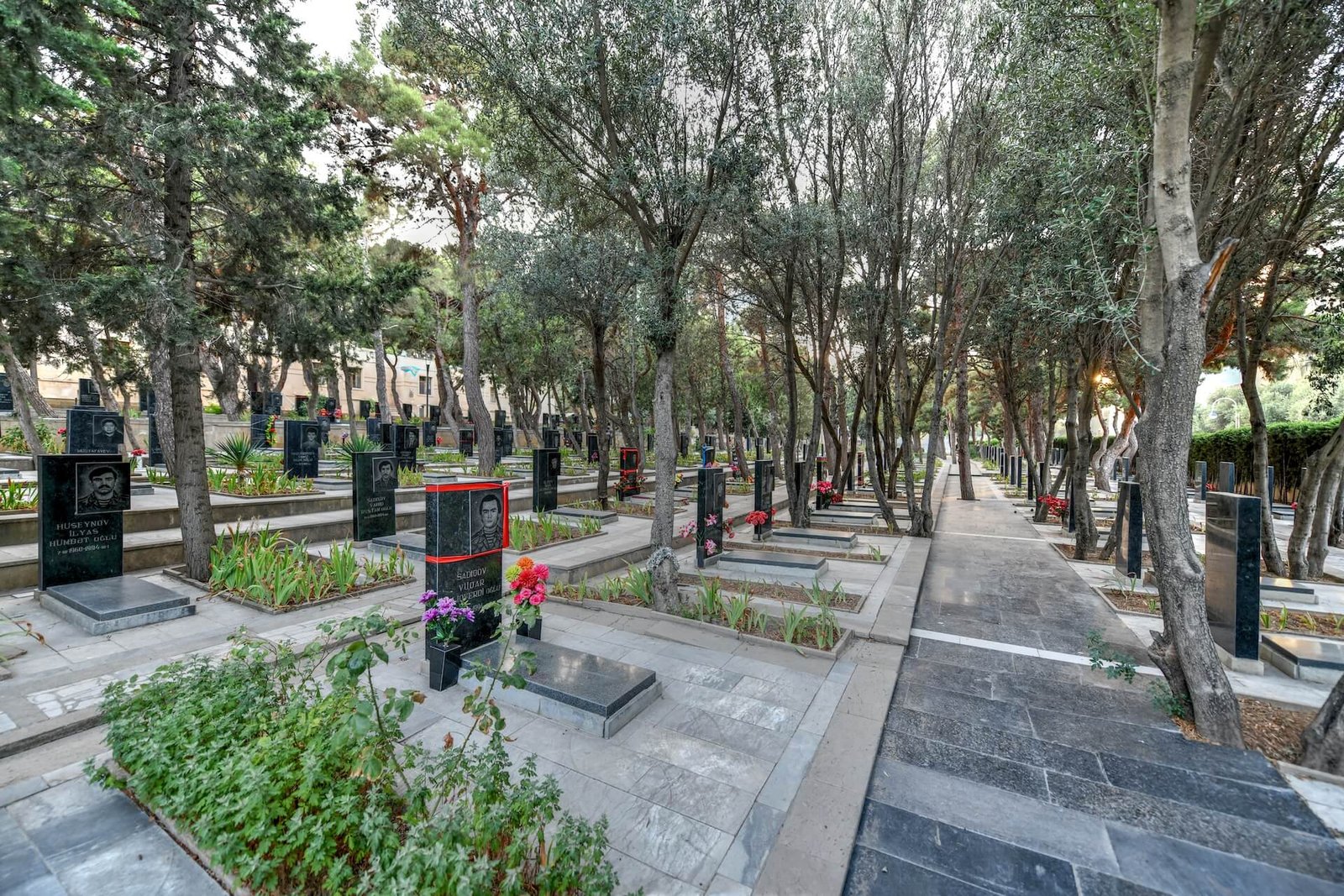
This is both a memorial and a cemetery. It is located on a hill next to the National Parliament. On the Alley of Fallen Heroes are the graves of those who died on January 20, 1990. At that time, Soviet Army units were brought into the capital of Azerbaijan to prevent conflicts between Armenians and Azerbaijanis.
The memorial commemorates people killed during Black January in 1990 and subsequent conflicts. It is a solemn place of remembrance.
Baku TV Tower
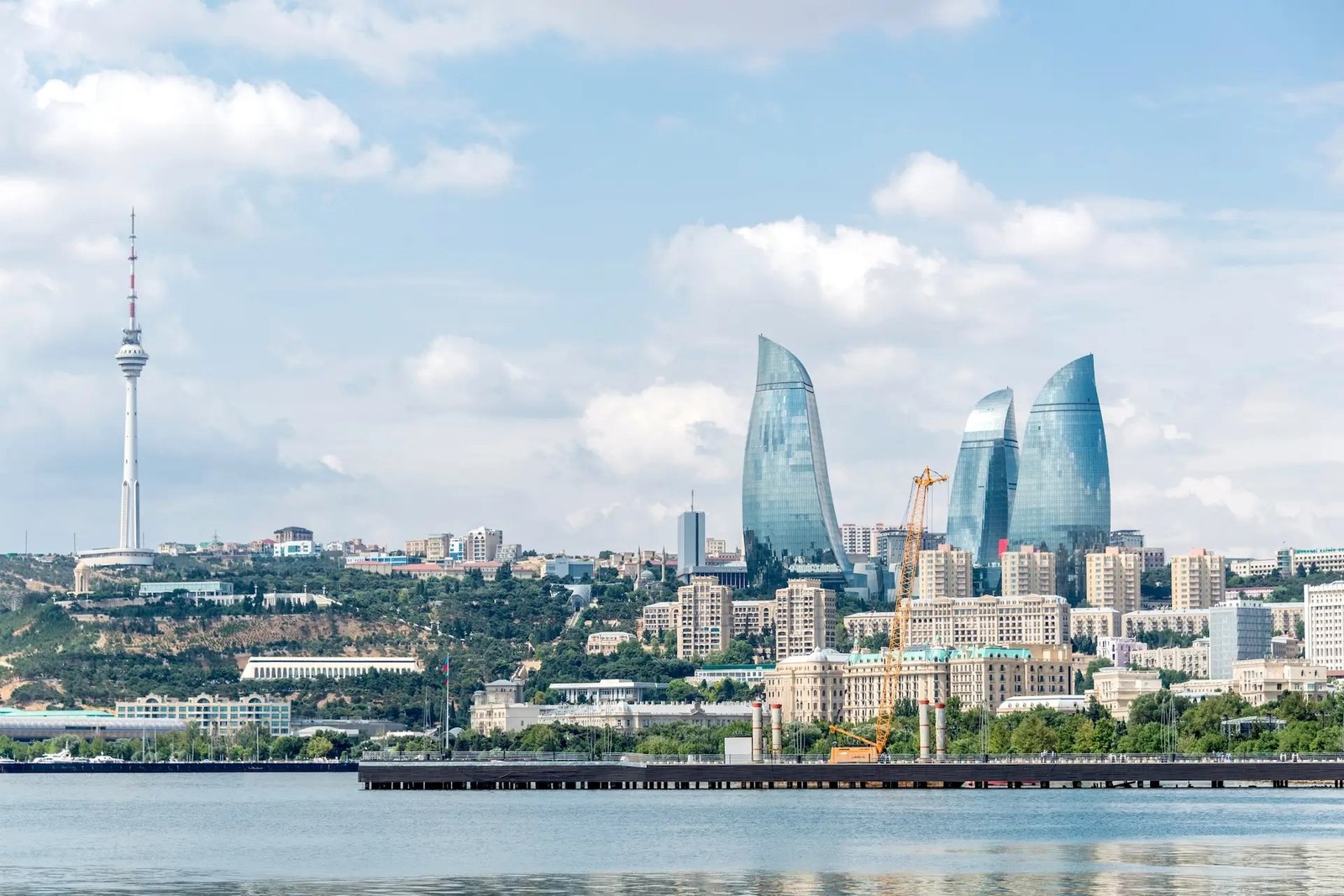
This is one of the main attractions of the city. Its height reaches 310 meters, making it the 34th tallest TV tower in the world. The decision to build the high-rise TV transmitter was made by a decree of the Council of Ministers of the USSR at the request of the Ministry of Communications of Azerbaijan.
Historically, construction of the TV tower began in 1979. It was planned to finish the construction in 1985. Due to the events related to the collapse of the USSR, construction was halted. Later, work resumed in 1993. Finally, the Baku TV Tower opened in 1996.
Over time, poor assembly led to the loss of load-bearing capacity of some tower structures. In 2008, a general reconstruction of the high-rise structure was carried out, and a revolving restaurant was built on the 27th floor (175 meters).
Visitors can enjoy delicious meals while admiring the panoramic view of the city. Most people try to get into the restaurant at the end of the day to catch the sunset. To do this, you need to book a table in advance and make a payment online.
To get to the restaurant, you need to go through the underground passage to the elevator. The elevator cannot be used independently. Visitors are met by a waiter who invites them to go upstairs.
Ferris Wheel
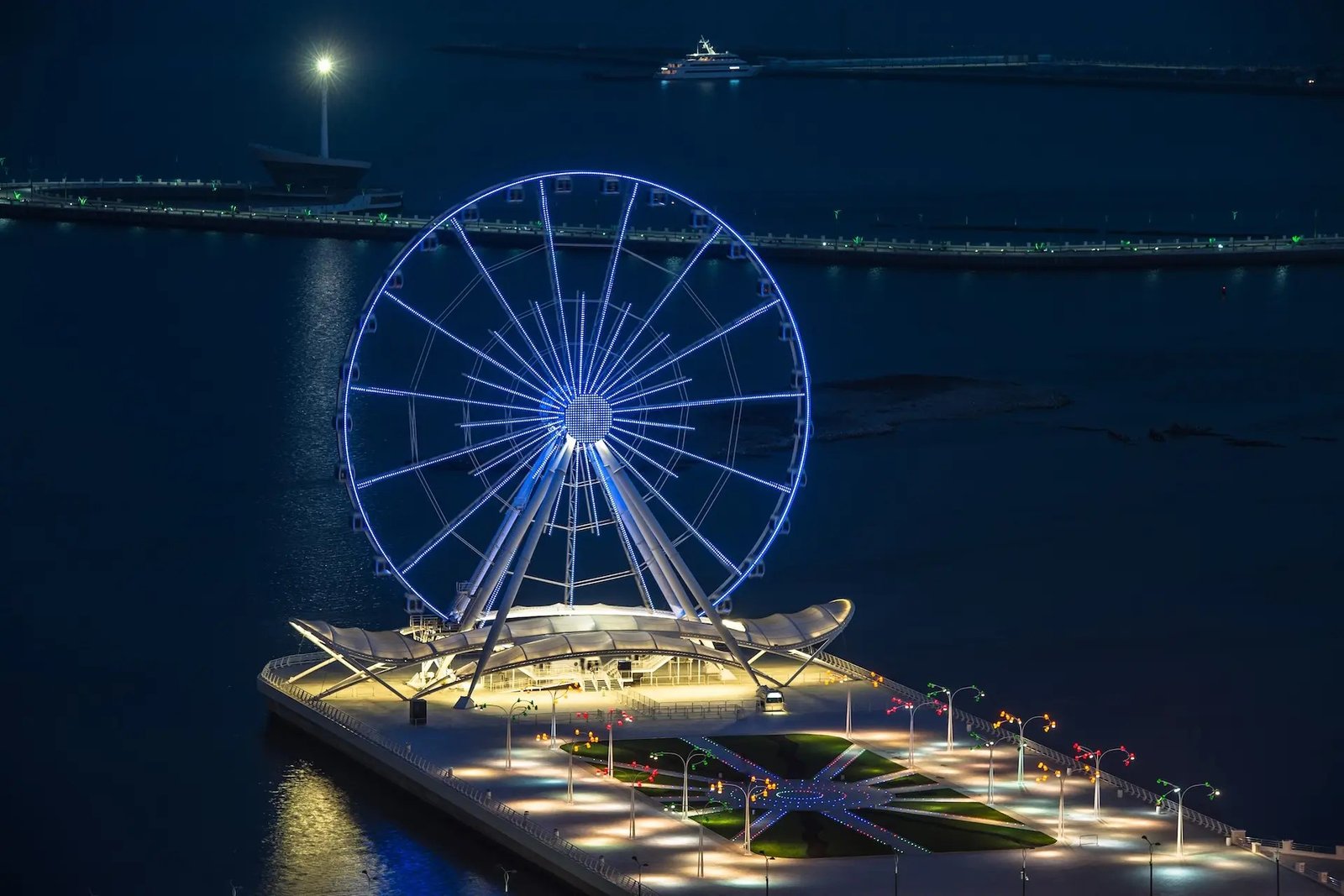
The attraction is located in the Seaside Park next to the State Flag Square. It stands 60 metres high. The assembly and installation of the Ferris wheel began in 2013. A Dutch company carried out the construction.
Eventually, the wheel opened with a significant delay in the spring of 2014. As explained by the authorities, the delay occurred due to the need for additional testing of the supporting structures of the overview structure. Moreover, the opening ceremony of the Ferris wheel was attended by the country’s president, Ilham Aliyev, along with his wife.
Typically, one rotation of the wheel can last from 10 minutes to half an hour. The operator can change the rotation speed at the visitors’ request. In total, thirty cabins are spaced along the circle’s rim. Each cabin can accommodate eight people simultaneously.
Check current ticket prices and operating hours before visiting. The cabins with panoramic windows are equipped with air conditioners and multimedia screens, showing a video about the construction of the attraction.
People strive to ride the attraction more in the evening when the city panorama, illuminated by evening lights, opens from above. Passengers should not worry when the wheel stops for a couple of minutes. This happens because people board and disembark in five cabins simultaneously.
State Flag Square
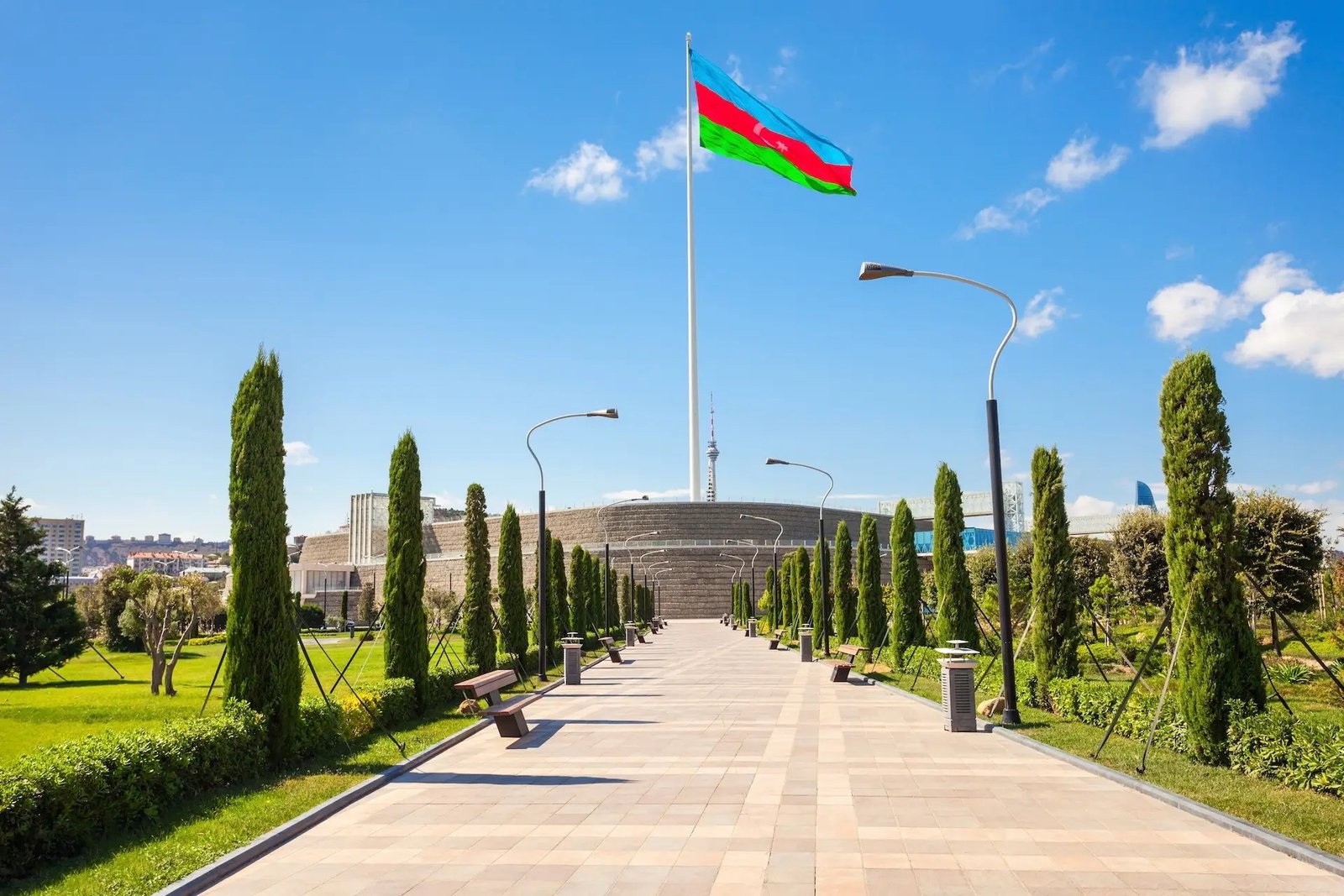
It was built over three years, from 2007 to 2010. In total, the grand square covers 60 hectares of land. Its construction was carried out by the construction company Azenko, according to the project of the architectural bureau Trident Support.
A large national flag stands at the centre of the square. The waterfront setting makes this a striking city landmark.
In addition, the square features symbols of Azerbaijan in its decorative elements.
Moreover, the State Flag Museum opened alongside the square in November 2010. Inside, visitors can see historical documents and flags of Azerbaijan, coats of arms, postage stamps, military awards, coins, and paper money related to different periods of the development of Azerbaijani statehood.
Crystal Hall
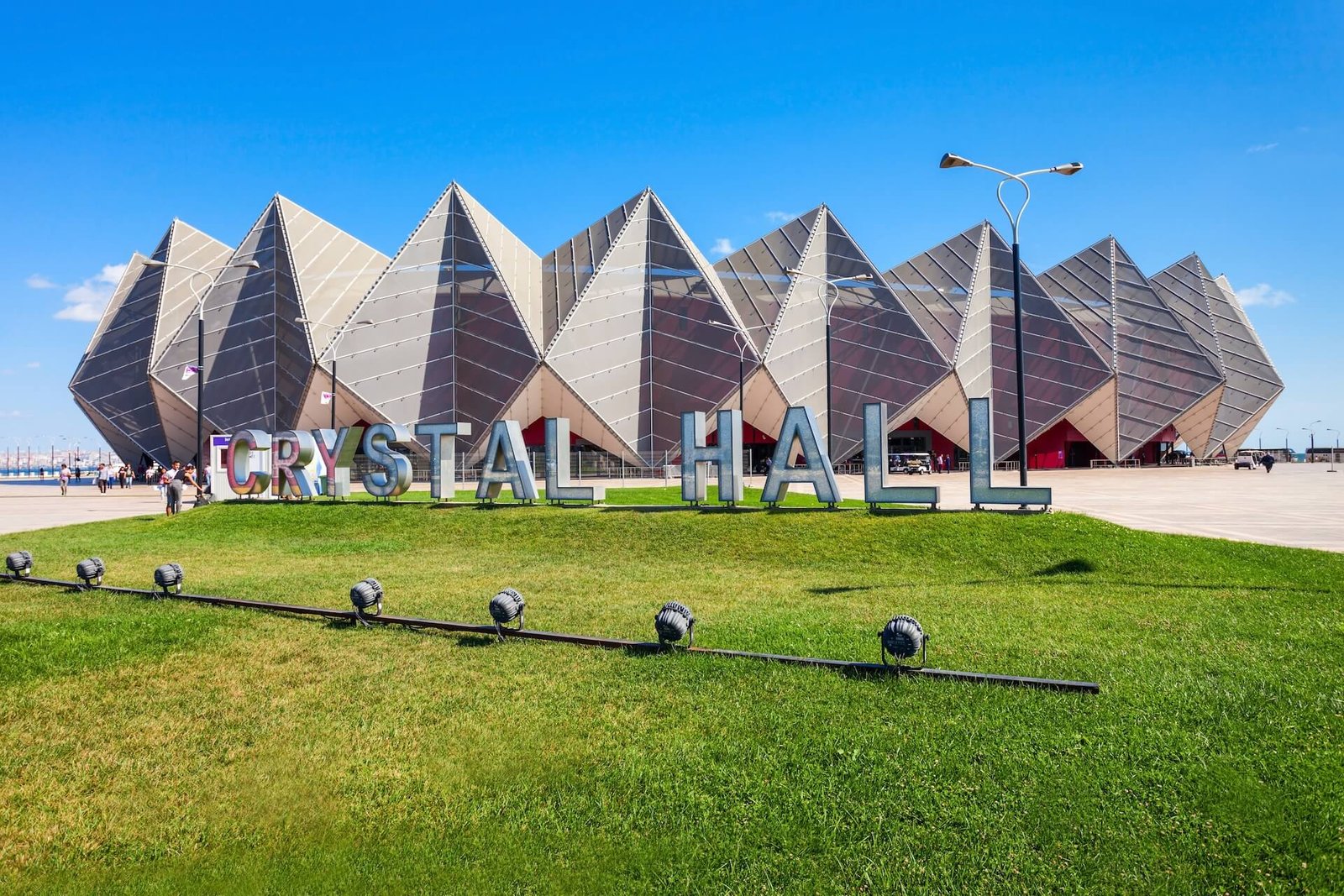
It is a concert complex built for the international song contest “Eurovision – 2012” in the capital of Azerbaijan. The grand opening of the Crystal Hall took place in January 2012. It was marked by the transfer of the contest symbol – the key to the city of Baku. The contest was held from May 22 to 26. During the event, the main hall accommodated 25 thousand guests of the contest.
Moreover, the Crystal Hall was built by the German company Alpine Deutschland AG in cooperation with other international construction firms. The concert complex has a sufficient number of entrances and exits, ensuring high-level safety for people in the hall.
In case of fire or other emergencies, spectators can leave the building within 10 minutes. Besides spectators, about 15 thousand people watched the contest on large screens installed outside.
In addition, numerous lighting devices are installed inside and outside the Crystal Hall, bringing various shows and effects to life. Numerous light displays on the complex’s facade display tens of thousands of colors and shades, creating the most phantasmagoric images at night.
During the Eurovision contest, each performer’s exit was accompanied by the facade lighting in colors corresponding to the flag of the country they represented. These light effects were visible even in the most remote areas. All this was carried out by equipment from a Swiss company.
Bibi-Heybat Mosque
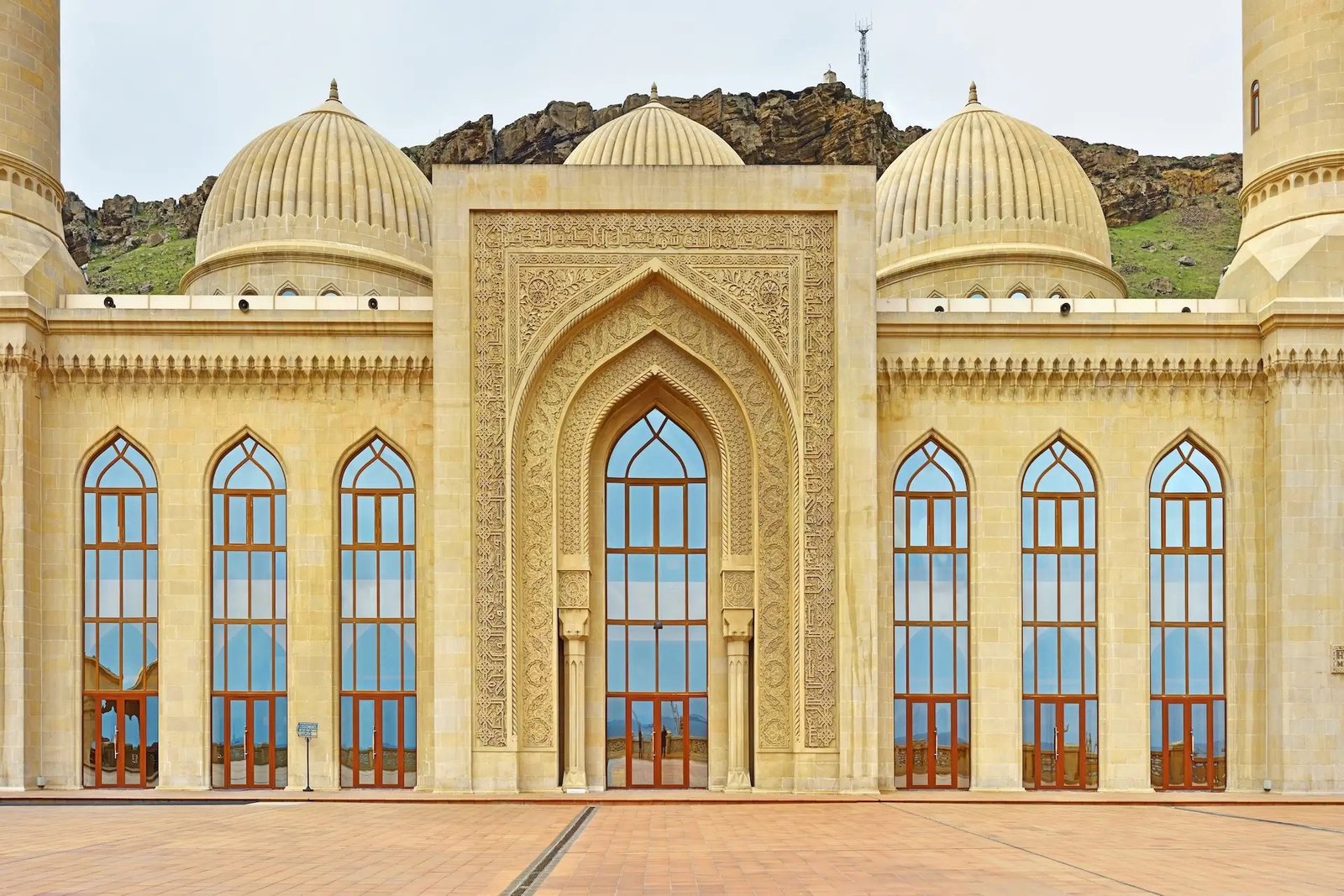
Shikhovo is a small, cozy resort village on the Caspian Sea’s shore, popular among residents due to its proximity to Baku. Here is the Shiite mosque Bibi-Heybat. It was built in 1999 on the site of the old mosque of the 13th century, erected by Shirvanshah Abu-L-Fath Farrukhzad. It was built over the mausoleum with the tomb of Ukeyma Khanum, the daughter of the Shiite Imam.
She belonged to the lineage of Imam Ali and Fatima and was considered a descendant of the prophet Muhammad. This is stated in the inscription carved on the stone tomb. The servant named Heybat is also buried in the mausoleum. Hence the name of the mosque Bibi-Heybat, meaning Aunt Heybat.
Historically, the mosque has been rebuilt many times. During the Soviet power’s struggle against religion in 1936, the temple was completely demolished because the mosque enjoyed great popularity among the local population and other Muslim believers from different parts of the country.
After the collapse of the USSR, the president of the republic, Heydar Aliyev, issued a decree in 1994 to build a new mosque Bibi-Heybat on the old site. Historical research and photographs of the temple greatly influenced the new project of the temple.
Architect Sanan Sultanov designed the new mosque and became much larger than the previous prayer hall. At the mosque consecration ceremony in May 1999, the first president of the republic, Heydar Aliyev, gave a speech.
After that, Bibi-Heybat underwent further reconstruction. Later, the next opening ceremony took place on July 14, 2008, with the participation of Heydar Aliyev’s son, President Ilham Aliyev.
Day 2: Museums and modern Baku
The program of sightseeing in Baku, both on the first and second day of stay in the capital, is not mandatory. The list of iconic places is advisory. Not everyone can withstand a tight schedule of tourist site visits. Therefore, it is necessary to develop your route according to your strength and interests. Here is a recommended list of tourist sites that can be visited on the second day of the stay in Baku.
Tezepir Mosque
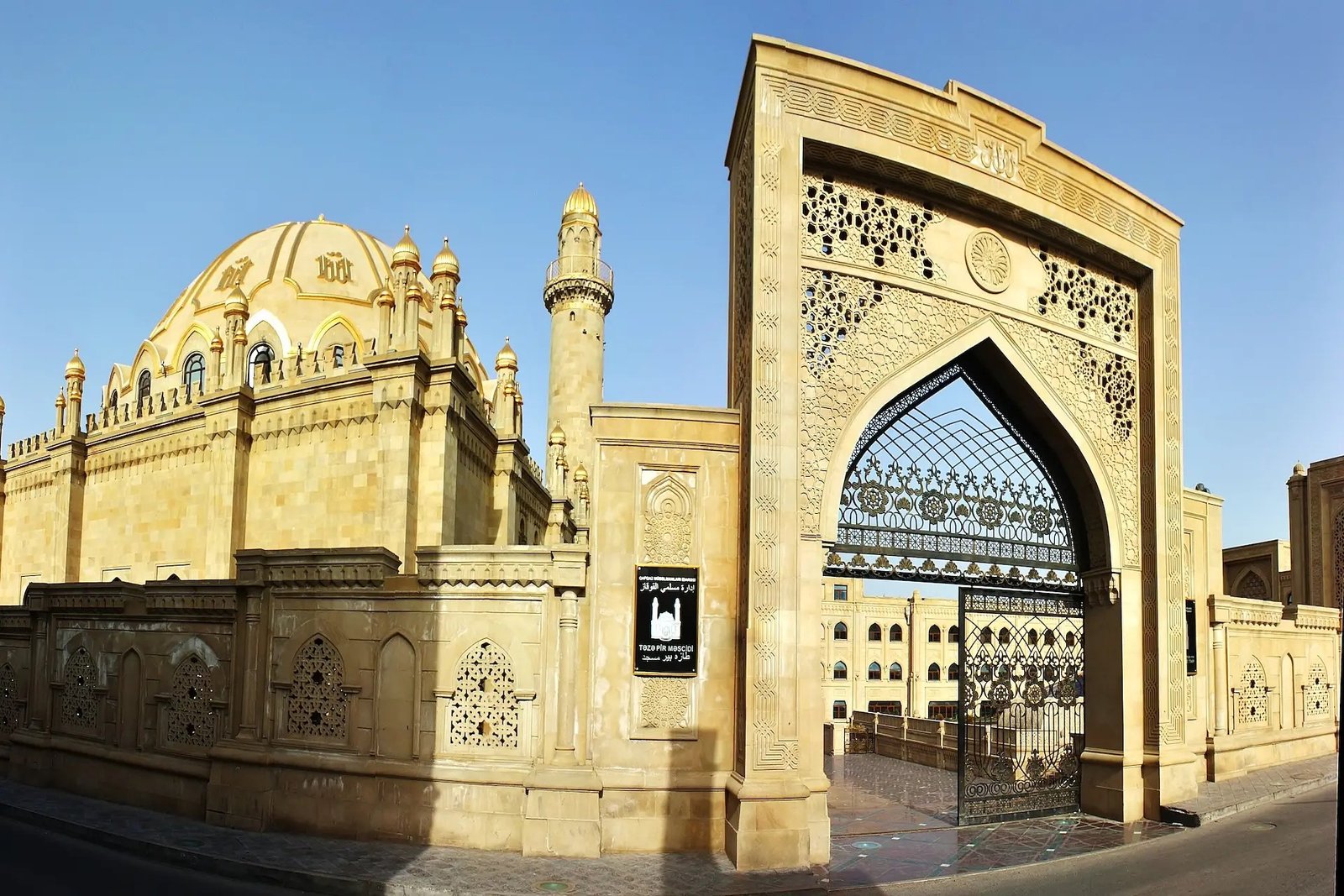
The city mosque Tezepir was built in the early 20th century. In fact, the organizer of the construction was a woman named Nabat Khanum Ashurbekova. She commissioned architect Ziverbey Akhmedbekov to develop the temple project. Eventually, her son completed the construction in 1914 after her death.
The mosque’s fate was unenviable due to its construction in pre-revolutionary years. The Bolsheviks, who came to power in 1917, closed temples of all denominations, which did not spare the Tezepir Mosque.
Until 1943, the temple was used as a cinema. After Stalin’s appeal to the believing peoples of the USSR, all churches, mosques, and synagogues resumed services. Since then, the Tezepir Mosque has been welcoming believers.
In particular, the mosque building occupies an area of 1400 m2. Inside, the walls are covered with beautiful Arabic script – these are quotations from the Quran. In addition, the walls are decorated with rare beauty oriental ornaments by local artists. Chandeliers illuminate the prayer halls. Moreover, marble lines the dome and mihrab. The mihrab is a niche in the mosque wall indicating the direction to Mecca.
In the women’s prayer room, the walls are paneled with pistachio wood, as are the concrete stairs. In addition, the doors and window frames are made of redwood. The floor is heated by a water-based underfloor heating system. In the men’s hall, 72 people can fit simultaneously on the prayer carpet.
Fountains Square
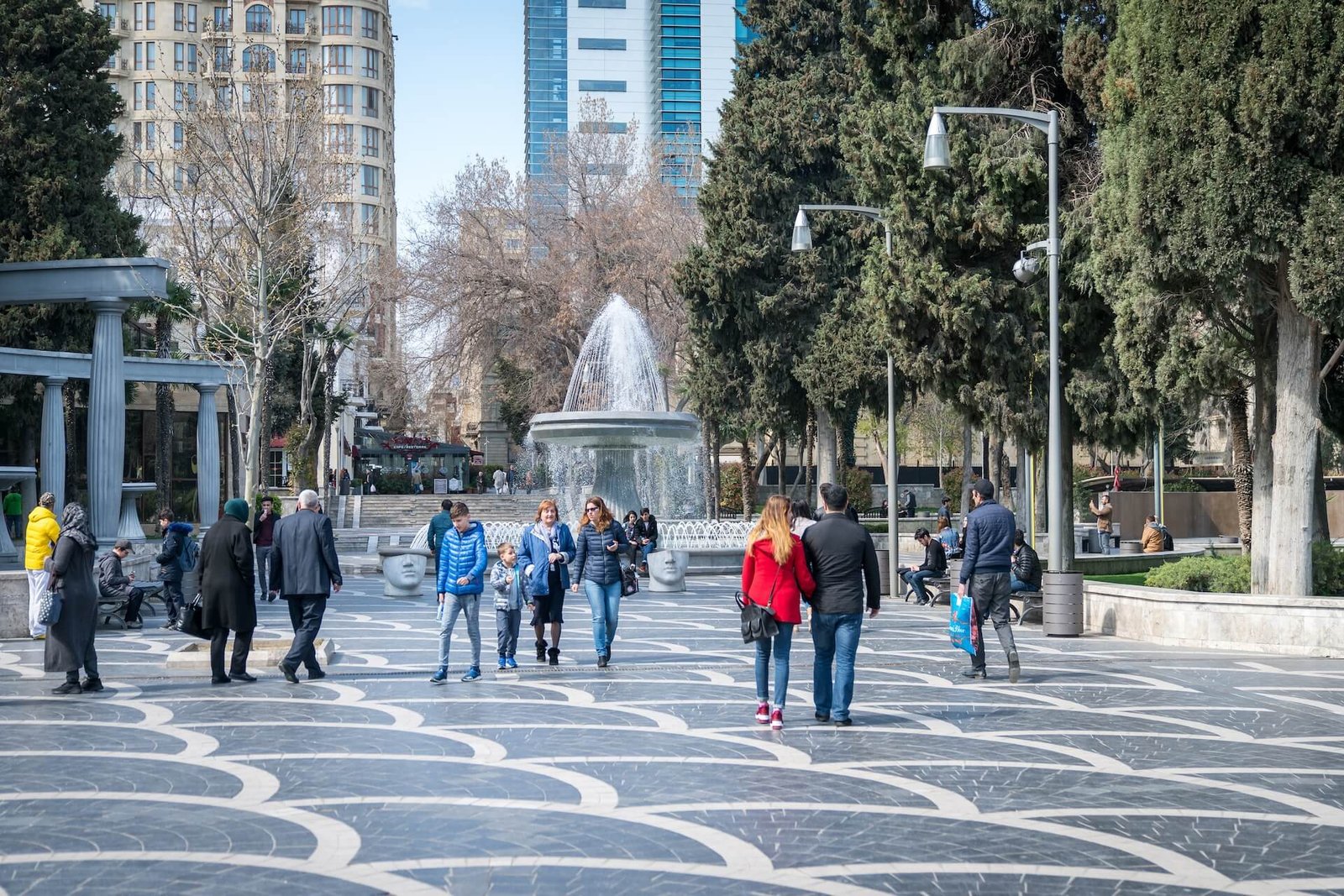
This is one of the most attractive places for residents and guests of the capital. For example, many fountains surrounded by historic buildings and architectural monuments of the 19th and 20th centuries.
The idea of Fountains Square was conceived during the Russian Empire. In 1864, the square was built as a parade ground for exercises and parades. At that time, it was the first and only square in the city. It was called Parapet or Kolyubakinskaya Square.
Historically, the project author was local architect Kasymbek Hadjibababekov. In 1868, the square was opened to the public. As a result, it became a place where the public and business circles gathered to discuss various trade events.
In addition, the surrounding houses were also the fruits of architect Hadjibababekov’s creativity. The two-story caravanserais have become architectural and historical monuments in our time. Moreover, there are several residential houses and world-famous hotels.
Meanwhile, the square of strict symmetrical shape is the beginning of the central city street – Mirza Ibrahimov Avenue.
In 2010, the square underwent major reconstruction. As a result, old fountains were repaired, and new ones were installed. The entire infrastructure of the square was also updated.
Kiosks, pavilions, and benches were installed, and lawns and flower beds were renewed. Fountains of classical shapes appeared, such as the central fountain. Some fountains, like a tray with steel balls, have many decorations made of human and animal figures.
For example, a bronze girl sitting on a bench near the fountain, fixing her makeup, and another girl talking on the phone, shielding herself from the fountain spray with an umbrella, attract attention.
National Museum of History of Azerbaijan
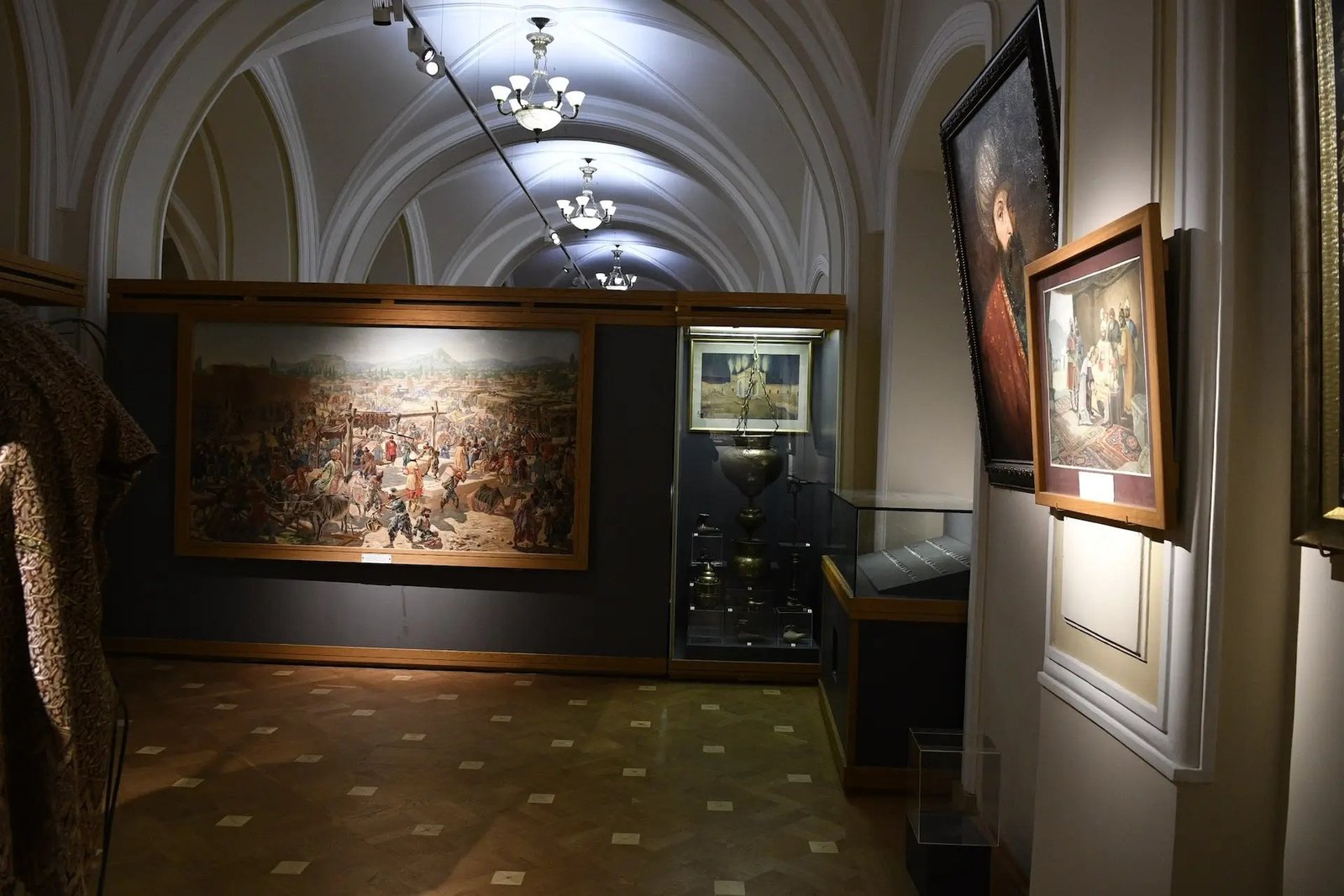
In 1920, the department of the cultural institution “Musexkurs,” which was subordinate to the commissariat of education, opened its doors to Baku residents. This is how the future history museum was born. Later, the official opening of the museum took place in 1921. During its existence, the institution changed its name several times.
Initially, the exhibition was housed in the mansion of wealthy industrialist Tagiev, along with several government institutions and an archive. In 1936, the institution was transferred to the jurisdiction of the Azerbaijani branch of the USSR Academy of Sciences.
Meanwhile, part of the exhibition moved to the Shirvanshahs’ palace. In 1969, the Tagiev building was completely given over to the National Museum of Arts of Azerbaijan.
Since then, the museum’s funds have significantly grown due to historical events in the republic’s life. Today, the museum’s exhibition occupies 3 thousand square meters. As a result, visitors come to the museum several times to take in the huge number of items, documents, photos, and various artifacts.
The exhibition consists of six departments, including the primitive and medieval sectors, a hall dedicated to modern history and contemporary events, and a numismatics and ethnography department. According to the latest data, the funds contain about 300 thousand artifacts, including 150 thousand coins, 90 thousand archaeological finds, and 2,300 samples of weapons.
Only a fraction of the collection fits on display at one time. Therefore, the exhibition is constantly updated with items from the reserves.
Opera and Ballet Theater
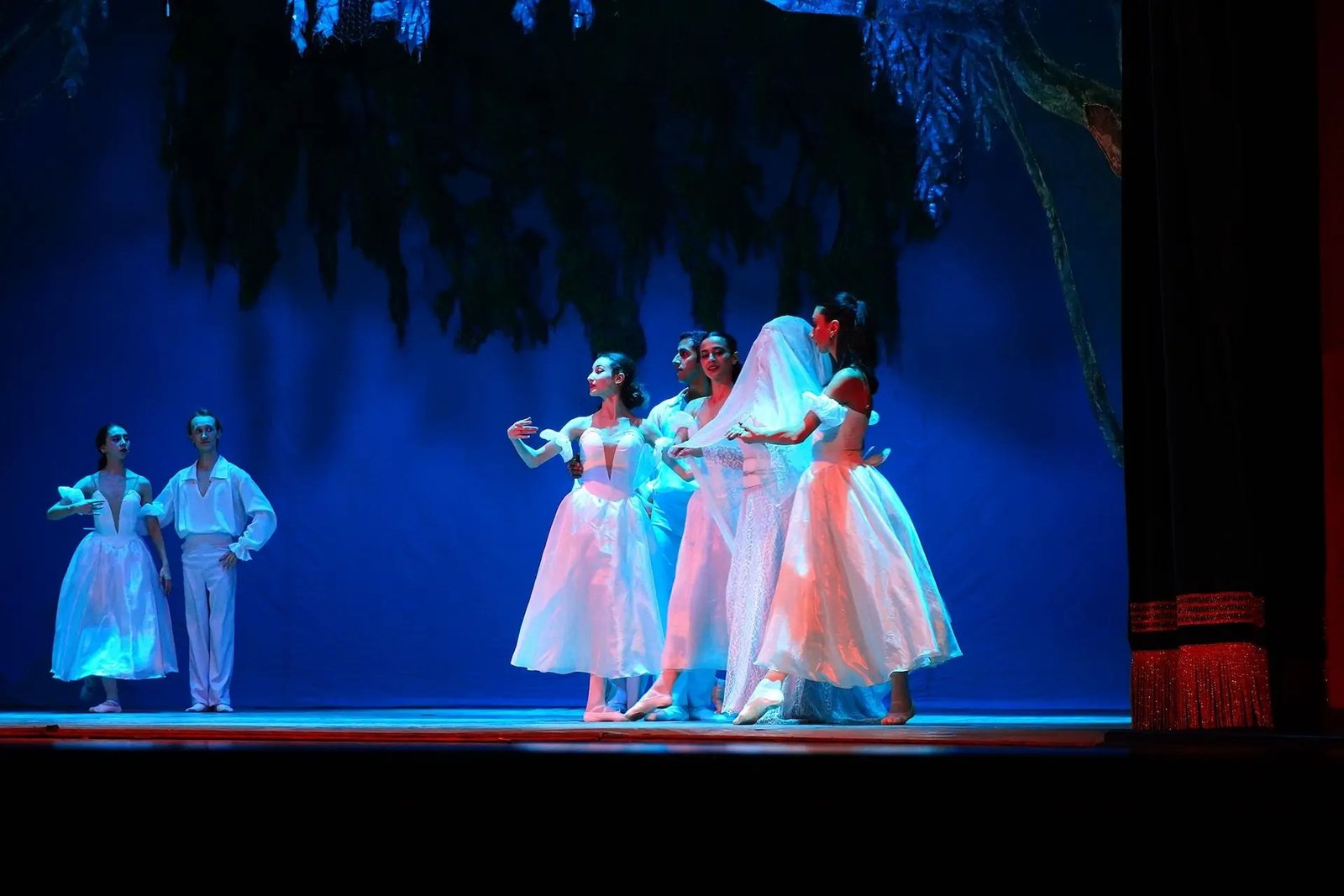
The theater’s history dates back to the pre-revolutionary times of 1917. The famous entrepreneurs and patrons of those years, the Mailov brothers, financed the theater building’s construction.
As a result, the city acquired an opera and ballet theater with a unique hall. The audience seats were arranged as follows: on the first level were the parterre and 38 boxes, the second tier was occupied by a balcony with a gallery for 220 seats. The theater could accommodate 1300 spectators simultaneously.
In 1911, the theater opened with the premiere of Mussorgsky’s opera “Boris Godunov.” Since then, many world-famous opera and ballet stars have performed on its stage. Masters such as M. Plisetskaya, M. Caballé, F. Chaliapin, E. Obraztsova, A. Volchkova, and others performed on the Baku opera stage. Traditionally, each season, the theater begins with a production of Hajibekov’s opera “Koroglu,” a masterpiece of the country’s theatrical art.
Today, the theater’s repertoire includes works by national artists and world classics. Operas such as Bizet’s “Carmen,” Puccini’s “Tosca,” and Karaev’s “Seven Beauties” are often staged. The theater also does not forget about young audiences.
Children eagerly come to see children’s performances, including the fairy tale opera “Jirtdan” by N. Aliverdibekov. The theater is named after the famous Azerbaijani writer, playwright, and founder of literary criticism, Mirza Fatali Akhundov (1812 – 1878).
Seaside Boulevard
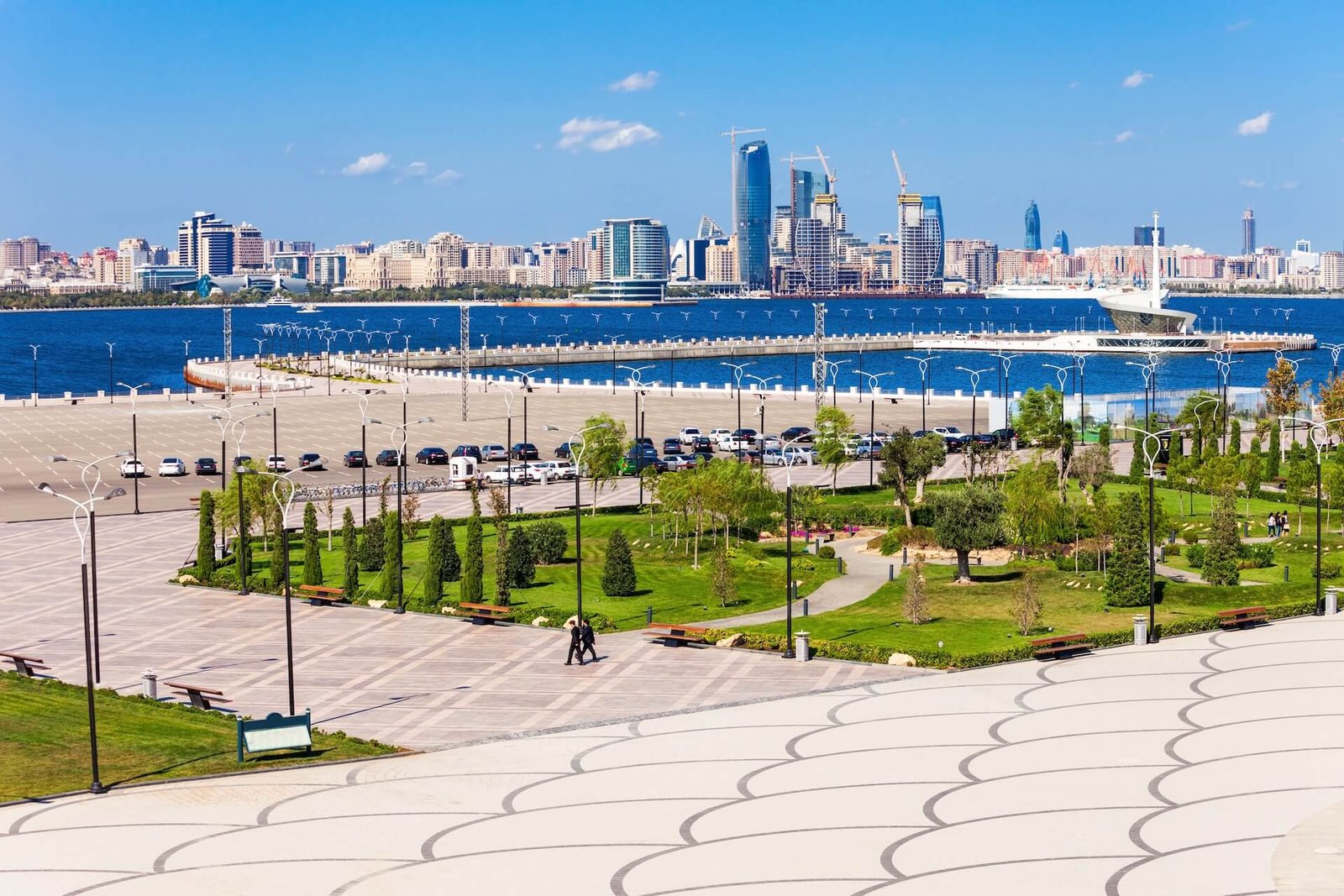
It stretches for 16 kilometers along the picturesque Caspian Sea coast. The promenade was established at the beginning of the 19th century. The first promenade lovers appeared on the embankment in 1909.
In fact, the park area called Seaside Boulevard occupies the territory along the southern side of the Caspian Sea bay. Starting from the Freedom Square, the boulevard reaches the Old City and continues beyond.
Since 2012, the boulevard has been extended from the shore to the State Flag Square. Later, in 2015, the White City Boulevard added another 2 km to the east of Freedom Square. According to the latest data, the total length of the Seaside Boulevard is 26 km.
In 2009, the boulevard celebrated its 100th anniversary. Over time, the boulevard has become filled with attractions and entertainment for residents and tourists. These include a futuristic musical fountain created in 2007, rivaling its Emirati counterpart, a Ferris wheel, an amusement park, a children’s theater, the Azneft Square, and numerous restaurants and cafes. In short, it’s always noisy and fun here.
During the day, you can visit museums, and in the evening, ride attractions. The musical fountain, created in 2007, immediately became the center of attraction for young people and tourists. As soon as dusk falls over the city, the magic of dancing water jets to the rhythms of beautiful music begins.
Government House of Azerbaijan
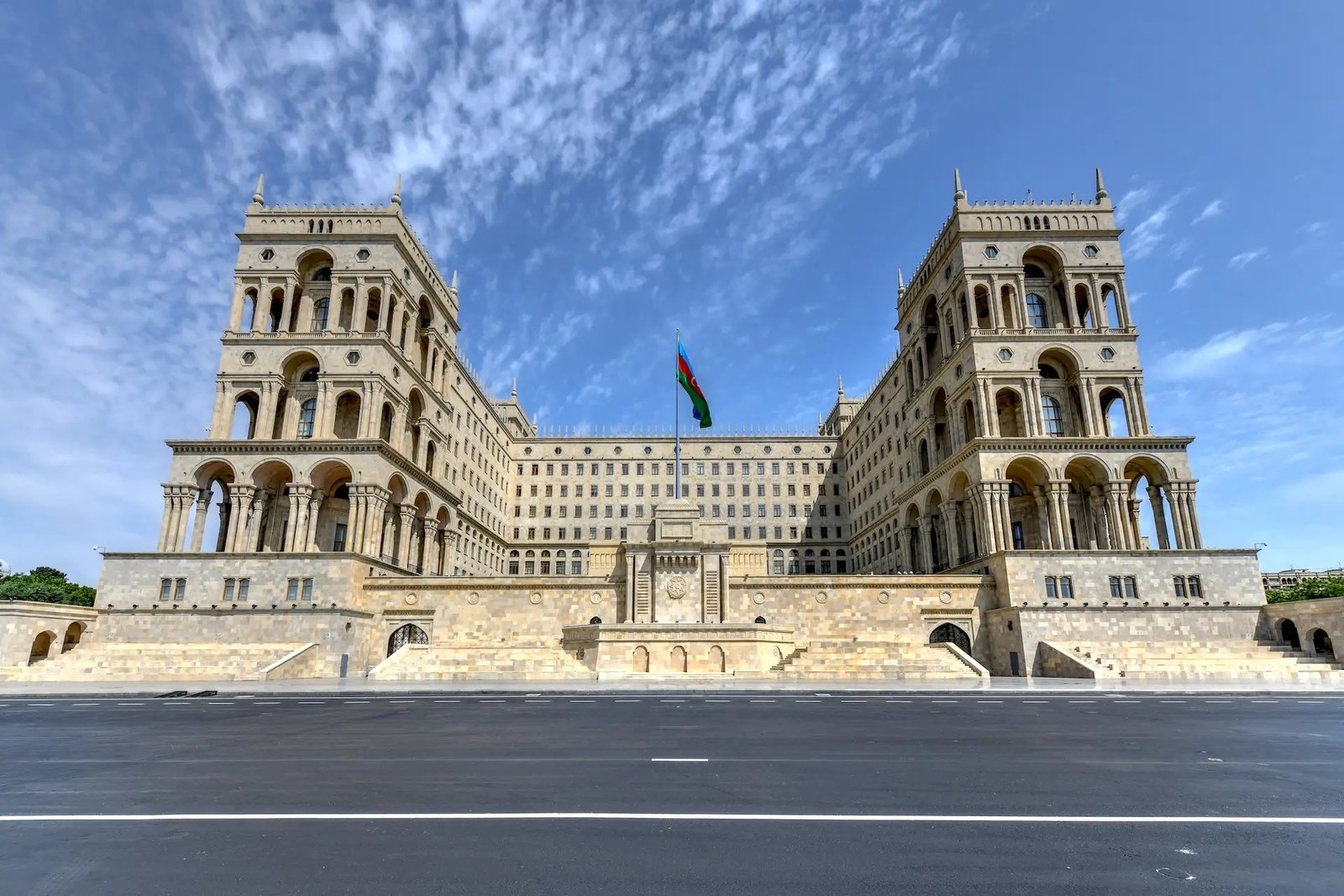
This is a building where, besides the government apparatus, the ministries of the republic and several municipal organizations of Baku are located. The architecture of the monumental building combines baroque elements and eastern motifs. Rows of lacy arched galleries, decorating the facades of the corner towers of the majestic structure, stand out particularly.
In fact, the building stands on Freedom Square. It houses government offices. Construction plans began in 1932, and work ended in 1952.
In particular, the main architectural style of the building corresponds to Stalinist Empire. Interestingly, several columns on the sides of the house are similar to the architectural solution of the Shirvanshahs’ palace. In 1955, a monument to V. I. Lenin was installed on the roof of the Government House.
After declaring full sovereignty of the republic, the monument was dismantled, and a flagpole with the state flag was installed in its place. Lenin Square was renamed Azadlig Square (Freedom Square).
Museum of Modern Art
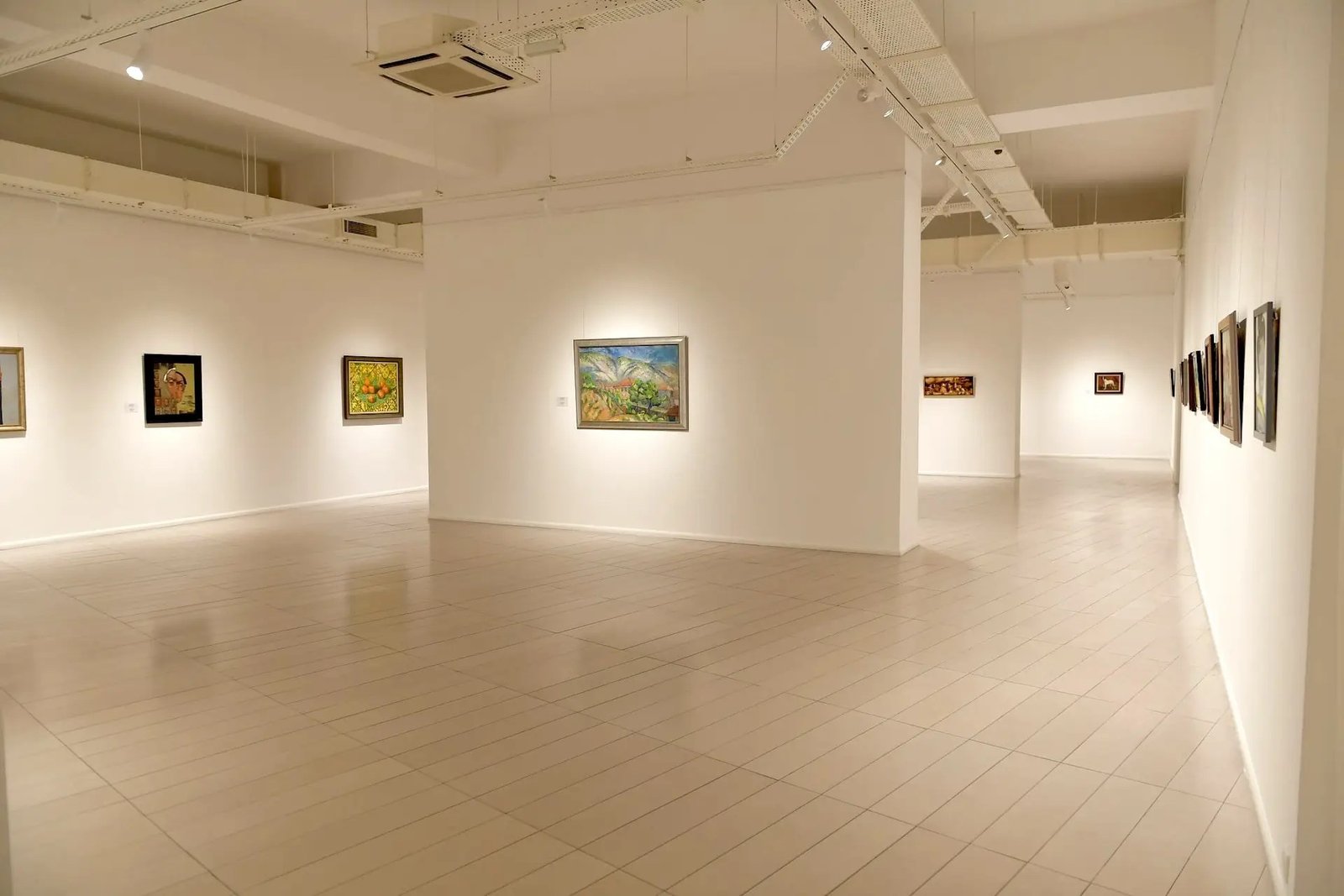
In fact, this is one of Azerbaijan’s younger cultural institutions. Its grand opening took place in 2009. The president’s wife, Mehriban Aliyeva, actively participated in creating the museum.
The cultural institution is organized based on the principle of free space and the absence of rigid restrictions in the exhibition. For example, this concept is reflected to some extent in the building’s architecture. You won’t find corners here; the walls in different rooms have different slopes. All this results from the project developer’s ideas, the author of the exhibitions, and curator, the famous artist Altay Sadikh-zade.
For example, the museum’s collection includes works in the style of modernism of the 60-70s of the last century, as well as paintings by such great artists as Dali, Chagall, and Picasso. In particular, the center of the exhibition is occupied by a collection of the best works and sculptural compositions of Azerbaijani masters in the genre of avant-garde.
Overall, the museum’s collection numbers around 800 items. These are works by supporters of the figurative art movement — Huseyn Aliyev, Nadir Kasumov, etc., and representatives of avant-garde — A. Murad, E. Mamedov, and others.
Moreover, the exhibitions occupy not only halls but also external spaces. This includes an art café and restaurant. There are also children’s art exhibitions, places for individual classes, a library, and a small shop. The “Metropolis” gallery exhibits extensive collections of contemporary artists’ paintings, which are available for purchase.
Park of Military Trophies
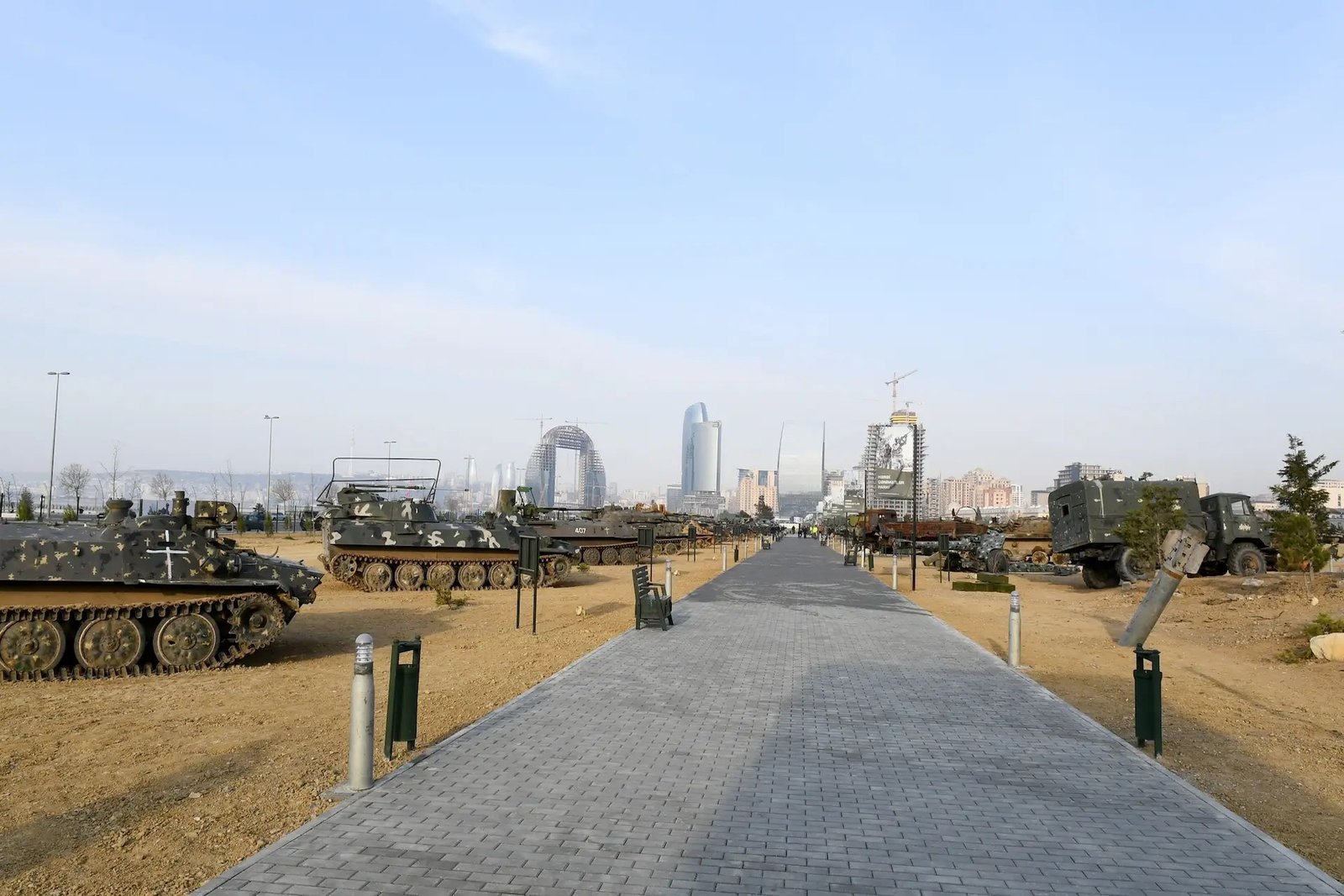
The park was established immediately after Azerbaijan’s victory in the 44-day Patriotic War. It is one of the newest attractions of the city and enjoys great popularity among Baku residents and visitors. On the eve of Victory Day, there were especially many visitors here.
On November 11, 2020, the Supreme Commander-in-Chief, President of the Republic of Azerbaijan Ilham Aliyev, announced during a meeting with military personnel that a decision had been made to display the captured weapons and equipment on a special square. A territory along the 8th of November Avenue was allocated for this purpose.
In just a few months, the park of trophies was ready. On April 12, it was officially opened by the head of state, who received the first ticket as the park’s first visitor.
The park presents exhibits relating to the 2020 conflict. Visitors may wish to approach this memorial site with sensitivity.
Murtuza Mukhtarov Palace
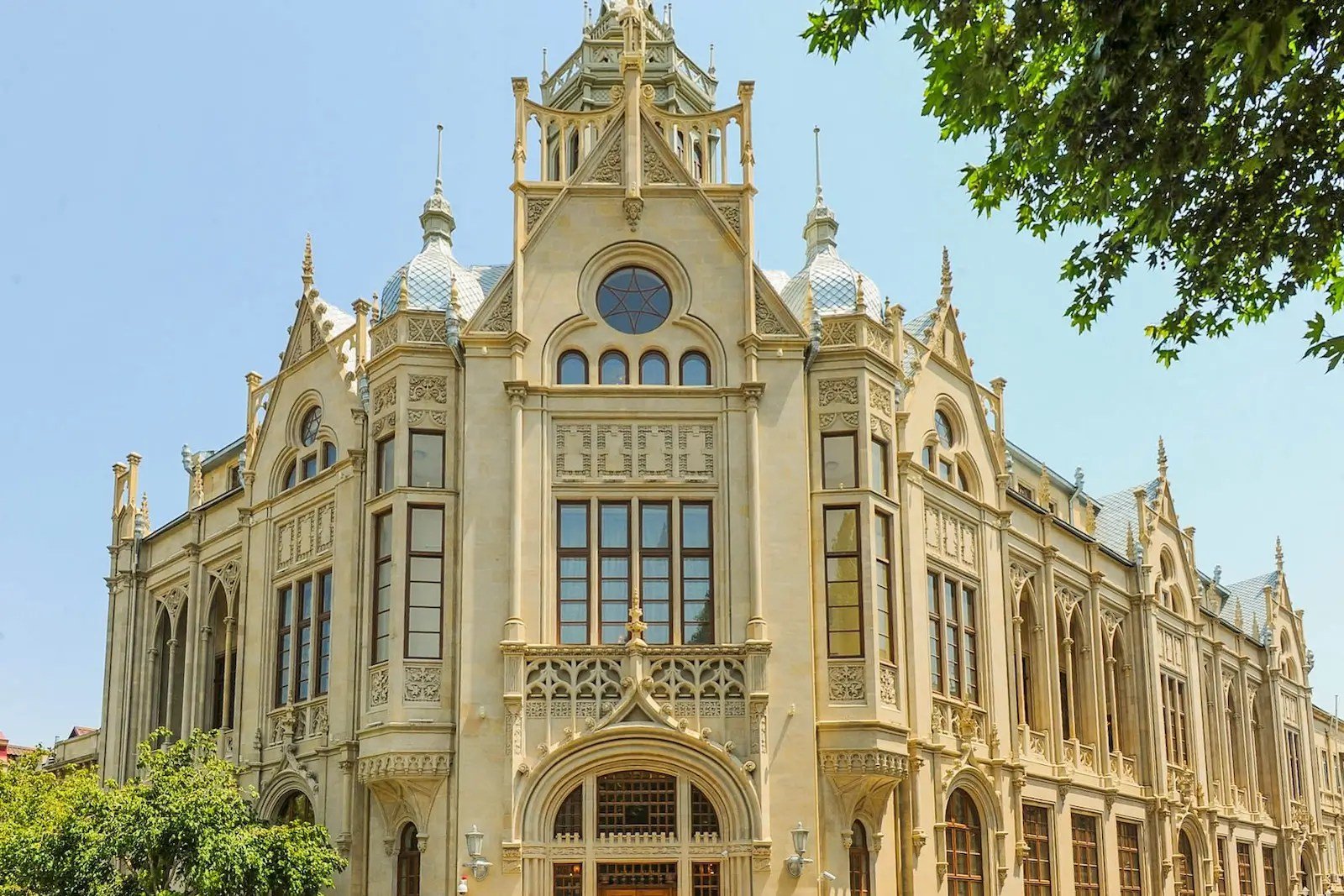
On Istiglaliyyat Street, you can admire the Mukhtarov Palace. Construction ended in 1912, five years before the revolution. The building was designed by Polish architect Józef Plośko, who is also the author of the Puppet Theater.
Wealthy oil industrialist Murtuza Mukhtarov financed the construction. He became a fan of Venetian architecture after visiting the famous Italian city on the water.
Mukhtarov wanted to build a building in Baku similar to Venetian structures. It only took a year for the beautiful house, unlike any other in the pre-revolutionary capital of Azerbaijan, to appear.
An interesting fact about the confiscation of the house from Mukhtarov is that when the Red Army soldiers rode into the palace to present an arrest warrant for Mukhtarov and his family members, the palace owner shot them all with a revolver before shooting himself. Despite this, the townspeople are grateful to Mukhtarov for the beautiful wedding palace that the city now has.
Heydar Aliyev Center
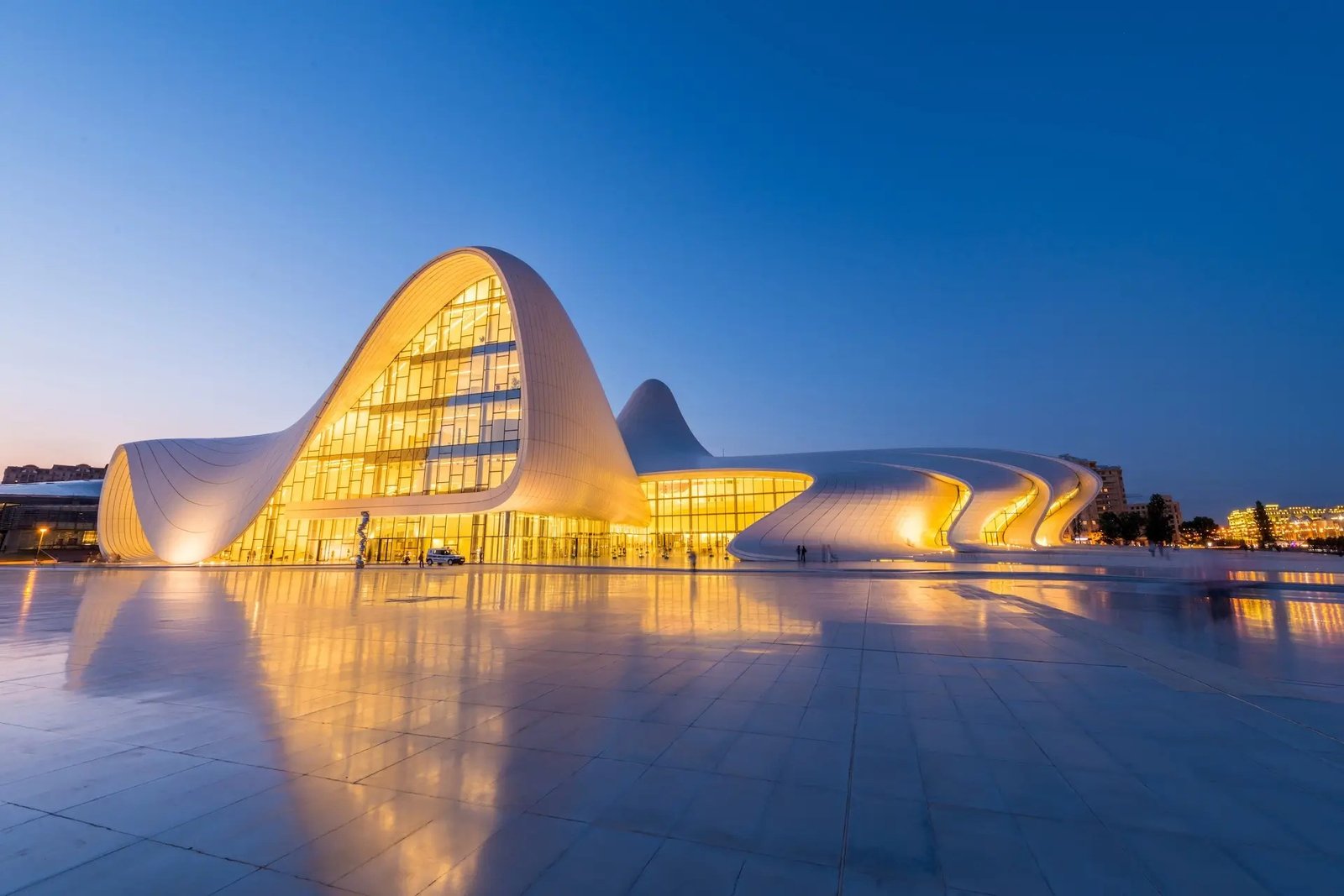
Opened on May 10, 2012. The opening coincided with the 89th anniversary of the birth of national leader Heydar Aliyev. The famous architect Zaha Hadid designed the building. In total, the centre and its grounds cover 16 hectares.
In addition, the cultural complex consists of the main building, an underground parking lot, and an upper parking lot. The center is divided into three sectors: the Heydar Aliyev Museum, exhibition halls, and conference halls “Auditorium.”
First, visitors can explore the exhibition “Masterpieces of Azerbaijan.” Here unique exhibits telling about the historical periods and cultural traditions of the state are collected. You can see rock paintings from Gobustan, coins, jewelry, household items, rare copies of sacred books, folk costumes, carpets, and musical instruments here.
Meanwhile, the second floor houses the exhibition “Mini-Azerbaijan.” It displays models of 45 buildings constructed during different periods of the country’s life. Among them are the Maiden Tower, Baku Railway Station, Flame Towers, and others.
Next, the third floor features photo exhibitions “Welcome to Azerbaijan.” Here visitors can familiarize themselves with photographs of natural and architectural monuments and attractions. The exhibition aims to acquaint the center’s guests with the rich culture of the republic.
Finally, the fourth floor focuses on Azerbaijani cuisine. Here photos of various national dishes are displayed — dolma, lavash, baklava, pilaf, and many others.
Zoo
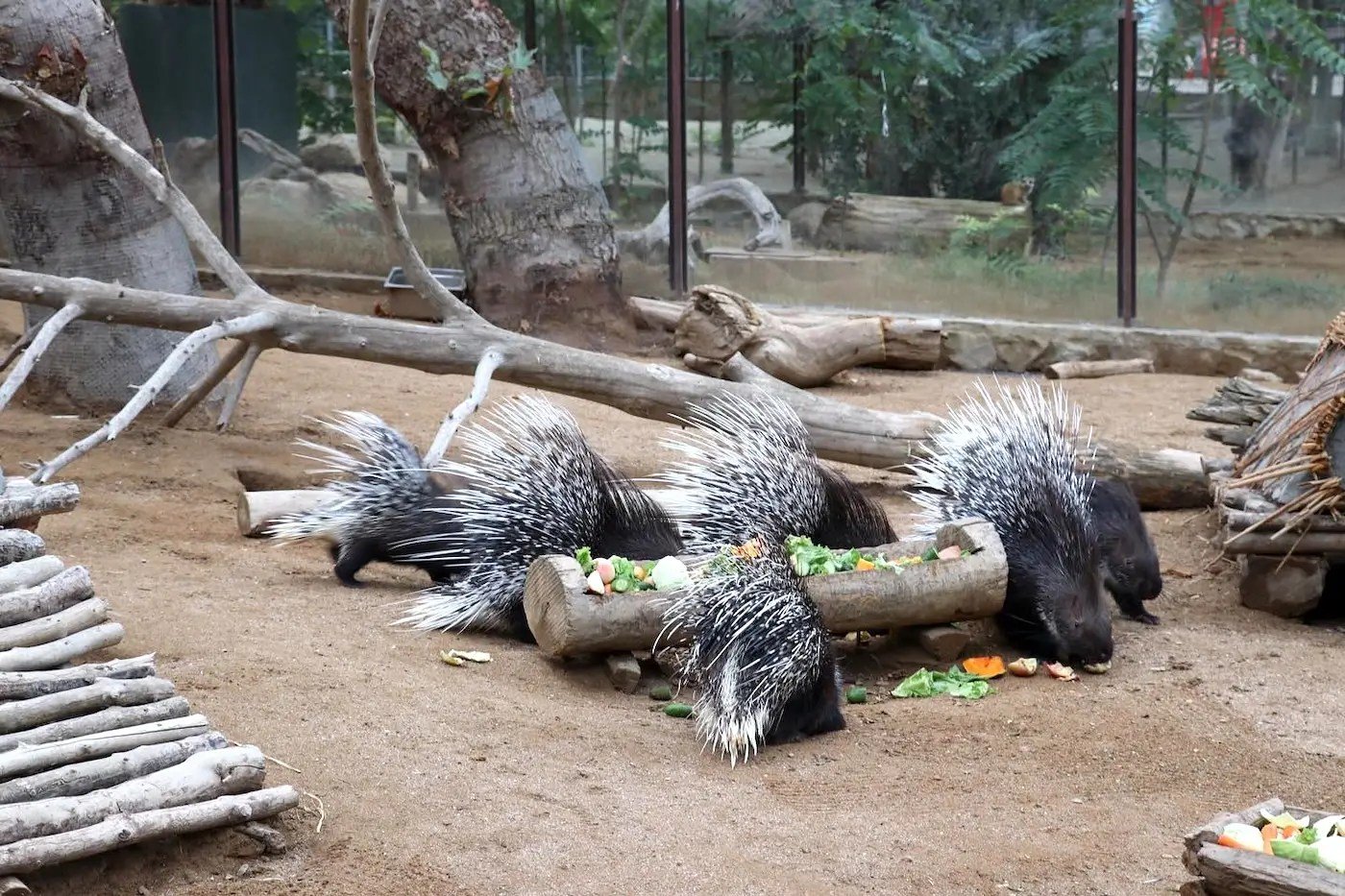
Located on a bit more than 4 hectares in the capital of Azerbaijan. It houses more than a thousand animals of 160 species. Historically, Baku’s first zoo opened in 1928. After merging with the evacuated zoo from Rostov-on-Don in 1942, it formed a new zoo. It was only in 1945 that it received its first visitors.
In the 90s, the first pink flamingos appeared here, becoming a symbol of the zoo. Residents sometimes bring these rescued injured birds here. They are nursed back to health. Today there are 30 such flamingos.
The zoo is home to many animals, from mammals and birds to fish and amphibians. Here you can find crocodiles, turtles, bears, moose, wolves, foxes, and even leopards, jaguars, camels, zebras, and reindeer.
In October 2021, the Baku Zoo opened its doors after a prolonged reconstruction. New enclosures, a terrarium, a petting zoo, and a veterinary clinic were built. Artificial lakes were dug, and new plants were planted.
Olympic Stadium
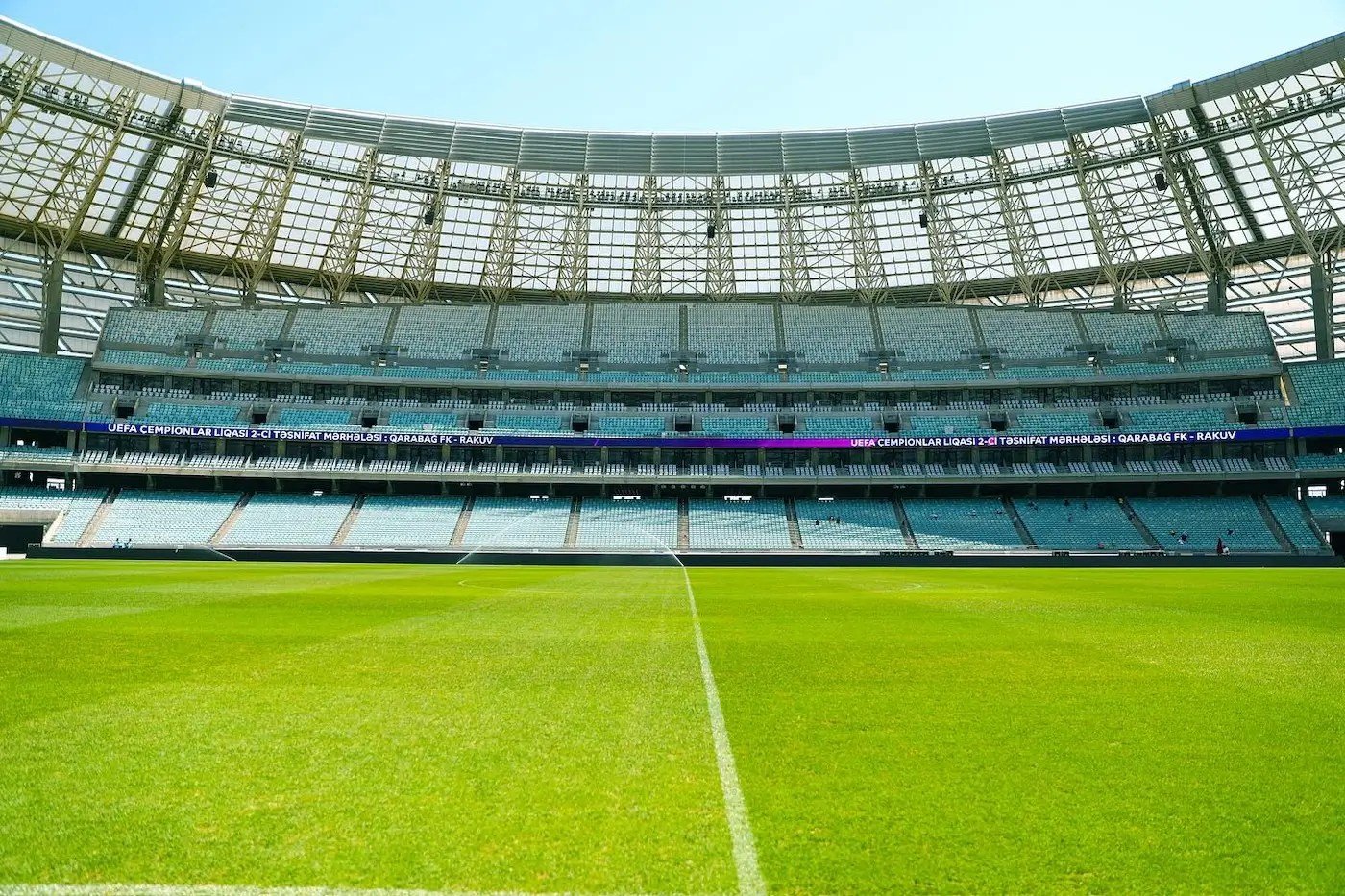
Its unusual shape stands out against the unique architecture of the city. It hosted such prestigious international sports competitions as the first-ever European Games, the IV Islamic Solidarity Games, and qualifying matches for the UEFA European Championship and Nations League, as well as the FIFA World Cup.
The stadium hosted four matches of UEFA EURO 2020, held in 2021.
Furthermore, the stadium is a favorite place for city residents to engage in sports. The sports complex’s territory offers a great time. Here one can work out in the fitness center or martial arts club.
You can always have a meal with friends in the restaurant or fan café. Next to the stadium is a beautiful park where you can fully enjoy a leisurely walk along the shore of Lake Boyukshor. Conferences, seminars, concerts, and corporate events are often held here. Check whether public tours are available before heading out.
Baku: The Best Restaurant and Bazaars to Explore
Baku in 2 days FAQ
Is two days enough for Baku?
Yes, two days are enough for the Old City, waterfront and several museums. Save longer excursions for an additional day.
How do you get from Baku airport to the city?
The H1 Airport Express connects the airport with the city. Alternatively, arrange a taxi or transfer.
What are the best free things to do in Baku?
Walk around the Old City streets, Fountains Square and Seaside Boulevard. Highland Park also offers panoramic views.
Where should you stay for a short visit?
Choose the Old City or the area near Fountains Square for easy access to restaurants and central attractions.

Konstantin is an acclaimed travel writer, celebrated for transforming ordinary journeys into extraordinary narratives. With years of experience exploring diverse destinations across the globe, his work blends vivid storytelling, cultural insights, and practical advice to inspire wanderlust and guide readers toward unforgettable adventures.
As a key contributor to enjoythetrip.org website, Konstantin has built a loyal readership through their expertise in uncovering both iconic landmarks and off-the-beaten-path treasures. He specializes in providing travelers with honest, actionable tips, whether it’s finding the best resorts in Maldives, exploring cultural hubs like Paris, or diving into the natural wonders of Croatia.