
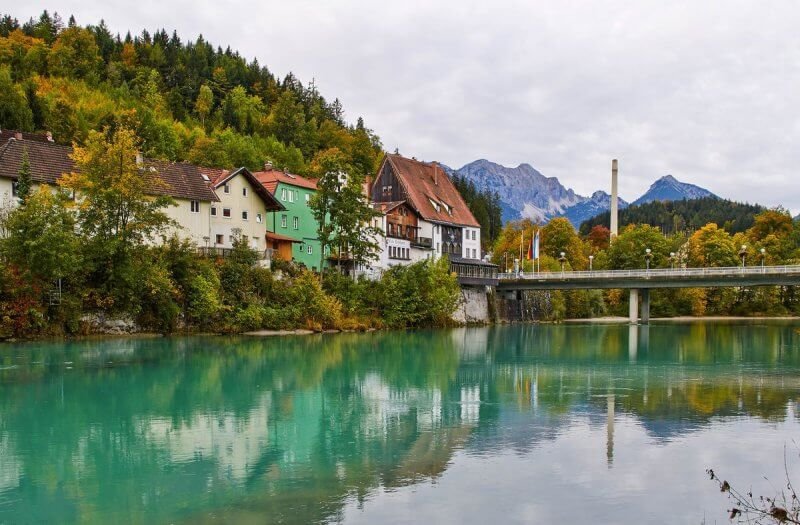
This Fussen Germany guide covers Füssen, a small town in the Allgäu at the southern end of the Romantic Road. It is the best base for visiting Neuschwanstein and Hohenschwangau castles.
Fussen, Germany – a small ancient town located in the Allgäu Alps at an altitude of 800 m above sea level. Ornamental painted houses, medieval churches and ancient castles have made it one of the most beautiful cities in Bavaria. In addition, its picturesque mountain landscape, clear lakes and natural springs have made it a sought-after climatic resort.
General information
Fussen is a cozy town on the banks of the Lech River, in the government district of Swabia. Just over 15,000 people live here. It lies near the Austrian border, so it offers easy access to neighboring Tyrol. It is also a popular destination for tourists in the Alps.
However, Fussen itself also has something to be proud of. For example, mineral water springs, healing mud and good spa facilities have made it one of the best resorts in Europe. About 100,000 people visit it every year.
Climate and outdoor activities
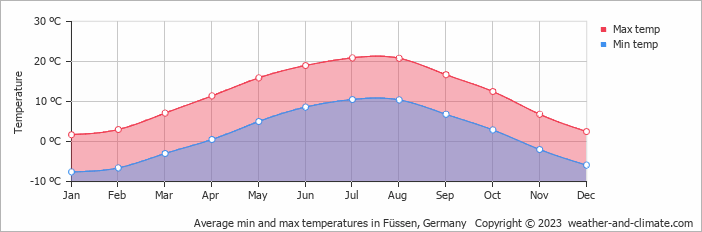
Interestingly, a holiday here is good at any time of the year. That is because the calm and windless weather in Fussen rarely brings unpleasant surprises. In summer, the air temperature stays at +26°C. In winter, the thermometer rarely falls below -5°C. At the same time, July is considered the hottest month, and January is considered the coolest. It rains very often, but the rains do not last long.
The mild climate, pleasant atmosphere and slow daily routine of the locals make this a great resort for older people. It also suits those who are tired of the hustle and bustle of the city. They can enjoy leisurely walks and peaceful views of the city’s landmarks. However, this does not mean that only misanthropes and retirees visit this place. Young and active tourists also have plenty to do. For example, the area offers excellent opportunities for eco-tourism, cycling, and sailing. In addition, with the arrival of winter, the city turns into a ski resort. It has both slopes for experienced skiers and gentle slopes for beginners.
Architecture and painted facades
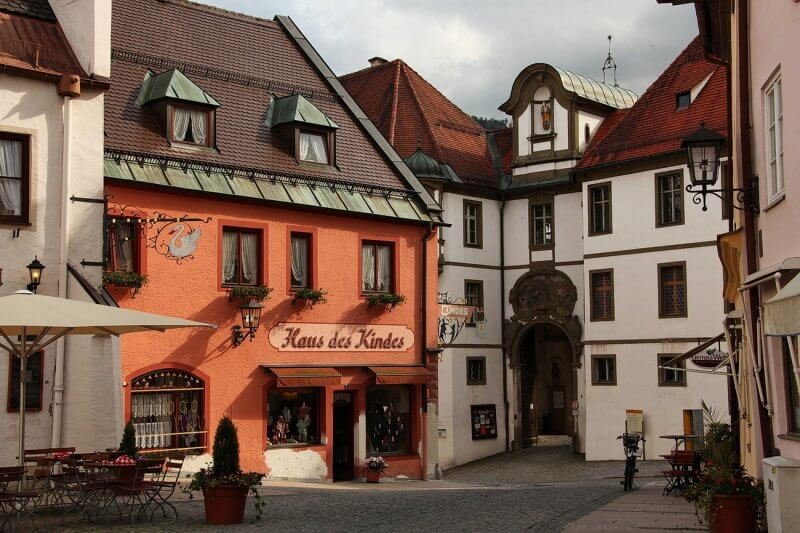
However, the beautiful nature and wide opportunities for outdoor activities are not the only pride of this ancient settlement. The city of Füssen in Germany is famous for its unusual architecture and numerous historical landmarks that attract tourists. As you enter the city, an unusual fountain greets you. It consists of large stone pillars that spray water onto the pavement. During hot weather, anyone can cool off under these pillars.
Also, most of the city’s residential buildings and public structures feature unique window frames and colorful triangular roofs. In addition, all of them feature Lüftlmalerei, a traditional Bavarian painting technique. It involves applying a baroque image directly to wet plaster. This technique creates monograms, balconies, mirrors, galleries, clocks, and even entire paintings on the smooth walls of the facades. As a result, the buildings have a festive and elegant appearance.
Attractions
Bavarians care deeply about their natural and historical heritage. So all the sights of Fussen in Germany are in truly perfect condition. Let’s explore the most popular sites.
Old Town
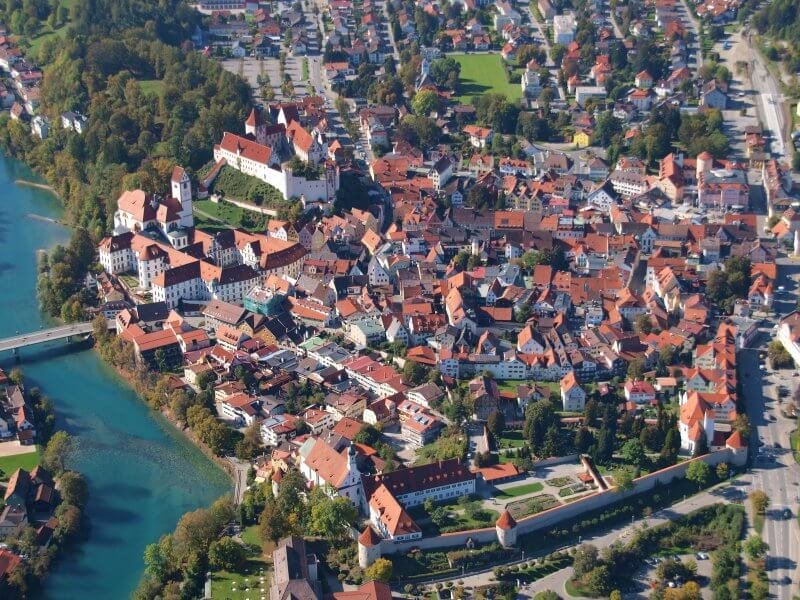
Altstadt von Fuessen is the historical part of Fussen, which was founded during the time of the Holy Roman Empire. Here, you can see all the features of a classic German settlement. For example, there are the remains of the city walls, the Town Hall with its ancient clock, the city gates, and many beautiful medieval buildings. The Old Town also has its own market square, known as the Bread Market. In addition, there is a luxurious palace that now houses the Museum der Stadt Fussen, a Franciscan monastery, and the ruins of a Roman villa.
At the center of Altstadt von Fuessen lies the pedestrian Reichenstrasse, which was once the great Roman road. Today, it is the wealthiest street in the city. Along it, you will find old painted houses, branded shops, souvenir stalls, and cozy restaurants. They serve the best Bavarian and European food. But the most popular dishes are classic German sausages with pretzels and sweet mustard, apple strudel with vanilla cream, and Fleischkäse.
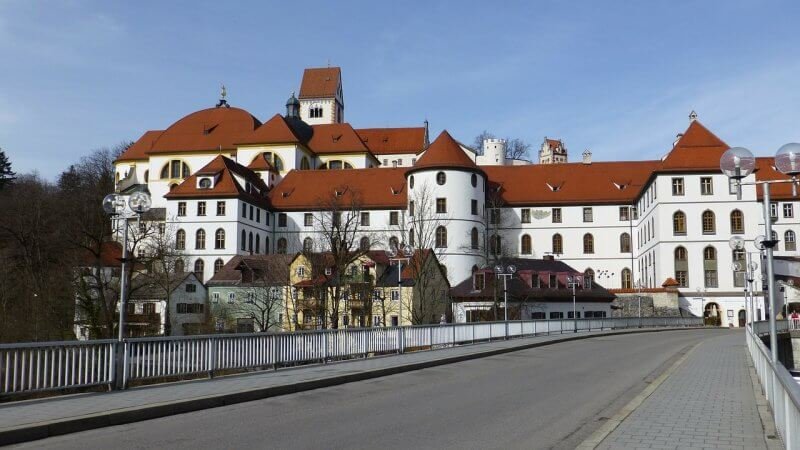
In addition, the Old City has the single-nave Church of St. Nicholas. It features ancient frescoes, stucco, angel figurines, a beautiful marble altar, and a sculpture of Nicholas of Myra, the church’s patron saint.
The old city pharmacy also deserves attention. Many rightly call it the most beautiful building in Altstadt von Fuessen. Its main feature is the ancient painting, which creates the effect of a fully present baroque setting.
Finally, the Old Town ends with the St. Magnus Fountain, a five-meter-high structure in the shape of a stone bowl. In the center of this pedestal stands a pillar topped by a figure of a priest fighting a fearsome dragon.
Monastery of St. Magnus
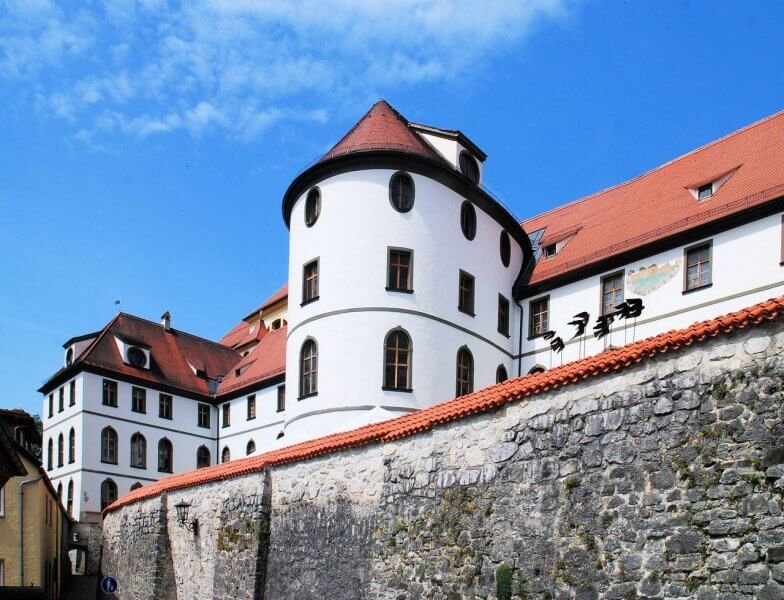
If you look at photos of Fussen in tourist brochures, you will probably notice the Monastery of St. Magnus. Its origins go back to the 8th century. It takes its name from Saint Magnus, the missionary known as the “Apostle of the Allgäu”. Over the years, the monastery has undergone several architectural changes. For example, a couple of centuries later, builders added a small basilica in the Italian Baroque style. Many consider it one of the city’s most beautiful landmarks.
Artistic paintings on the walls of this majestic structure depict the life and deeds of the great preacher. Marble medallions adorn the lower level, while luxurious medieval stucco covers the vaults. However, perhaps the most historically significant aspect of the church is the crypt located beneath the main altar. Here, for centuries, the monastery has kept its most cherished relics, including relics associated with Saint Magnus, such as his staff.
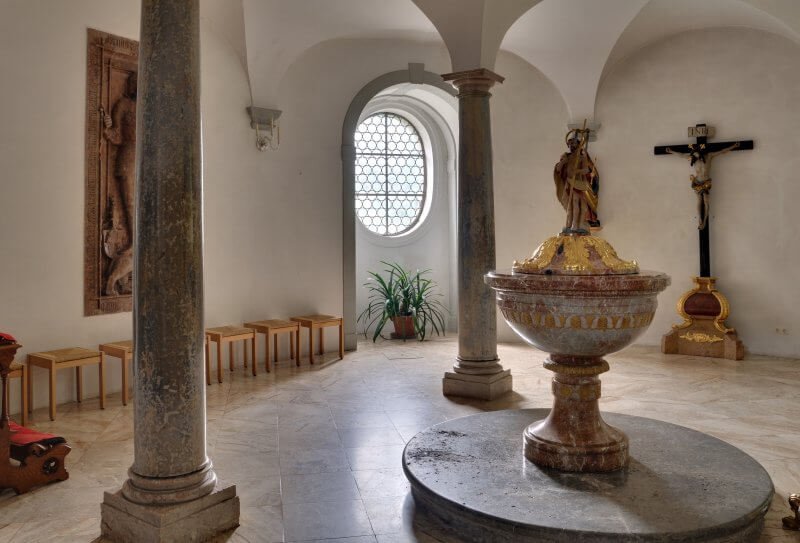
Other monastery rooms are also of great interest. They include the Knights’ Hall with its columns, the oval library, and the city museum, which has hundreds of unique exhibits. Among these, the most popular are the series of paintings titled “Dance of Death,” an exhibition of antique coffins, and a collection of various musical instruments (violins, lutes, and more). Music lovers will also find a surprise in the Monastery’s Princely Hall. It regularly hosts not only chamber music concerts but also jazz performances.
There is also a small library in the city museum, with hand-painted ceilings and walls. It contains many handwritten books, interesting medieval editions, and ancient folios.
Location: Lechhalde 3, 87629 Fussen.
Neuschwanstein Castle
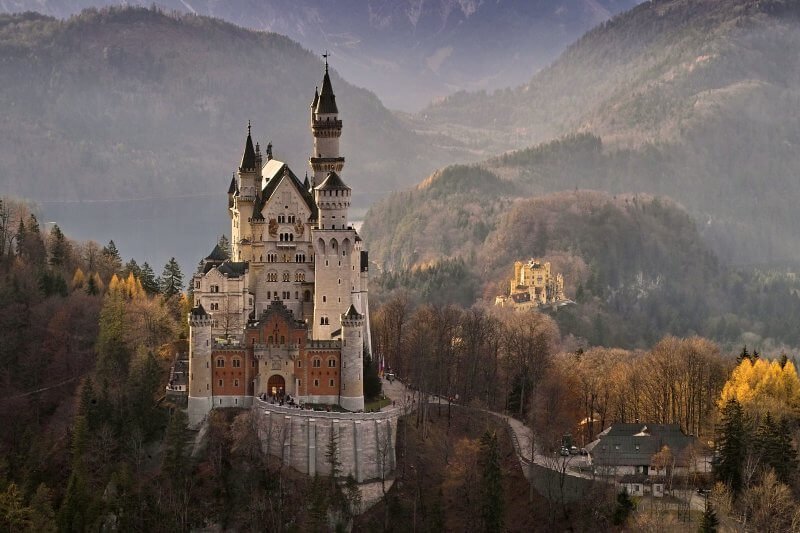
Without exaggeration, Neuschwanstein is the most famous castle near Fussen. Every year, about 1.5 million tourists from all over the world visit it. Located at the very foot of the Alps, it seems to have come from the pages of children’s books. It has snow-white walls that contrast sharply with the red entrance gate, pointed towers, many carved balconies and semi-circular windows. In fact, Neuschwanstein became the prototype of the fairy-tale palace from Walt Disney’s Sleeping Beauty.
Working hours:
- 01.04 – 15.10: from 09:00 to 18:00;
- 16.10 – 31.03: from 10:00 to 16:00.
The castle is open every day except for 24.12, 25.12, 31.12, and 01.01.
You can only get there with a guided tour, which costs between 12 and 26€, depending on the type of ticket. Prices may have changed, so check the official website before your visit.
Location: Neuschwansteinstrasse 20, 87645 Hohenschwangau.
Alatsee
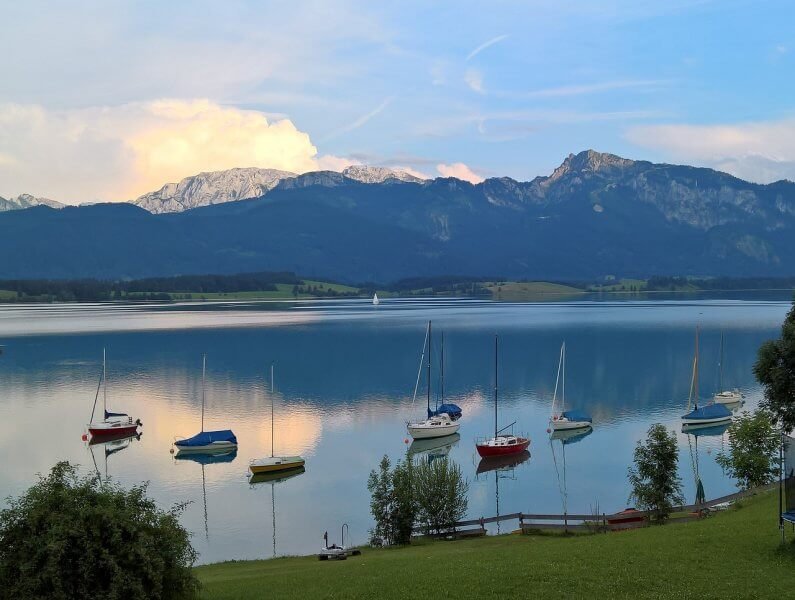
Alatsee, nestled in the middle of the Bavarian Alps, lies 4.5 km from the city. It is one of the most beautiful natural attractions in Fussen, Germany. Despite its relatively small size (490/290 m), Lake Alat has a remarkable depth of over 30 meters. However, its main feature is the 15-meter-deep layer. It is home to many kinds of plants and animals. Among them, the photosynthetic purple bacteria deserve special attention, because they give this layer a beautiful purple hue. However, everything below this zone is a dead zone because it lacks oxygen. There are almost no living organisms there.
Location: 87629, Fussen.
Hohenschwangau Castle
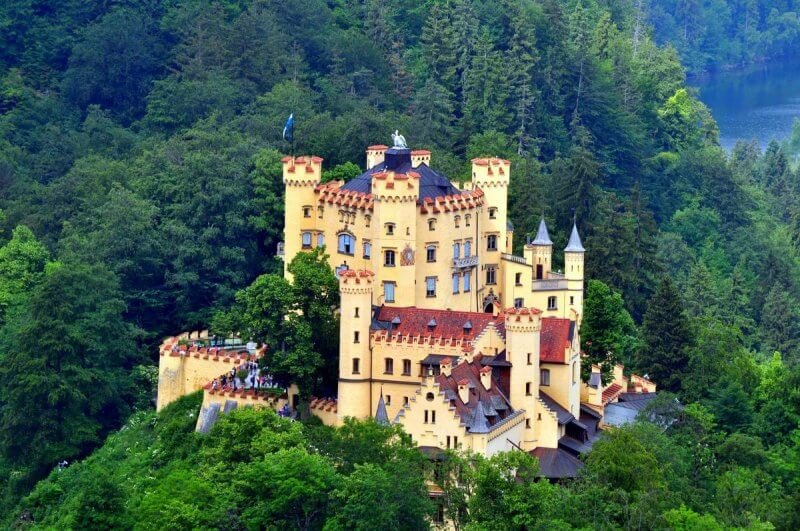
The Hohenschwangau Castle, whose name translates to “high swan land,” stands near the village of Schwangau. It stands in the middle of a dense coniferous forest. It is one of the most fascinating sights not only in Fussen but also throughout Bavaria. The castle’s main façade, adorned with intricate bas-reliefs, captivates tourists. So does its lavish interior design, featuring medieval frescoes and original mid-19th-century furniture. You can only visit Hohenschwangau Castle as part of a group tour. The tour lasts 30 minutes and runs in English and German.
Location: Alpseestrabe 30, Hohenschwangau.
Waterfall on the Lech River
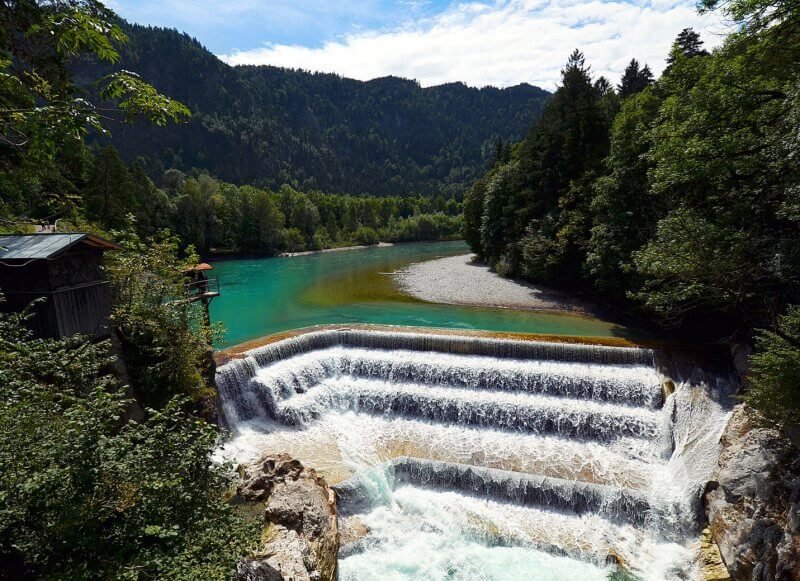
The description of Fussen’s attractions with photos ends with Lechfall, an artificial waterfall. Engineers created it on this site during the construction of the dam. The water falls down five steps into a gorge. Unlike the dam itself, the gorge is natural.
You can walk or drive to the waterfall. There is also a fenced-in viewing area and a small kiosk selling tea, coffee, and other beverages. In addition, the Maxsteg footbridge above the falls offers a fine view of the gorge. However, the famous view of Neuschwanstein Castle is from the Marienbrücke, a bridge over the Pöllat Gorge near the castle.
Location: Fussen Outskirts.
Tip! You can get free maps and brochures describing tourist routes at the Information Center, right in the city center.
Where to stay?
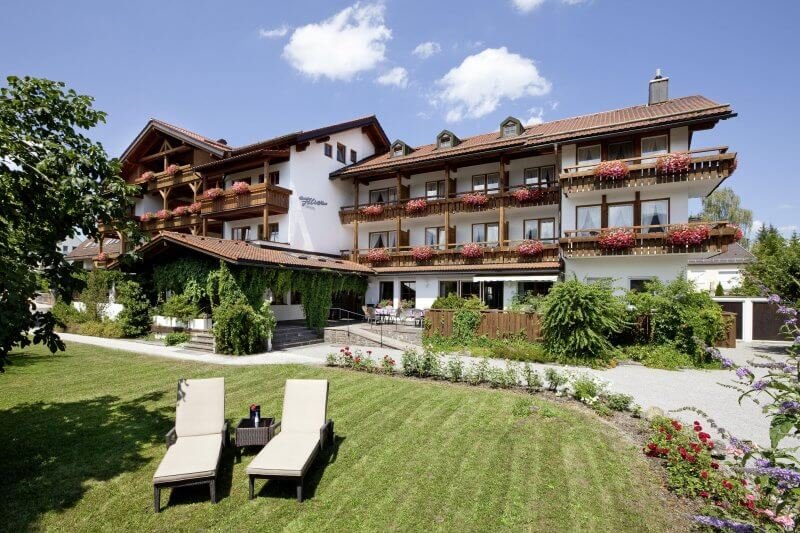
There are plenty of hotels, hostels, campsites, guesthouses, and apartments available for rent in the city. Most of them are located in the city center or within walking distance of the main attractions. For example, a 2-bed room in a 3-star hotel starts at around 60€ per night. On the other hand, renting an apartment for the same period will cost around 150€.
How to get there from Munich?
If you know how to get from Munich to Fussen, you can use one of these methods.
| Carrier | Departure | Arrival | First / last flight | Travel time | Traffic interval | Ticket price |
|---|---|---|---|---|---|---|
| Method 1: By train from Munich to Fussen | ||||||
| Deutschen Bahn | München Hbf | Füssen Hbf | 03:17/ 20:44 | 2.5 – 4 hours | 10-60 minutes | 24.20 – 37.50€ |
| Method 2. By bus | ||||||
| Flixbus | München ZOB | Füssen ZOB or Füssen Pulverturm | 08:15/12:15 | 2.5 – 3 hours | 3 flights per day | 12.60 – 19€ |
You can also get here in your own or a rented vehicle. In this case, it is worth using the A7 autobahn and federal roads B310, B17, B16, and B179 (the latter comes from Austria).
Tip! If you come here with a Bavarian ticket, check the train schedule between Munich and Fussen in advance. This ticket has limited validity. So you can leave Munich no earlier than 9 a.m. and return no later than 3 a.m. the next morning.
Interesting facts
When talking about the city of Füssen, Germany, it is impossible not to mention a few interesting facts about its history:
- Fussen is the end point of the famous Romantic Road, which runs from Würzburg through Bavaria and Baden-Württemberg.
- Milka filmed an advertisement for its chocolates on the banks of the Lech River.
- By the way, the cow is the main symbol of the city. Every souvenir shop sells postcards with images of happy cows, as well as cow bells. Moreover, you can even see a bas-relief of this animal in the central city square.
- The most unusual theater in Fussen is located on the shore of Lake Forggensee. Instead of traditional curtains, it features a glass backdrop that overlooks the lake. At night, powerful spotlights light it up.
- The coat of arms of Fussen is a golden shield with three running legs on it. However, the exact origin of this symbol is unknown. Most historians link it to the ancient Roman road through the Alps. It was a major trade route. But some argue that the legs stand for the flow of history or the turning of the sun.
- There are many pubs, cafes, and eateries in the city. But most tourists look for Gasthof “KRONE”, a themed restaurant decorated in the style of medieval chivalry. It is customary to eat with your hands, wiping your dirty fingers on huge paper bibs.
- The first name of Füssen was Foetibus (from the Germanized word for “leg”). Over the course of the city’s long history, the name changed five more times. It was first called Fozen, then Fozin, then Fuozzen, then Füzzen, and finally Füssen.
Fussen Germany at a glance
- Where: south-west Bavaria, on the Lech River close to the Austrian border
- Top sights: the Old Town, St. Mang (St. Magnus) Monastery, Neuschwanstein and Hohenschwangau castles, Alatsee and the Lechfall
- Neuschwanstein: about 4 km from town by bus 73 or 78, by bike or by taxi
- From Munich: about 2 hours by regional train, or by Flixbus or car
- Official information: Füssen Tourism and Neuschwanstein Castle
Note: we collected the prices in this article when we wrote it, so they may have changed. Please confirm current prices on the official websites before your trip.
One day in Fussen Germany: a simple plan
- Morning: visit Neuschwanstein and Hohenschwangau with timed tickets booked in advance, and walk to the Marienbrücke for the classic view.
- Afternoon: stroll through the Old Town and visit St. Mang Monastery and the city museum.
- Late afternoon: walk along the Lech to the Lechfall.
- Evening: Bavarian dinner in the Old Town, for example sausages with pretzels or Fleischkäse.
Fussen Germany: frequently asked questions
How far is Neuschwanstein from Fussen, Germany?
About 4 km. Buses 73 and 78 run from Füssen station to Hohenschwangau, where the castle ticket centre is.
How do I get from Munich to Fussen?
Regional trains from München Hbf take about 2 hours, some direct and some with a change in Buchloe. Flixbus and driving are also options.
Do I need to book Neuschwanstein tickets in advance?
Yes, it’s strongly recommended. You can only visit the castle on a guided tour, and tickets often sell out in summer.
How many days do you need in Fussen?
One full day covers the castles and the Old Town. Stay two days if you also want to see Alatsee, the Lechfall or the lakes nearby.
Related guides on Enjoy The Trip: Burg Eltz, Germany: The Remarkable Medieval Castle in the Forest, Where to Go from Munich in 1 Day: 20 Amazing Destinations, The English Garden – the best place to relax in Munich, German Cuisine: Delicious Dishes That Will Blow Your Mind.

Konstantin is an acclaimed travel writer, celebrated for transforming ordinary journeys into extraordinary narratives. With years of experience exploring diverse destinations across the globe, his work blends vivid storytelling, cultural insights, and practical advice to inspire wanderlust and guide readers toward unforgettable adventures.
As a key contributor to enjoythetrip.org website, Konstantin has built a loyal readership through their expertise in uncovering both iconic landmarks and off-the-beaten-path treasures. He specializes in providing travelers with honest, actionable tips, whether it’s finding the best resorts in Maldives, exploring cultural hubs like Paris, or diving into the natural wonders of Croatia.