

The Knossos Palace on Crete is a must-visit place for tourists. The complex is located near the capital of Crete, the city of Heraklion. But it’s not just the convenient location that attracts visitors. The site is a living testament to the ancient civilization. Walking through its passages and studying the ancient frescoes, it’s easy to imagine the life of the townspeople 2000 years BC. The legends surrounding the ancient building add to its charm.
Knossos Palace at a glance: Located around 5–6 km south of Heraklion, this remarkable Bronze Age archaeological site is included in the UNESCO-listed Minoan Palatial Centres, inscribed in 2025. Allow around 1.5–2 hours to explore the palace and another 1.5–2 hours for the Heraklion Archaeological Museum.
History of Knossos Palace
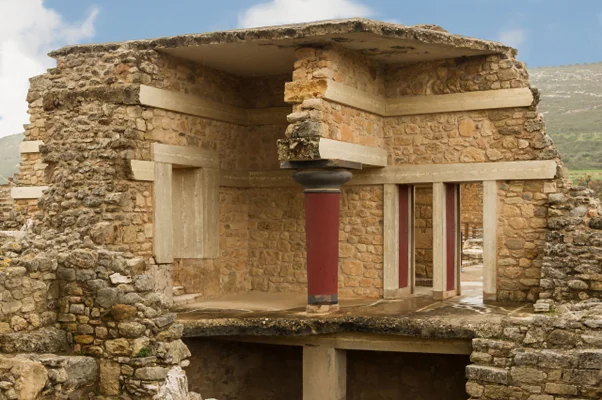
The first Knossos Palace was presumably built by the Minoans around 2000 BC. However, in 1700 BC, an earthquake almost completely destroyed the structure. This disaster did not spare any buildings on the island. But the palace was rebuilt soon after. This was the time of the full bloom of the Cretan civilization, and the new structure surpassed the previous one in beauty, elegance, and luxury. Knossos continued to be an important centre after the widespread destruction of other Minoan palaces around 1450 BC. Its final palatial phase ended later in the Bronze Age; the precise chronology and causes remain debated. It is considered a miracle that parts of the palace were excavated and reconstructed.
Knossos Palace excavations and Arthur Evans
Initial excavations at the site of the Knossos Palace were conducted by Greek archaeologist Minos Kalokairinos in 1878. He discovered some artifacts, which attracted the interest of Europeans. One of them was Englishman Arthur Evans. Evans arrived on the island in 1900 and bought all the land where he believed the remains of the unique building were located. His systematic excavations began in 1900 and revealed major features of the palace.
Evans and his team uncovered remains and artifacts of great significance, including:
- An abundance of household items
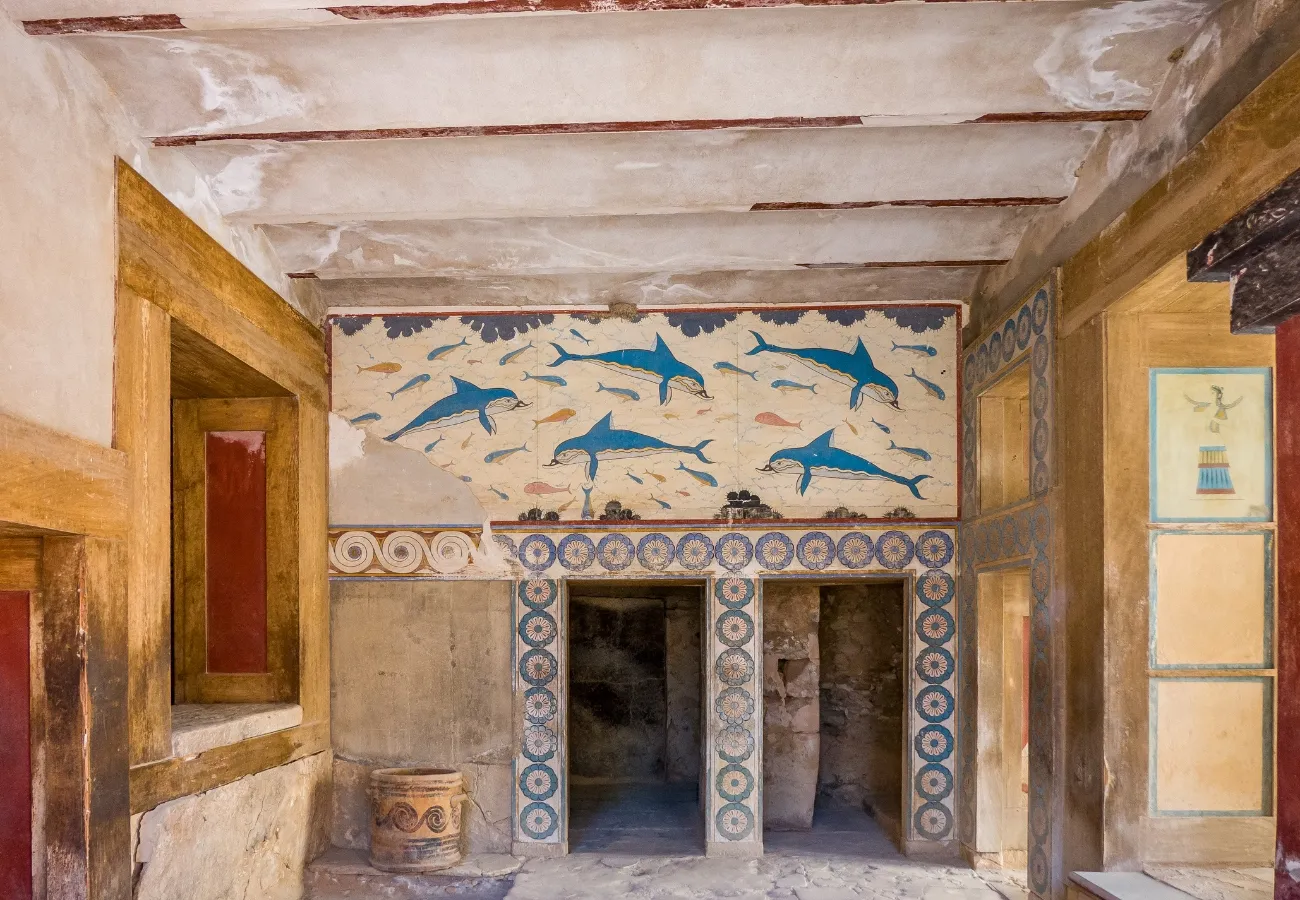
- Frescoes such as “Prince with Lilies” and “The Procession”
- The fresco “Bull-Leaping”
- The fresco “The Parisienne”
- Remains of palace rooms, including the Throne Room, workshops, and storage rooms
- Inscriptions on tablets
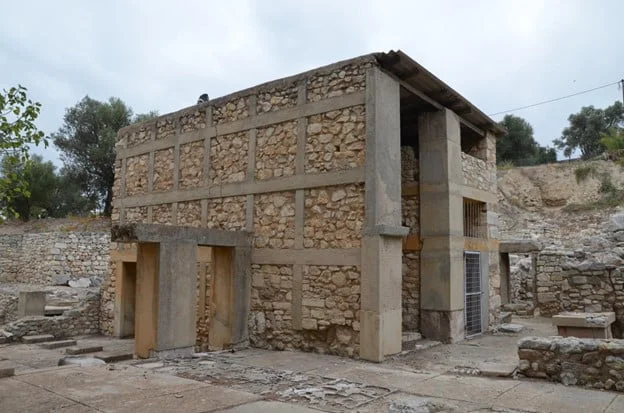
Evans didn’t stop there; he conducted a large-scale reconstruction of the buildings, acting as the architect himself. Thanks to this colossal work, today’s visitors have an idea of what the structure looked like after the first reconstruction (1700-1450 BC).
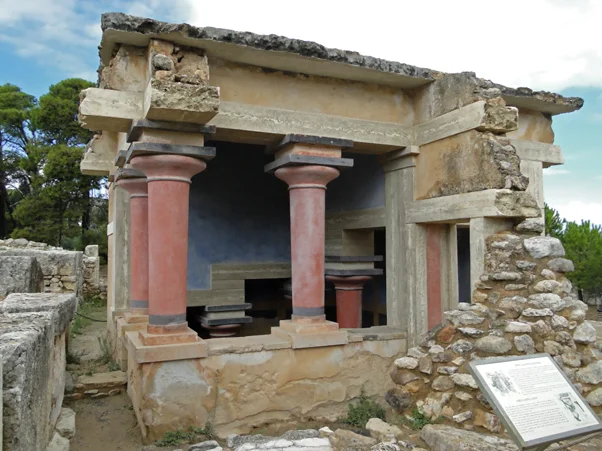
Of course, new elements were introduced. All the columns that adorn the building were recreated by Evans. The Minoans used wood for columns, which protected the building during earthquakes but decayed quickly. Evans used modern materials, including reinforced concrete, in his reconstructions.
Scientists have differing opinions on Evans’s approach; some believe it would have been sufficient to preserve the excavation and transfer artifacts to museums. Nevertheless, the reconstruction has made the monument a major tourist attraction.
Theories of the Palace’s Demise
Several theories explain the final destruction of the building:
- Several Minoan centres suffered destruction around 1450 BC. Knossos continued under a Mycenaean administration, as evidenced by Linear B tablets recording an early form of Greek. The final destruction of the palace is generally placed in the later Bronze Age, and archaeological interpretations differ. Roman rule on Crete came much later, in the first century BC.
Scientists still need to make a final conclusion about the tragedy that befell this unique structure.
The Labyrinth of the Minotaur
It is commonly believed that the Knossos Palace is the Labyrinth of the Minotaur. Supporting this claim are:
- The labrys, or double axe, a symbol associated with Minoan culture
- The chaotic and confusing layout of rooms, corridors, and passages
The labyrinth and Minotaur belong to Greek mythology. No archaeological evidence establishes that the palace was a literal labyrinth or that the mythical creature existed. While scholars debate, tourists eagerly visit the complex, imagining that it was here that Ariadne’s thread saved Theseus from the monster.
Architecture of Knossos Palace
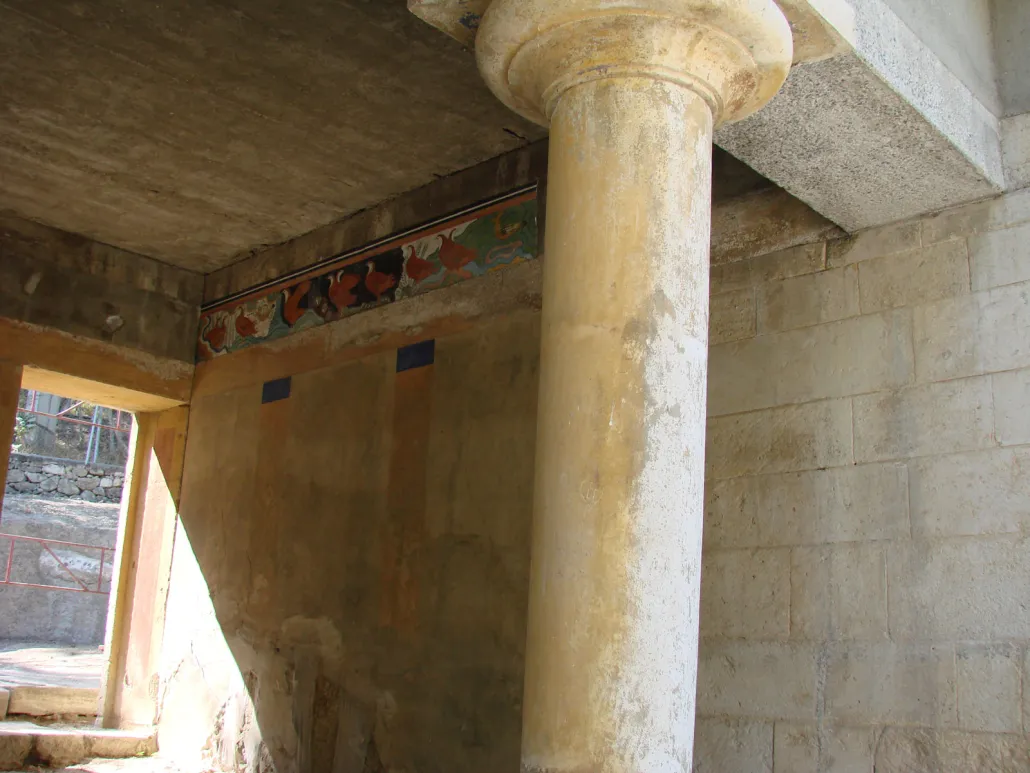
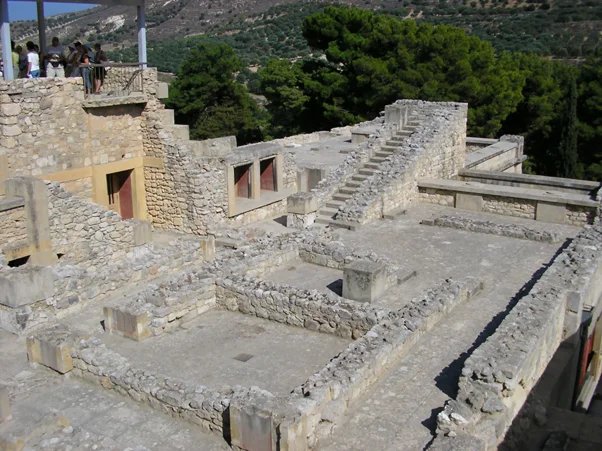
Some modern architects believe it is incorrect to call the complex a palace. Rather, it is a closed city capable of existing autonomously. At first glance, Knossos seems like a confusing and disorganized structure. But its logical center is the courtyard, measuring 50×50 meters.
Here, winding corridors and passages intersect. The complex had plumbing, sewage, and ventilation systems. It was built both above and below ground. Notably, the complex lacked defensive walls; the significance of its lack of major fortifications is still debated. Natural disasters, however, posed a greater threat to the civilization.
The Throne Room and Other Rooms

The Throne Room is a well-preserved chamber named after a massive stone chair. Nearby is a bathing pool. It is assumed that the rulers of Knossos held audiences in this room. The complex also includes rooms for the palace owners, courtiers, and priests.
Other rooms had functional purposes:
- Storage rooms for grain and prepared food
- Kouloures (pits used for storing grain or the remains of sacrificial animals)
- Artisans’ workshops
- A bathing pool for all visitors
Archaeologists interpret the palace as a centre of administration, storage, ceremony and craft production; some room functions remain uncertain.
Legends and Myths
This wonderful place gives rise to amazing myths:
- Minos himself was the son of Zeus and Europa, whom the god had abducted. However, Zeus ordered the ruler of Crete, Asterius, to marry Europa and become the father of her children. Thus, Minos became the legitimate ruler of the island, favored by the gods. Poseidon gifted Minos a white bull, which had a magnificent appearance. But the sea god placed a condition: the animal must be sacrificed. Minos, however, couldn’t part with the bull and sacrificed another animal instead. The deception was discovered, and Poseidon made Minos’s wife fall in love with the bull. From this unnatural passion, a monster was born with the head of a bull and the body of a man. The monster was aggressive, almost devouring its nurse right after birth. The Minotaur (along with its mother) was imprisoned in a labyrinth with no way out, designed and built by Daedalus. Anyone entering the labyrinth was devoured by the monster. To ensure a supply of victims, Minos demanded that Athens send seven young men and seven maidens every ten years. Theseus, who eventually killed the Minotaur, was among them. He found his way out of the labyrinth using Ariadne’s thread.
The legends do not tell how Minos died, but he continued to govern the fates of people in the underworld.
Interesting Facts
- Arthur Evans conducted excavations at his own expense, almost bankrupting his family. Additionally, he was too hasty for an archaeologist; instead of careful clearing, he ordered workers to remove what he considered uninteresting layers. As a result, little is known about the monument after its second destruction.
- Evans lacked accurate data, but this didn’t bother him; he simply invented missing architectural details. Some scholars were outraged, while others were understanding. Additionally, Evans masterfully restored unique Minoan frescoes. Greeks appreciate his work; a monument to the dedicated architect stands at the excavation site.
- Some modern architects consider Knossos an ancient skyscraper, and a very comfortable one at that: the building had several floors, ventilation, sewage, plumbing, and lighting. The mythical Minotaur, who lived in the labyrinth, was transferred by Dante to the “Divine Comedy” as a judge and executioner in the infernal circle. The Minotaur’s popularity has endured ever since.
- Minoan Crete maintained extensive trade and cultural connections across the eastern Mediterranean, including mainland Greece and Egypt. The complex serves as both a museum and a research center; excavations periodically resume, and future finds may answer many questions.
Knossos Palace tickets and opening hours
As of November 2026, standard admission to Knossos Palace is €20 and reduced admission is €10. Free admission is available to eligible visitors; check nationality, age and documentation requirements before booking. Choose your entry time through the official Hellenic Heritage website.
Free admission is available:
- First and third Sunday of each month from November through March
- The last weekend of September
- March 6, April 18, May 18 and October 28
The archaeological site opens daily at 8 AM, with seasonal closing times shown below. Last entry is 20 minutes before closing. It is normally closed on January 1, March 25, May 1, Orthodox Easter Sunday and December 25–26. Check operating notices before travelling.
| Season | Opening hours |
|---|---|
| April–August | 08:00–20:00 |
| September 1–15 | 08:00–19:30 |
| September 16–30 | 08:00–19:00 |
| October 1–15 | 08:00–18:30 |
| October 16–31 | 08:00–18:00 |
| November–March | 08:00–17:00 |
Location and How to Get There
The attraction is located at Minoiton, Heraklion 71409. You can get there in several ways:
- By bus from Heraklion. Take city bus 2 (Port–Knossos), allowing about 20 minutes. Check the current timetable on the Heraklion City Bus website, as frequencies vary.
- By taxi. The drive from central Heraklion normally takes about 15 minutes; confirm the fare in advance.
- By rented car. This is a convenient mode of travel; there is parking near the monument. The journey from Heraklion is short. Use a GPS if traveling from another city.
If your starting point is not Heraklion and you plan to use public transport, first get to the city’s bus station, then take bus number 2 to the final stop.
Discover Rethymno: Crete Most Colorful and Lively City
What to see at Knossos Palace
Central Court and West Magazines: Start with the large open courtyard and storage areas, where monumental jars illustrate the role of the palace as a centre of production and distribution.
Throne Room and Grand Staircase: Look for the stone throne, reconstructed frescoes and the multilevel eastern wing. Access to individual rooms can be restricted depending on conservation work and visitor flow.
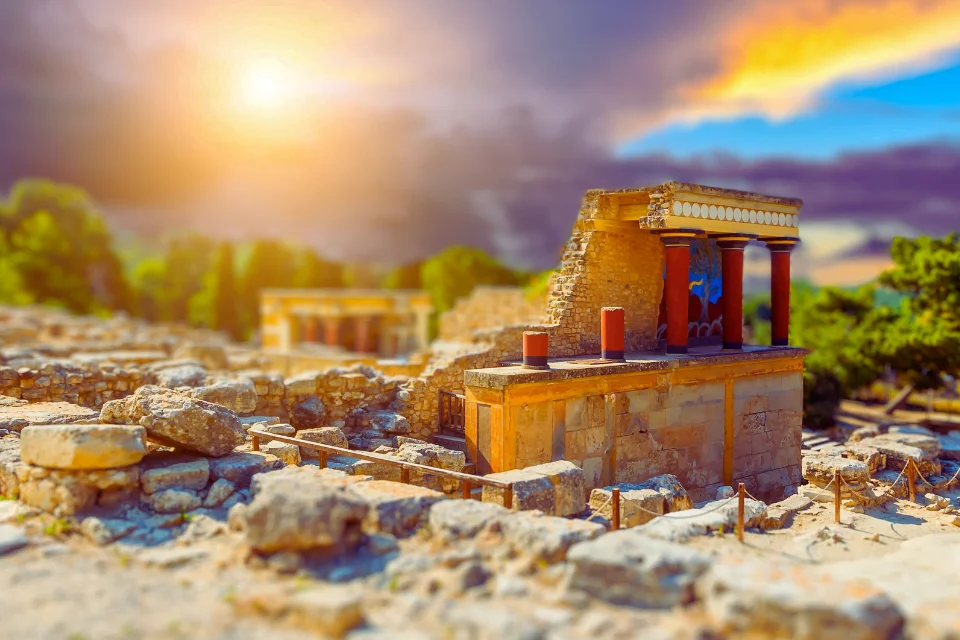
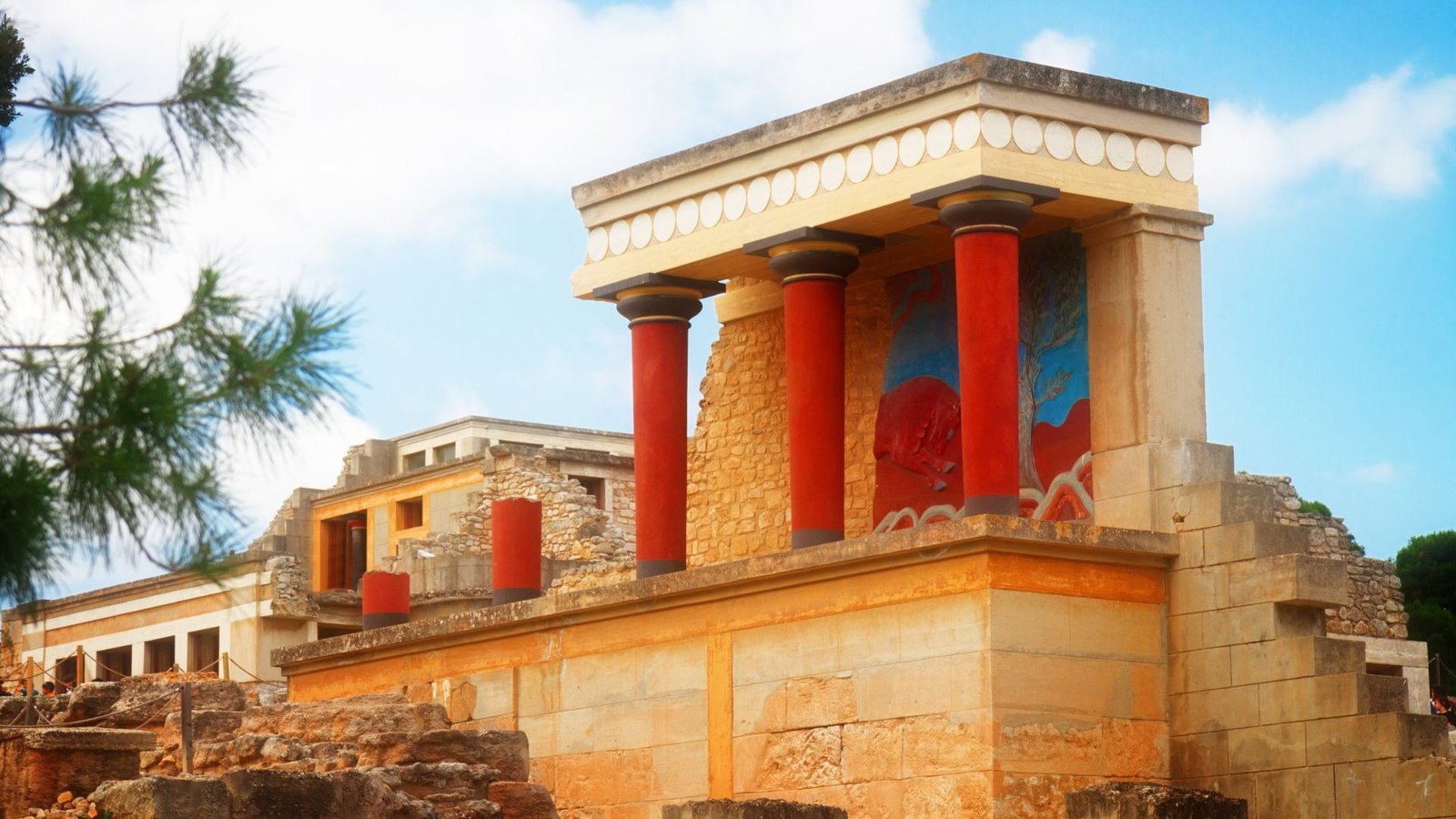
North Entrance and frescoes: The reconstructed red columns and bull imagery are among the most recognisable views of the site. Many paintings on display are reproductions; see original artifacts at the Heraklion Archaeological Museum.
Knossos Palace map and day trip from Heraklion
Visit Knossos early, especially during summer, then travel back to Heraklion for lunch and the Archaeological Museum, where the original Minoan frescoes and other finds provide context for the reconstructed palace. Bring water, sun protection and shoes with good grip, as the site has uneven surfaces, exposed paths and steps.
Frequently asked questions about Knossos Palace
How much does Knossos Palace cost? Standard admission is €20 and the reduced ticket is €10 in 2026. Check the official website for eligibility and current prices.
How long does a visit take? Allow 90 minutes to two hours, longer if taking a guided tour.
Is Knossos the Minotaur’s labyrinth? The association is a famous Greek myth, inspired in part by the complex layout of the Minoan palace.
Can you visit without a car? Yes. Heraklion city bus 2 connects the port and Knossos.
What is the best time to visit? Arrive near opening time for cooler temperatures and fewer tour groups. Spring and autumn are especially pleasant.

Konstantin is an acclaimed travel writer, celebrated for transforming ordinary journeys into extraordinary narratives. With years of experience exploring diverse destinations across the globe, his work blends vivid storytelling, cultural insights, and practical advice to inspire wanderlust and guide readers toward unforgettable adventures.
As a key contributor to enjoythetrip.org website, Konstantin has built a loyal readership through their expertise in uncovering both iconic landmarks and off-the-beaten-path treasures. He specializes in providing travelers with honest, actionable tips, whether it’s finding the best resorts in Maldives, exploring cultural hubs like Paris, or diving into the natural wonders of Croatia.