
It is located quite close to Rome, from where it is easy to reach by public transport.
From the ancient monuments of Rome to the artistic heritage of the Renaissance in Florence and the picturesque cliffs of the Amalfi coast — it is no surprise that Italy is setting tourism records, Travel Off Path writes.
The point is that, according to Eurostat, in the first half of 2026 the country overtook Spain and France in the number of tourist overnight stays: there were more than 65 million of them.
Millions of travelers come here for the atmosphere of the Old World. However, the impressions of a trip can be spoiled by hours-long queues at churches and inflated prices in restaurants, where even an ordinary portion of pasta sometimes costs around $30.
“For those planning a trip to Italy in 2026 or 2027 but wanting to avoid the tourist bustle and unnecessary expenses, it is worth turning their attention to the little-known medieval city of Viterbo. Here affordable prices, rich history and the hospitality that is often lacking in the tourist-crowded center of Rome are combined,” the article says.
One of the most interesting medieval cities in Italy
Viterbo is located just north of Rome, in the Lazio region. It is an ancient city with a rich cultural heritage, where traces of the Etruscan civilization are combined with well-preserved medieval architecture.
Viterbo is often called the City of Popes. It is considered one of the best places in Italy for seeing historical attractions without huge crowds of tourists.
November is one of the best months for getting to know Viterbo. The hot summer typical of the Lazio region is already behind us, and comfortable autumn weather takes its place. Thanks to this, walks along the steep cobbled streets become far more pleasant.
In addition, cool weather is especially favorable for visiting the city’s main natural attraction — the thermal springs. Bathing in the hot mineral waters of volcanic origin at the Terme dei Papi complex is far more pleasant in November’s cool than in July’s heat.
Another advantage of traveling in this period is the opportunity to visit authentic restaurants and medieval squares without the crowds of summer tourists, who usually come here from Rome for a day.
A journey into the Middle Ages
Most Italian cities have historic centers, but Viterbo stands out for its especially well-preserved medieval buildings. The San Pellegrino district is considered one of the best-preserved medieval quarters in Europe.
Here the original town layout has been largely preserved: narrow streets, squares with arcades and clearly defined blocks.
In the city you can see ancient streets and characteristic houses connected by covered bridge-passages. Particular attention is drawn to the traditional external staircases, which local residents call profferli.
A real Palace of the Popes
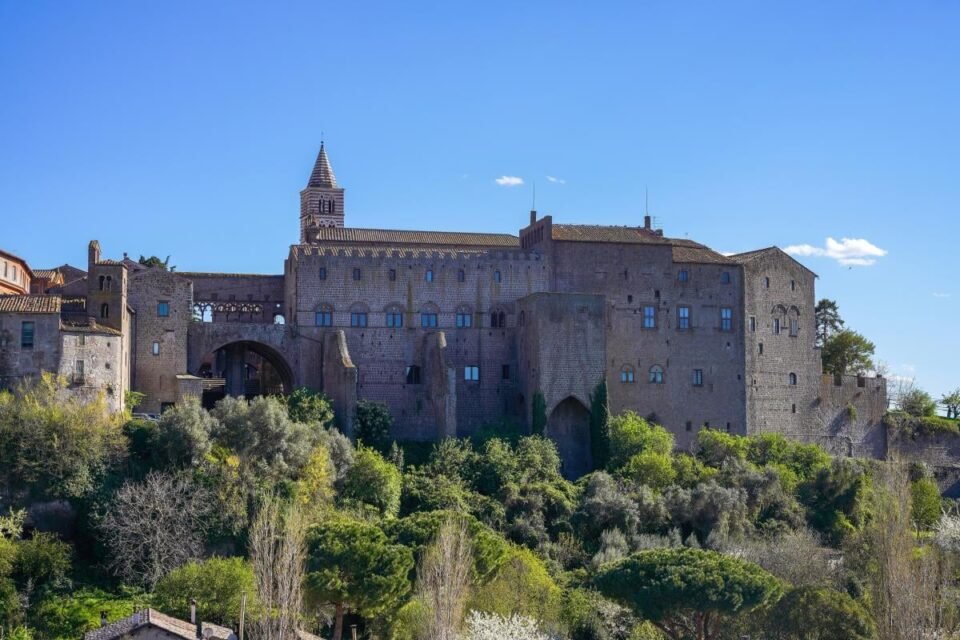
A walk through the historic center of Viterbo is reminiscent of a journey into a medieval fairy tale. However, the most impressive attraction of the city is considered to be the Palazzo dei Papi — the Palace of the Popes.
In the 13th century Rome suffered from acute political disputes, so the papal residence moved to Viterbo, where it was possible to create a safer place for governing the church.
The palace impresses with its graceful loggia with columns and pointed arches. It also houses the famous Hall of the Conclave — where, once, over an incredible 33 months, Pope Gregory X was elected.
According to legend, local residents locked the cardinals in the hall to force them finally to reach a decision. This episode went down in the history of the Catholic Church forever.
Practical information: the palace is open to visitors daily except Friday. An adult ticket costs 10 euros, and children under 12 can visit it for free.
Authentic cuisine and hot springs
Since Viterbo caters mainly to local residents rather than mass international tourism, restaurant prices correspond to the local standard of living.
In unpretentious family establishments you can have lunch next to local residents and try traditional hearty dishes of regional cuisine. In particular, a large portion of restaurant-quality handmade pasta here can cost around $12.
After walks and getting acquainted with the local cuisine, you can rest at the Terme dei Papi thermal complex — the “Baths of the Popes”. Viterbo sits above a network of natural hot springs of volcanic origin. They feed large open pools of warm mineral water.
A trip to Viterbo does not require great expense, the authors maintain. The city is located close enough to Rome, from where it is easy to reach by public transport.
How to get there: the most convenient option is a train from Rome’s Roma Termini station to Viterbo P. Fiorentina station. The journey takes about 1 hour 43 minutes, and the ticket costs from 8 to 23 euros.
Getting around: the historic center of Viterbo is fairly compact, so it is convenient to explore on foot. For longer journeys around the city, buses of the local Francigena network run. A 90-minute ticket can be bought at tobacco kiosks — it costs only 0.70 euros.

Konstantin is an acclaimed travel writer, celebrated for transforming ordinary journeys into extraordinary narratives. With years of experience exploring diverse destinations across the globe, his work blends vivid storytelling, cultural insights, and practical advice to inspire wanderlust and guide readers toward unforgettable adventures.
As a key contributor to enjoythetrip.org website, Konstantin has built a loyal readership through their expertise in uncovering both iconic landmarks and off-the-beaten-path treasures. He specializes in providing travelers with honest, actionable tips, whether it’s finding the best resorts in Maldives, exploring cultural hubs like Paris, or diving into the natural wonders of Croatia.